



 Camera Basics
 Camera Choosing
 Camera Models
 Camera Buying
 DSLR Buying
The DSLR Difference
Overview & User Experience
The photographic experience of using a digital SLR differs from that of using a non-SLR digital camera. While it is known that digital SLRs can take better pictures, little has been said about the photographic experience and usability of these types of cameras. The purpose of this article is to fill this gap.
There are many articles available discussing the differences between SLR and non-SLR digital cameras. Most of these articles conclude that the main advantage of a digital SLR is its lower noise-levels, particularly at high ISO sensitivities (not even available on most non-SLR digital cameras). Other significant advantages include a viewfinder that shows focus clearly, a panoply of interchangeable lenses, longer battery-life and generally speedier operation. These conclusions are understood to be valid, so they wont be discussed directly here.
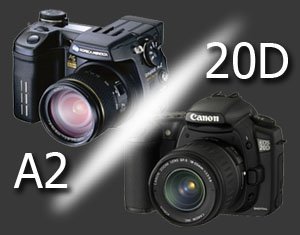
For the purpose of this article, we took the excellent Canon 20D DSLR and the amazing Konica-Minolta Dimage A2 for several photo-shoots and took hundreds of pictures with both cameras under the same conditions. The photographic experience uisng other camera models will vary, but these two cameras represent excellence in their class. The first noticeable difference, before starting to shoot, is the weight and size of these cameras. The 20D requires a larger camera bag and the A2 feels very light after using the 20D extensively with a 200mm lens.
The second difference encountered is with the viewfinder. While differences between each type of viewfinder has already been discussed at length in our viewfinders article, here is a summary of our experience: The exposure-priority live-preview on the A2's LCD is a wonderful feature, it allows to search for the composition very casually and freely. Conversely, an SLR's viewfinder is much less convenient for that since an eye must be brought to the viewfinder's level while checking composition. Then again, that is where the DSLR conserves the most battery power. To precisely control the composition however, one must look through the viewfinder (either EVF or OVF) . Here the EVF's 100% coverage provides the best experience. When it comes to judging focus, despite the EVF's remarkable sharpness, the SLR's optical viewfinder is far superior. With the SLR's OVF, any slight focus error is easily recognized. It would be hard to give up a true SLR viewfinder for anyone who frequently uses manual focusing.
Now the shot is taken. The shutter-release button is pressed halfway, then fully. The SLR always completed these actions faster. It is true that focusing speed depends on the lens used but it always seemed faster with the 20D. There probably isn't a technical reason for the focus to be slower (its probably manufacturers' product differentiation). For the shutter-lag, the non-SLR camera has to flush the charge on the CCD and probably close the shutter before doing that. This could explain why the DSLR reacts faster. The continuous drive on the DSLR is also much better but this seems to be more product differentiation again (since non-SLR cameras are sold for less, they are equipped with less memory buffer and slower internal processors).
Before even inspecting pixels, there are some obvious differences which should be explained. The Digital SLR always shoots in a 3:2 aspect ratio, this is the same aspect ratio as a 35mm film camera. Pictures having 3:2 aspect ratio print exactly on 4"x6" paper without any wasted space or distortion. When displayed on most computer screens, 3:2 pictures do not cover the entire area, they leave empty space at the top and bottom. On the other hand, pictures from most non-SLR digital cameras have an aspect ratio of 4:3 which is exactly the aspect ratio of the majority of computer monitors. Note that the A2 (and some other non-SLR cameras) can shoot in 3:2 aspect ratio by cropping the image in-camera and on the EVF and LCD. Printing 4:3 pictures on 4x6 paper gives 4"x5 1/3" prints bordered by 1/3" stripes on each side. Consequently, pictures will differ in composition even if the 35mm equivalent focal length is the same.
 Next
Next Equipment Articles
Please Support Neocamera
All information on Neocamera is provided free of charge yet running this website is a huge endeavor. Purchases made via affiliate links found throughout the site help keep it running and up-to-date. There is no additional cost to you, so please consider buying via these links to our affilates:




Thank you for your support!


Updates
2026.09.08

The Wild Magic of Iceland Book Review
Review of The Wild Magic of Iceland by Norris Niman. A photographic journey through seasons.
2026.07.31

ZY Optics Pittura 30mm F/2.4 Medium-Format Lens Review
The ZY Optics Pittura 30mm F/2.4 is a manual lens designed exclusively for Medium-Format Digital Cameras. This fast prime lens captures a wide field-of-view, equivalent to a 24mm on Full-Frame. It is am affordable alternative to first-part GFX and XCD lenses.
2026.07.26

Fujifilm GFX100S II Review
Express review of the Fujifilm GFX100S II. This 102 MP Medium-Format Mirrorless Digital Camera packs an 5-Axis 8-Stop IBIS and a 5.8 MP 0.5" EVF showing 100% coverage at an extra-large 0.84X magnification. It is a more compact version of the flagship GFX100 II. This review covers exactly how these camera compare.
2026.07.14

Sony Alpha A7R VI Review
Extended In-Depth Review of the Sony Alpha A7R VI. This flagship Full-Frame Mirrorless Digital Camera combines ultra-high 67 MP resolution with very fast 30 FPS continuous shooting. It packs a 5-axis 8½-stop IBIS mechanism and an ultra-sensitive 759-Point Phase-Detect AF system. Its incredibly sharp 9.4 MP 0.64" EVF has a huge 0.9X magnification, 100% coverage, 10-bit HDR and 100% DCI-P3 color-space. Captures 8K video at 30 FPS or 4K video at 120 FPS.
2026.05.21

Laowa 4.5-10mm F/2.8 Fisheye Zoom Lens Review
In-depth review of the Venus Optics Laowa 4.5-10mm F/2.8 Fisheye Zoom Lens. This lens zooms from a circular to rectangular fisheye with an 180° viewing angle. This review analyses its optical quality, construction and handling.
2026.04.13

Laowa 17mm F/4 Zero-D Shift Review
In-Depth review of the Venus Optics Laowa 17mm F/4 Zero-D Shift Lens. This ultra-wide Shift lens is specifically designed for Mirrorless Digital Cameras and is available in 4 Full-Frame mounts plus 2 Medium-Format ones.
2025.11.13

Best Gifts for Photographers in 2025 by Budget
The annual Neocamera Photography Gift Guide updated to 2025. Find great gifts for photographers with any price budget.
2025.07.07

Stellar Photo Recovery Review
Review of Stellar Photo Recovery V12. This Windows and MacOS software can recover photos and videos in a huge number of formats from memory cards, USB drives, SSDs and HHDs.
2025.05.14

Huion Kamvas 13 Gen 3 Review
In-Depth review of the Huion Kamvas 13 Gen 3 Pen Display Tablet for photographers and graphic artists.
2025.01.18

Fujifilm GFX 2025 Lens Roundup
Lens Review roundup of Fujifilm GFX Medium-Format lenses. Quality, performance and handling of the GF20-35mm F/4R WR, GF30mm F/3.5 Tilt-Shift and the GF55mm F/1.7.
2024.11.18

Best 2024 Photography Gifts for Every Budget
Great gifts for photographers and photo enthusiasts selected for every budget among the best products of 2024.
2024.08.07

Eye Protection Tips for Professional Photographers
The four main considerations for professional photographers regarding eyewear.
2026.09.08
2026.07.31
2026.07.26
2026.07.14
2026.05.21
2026.04.13
2025.11.13
2025.07.07
2025.05.14
2025.01.18
2024.11.18
2024.08.07
Camera Bag


Your camera bag is empty. To add a camera or lens click on the star next to its name.
Your camera bag is empty.
Add cameras or lenses by clicking on the star next to their name.
NEWS
2026.10.14

Sony Launches High-Resolution Audio Wireless Microphone
Audio ○ sony
2026.09.27

Nikon Introduces First Compact Full-Frame Mirrorless
Digital Camera
2026.09.16
Canon Increments R8 to Mark II
Digital Camera
2026.09.15

Sony Launches Super-Telephoto GMaster Lenses
Lens
2026.09.09
OM Systems Relaunches PEN
Digital Camera
2026.09.08
Sony Reveals First Fisheye Zoom Lens
Lens
2026.09.04
Fujifilm Launches New 400mm Prime Lens
Lens
2026.08.10

Peak Design Launches City Line Bags
Bag
2026.08.04
Sony Launches Light Super-Telephoto Full-Frame Zoom Lens
Lens
2026.07.31
Venus Optics Creates Two Parfocal Ultra-Macro Lens
Lens
2026.07.31
ZY Optics Pittura 30mm F/2.4 Medium-Format Lens Launch and Review
Lens ○ Review
2026.07.26
Fujifilm GFX100S II Review Published
Digital Camera ○ Review

