



 Camera Basics
 Camera Choosing
 Camera Models
 Camera Buying
 DSLR Buying

Sony Alpha A700 Summary
 12 Megapixels
 Single Lens Reflex
 Stabilization: Compensates for tiny involuntary movements of the camera.
 Continuous Drive
 Manual Controls: Both fully-manual (M) and semi-automatic modes (T and V).
 Custom White-Balance: Specifies exactly what should be white to the camera.
 Action Photography: Shutter speeds of 1/1500 or more.
 Night Photography: Reaches shutter-speeds longer than 4 seconds.
 Hotshoe: Allows external flash units to be attached.
 Spot Metering
 Depth-Of-Field Preview: Improve perception of DOF before shooting.
 Accepts Compact Flash memory.
 Accepts Memory Stick Duo memory.
 Neocamera detailed review
 Discontinued: No longer produced by the manufacturer. May still be in stock or found used.
Sony Alpha A700 Assessment
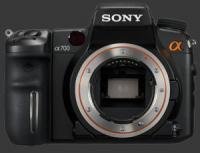
With the Alpha A700, Sony continued to build on its Minolta heritage and produced another great digital SLR with good ergonomics and a rich feature set aimed at advanced photographers. It also does not hurt that Sony delivered to themselves what appears to be their best sensor yet.
DSLR manufacturers keep improving image quality with each new generation despite also increasing sensor resolutions. The Sony Alpha A700 is no exception as it delivers excellent image quality with good control over noise and image details. This digital camera is a fast one too.
At this point, there are tons of reasons to choose the Sony Alpha A700 and very little reasons not too. Its feature set includes body-based stabilization, hardware dust-reduction and tone-mapping. With body-based stabilization, all lenses automatically benefit from stabilization, even ultra-wide-angle and prime lenses. One feature that separates this DSLR from professional ones is that it is not really weather-sealed. The A700 is designed to keep dust out but the lens-mount is not sealed and the user manual clearly states that the camera should never get wet.
We can easily recommend the Sony Alpha A700 for any type of photography. There are faster or higher resolution cameras but those are much more expensive and do not feature built-in stabilization. For ultra-low-noise images, the full-frame Canon EOS 5D is worth considering. In terms of features and price though, the Sony A700 is significantly ahead. For a full weather-sealed digital SLR, the Pentax K10D is a great option, plus it preserves more details in very low light. It remains to be seen how the Nikon D300, which presumably uses the same sensor, will compare to the A700.
Neocamera detailed review Read the full Sony A700 review here.
| PROS | CONS |
|---|---|
| Extremely low image noise. Usable until ISO 6400 in good light | Poor white-balance performance under artificial light |
| Low image noise in low light until ISO 800 | Inconsistent metering when light is very low |
| Natural image colors | Images on the LCD are overly yellow |
| Effectively stabilizes all lenses at no extra cost | Too much sharpening applied to LCD display |
| Extremely fast focusing system with good focus accuracy | Long shutter noise-reduction destroys details at all ISO |
| Very fast and responsive | |
| Eye-start and grip sensor | |
| Ambient and flash-based exposure compensation | |
| Hardware dust-reduction | |
| Good ergonomics | |
| Efficient interface and auto-rotating display | |
| Large viewfinder | |
| High-resolution LCD | |
| Excellent build quality | |
| Precise battery meter | |
 Excellent Excellent Excellent Excellent |
|
Recent Similar Cameras


Sony Alpha A700 Related Information
| Sister Models |
|---|
| Sony Alpha A100 - 10 Megapixels, ISO 100-1600, -2..+2 Exposure and flash compensation, 3 FPS continuous drive, 9-point auto focus (vs 11-point), 3-frame bracket (vs 5-frame), 1/4000 Max shutter-speed, 2.5" LCD 230K pixels |
 |


|
Please Support Neocamera
All information on Neocamera is provided free of charge yet running this website is a huge endeavor. Purchases made via affiliate links found throughout the site help keep it running and up-to-date. There is no additional cost to you, so please consider buying via these links to our affilates:




If you found any information on this site valuable and did not purchase via our affiliate links, please considering donating via PayPal:
Any amount will be greatly appreaciated. Thank you for your support!


Sony A700 Highlights


 SLR digital camera
Sensor-Size: 24 x 16mm

Actual size when viewed at 100 DPI
| 12 Megapixels DSLR | ISO 100-6400 |
| Sony A Mount 1.5X FLM | Shutter 1/8000-30s |
| 2-Axis Built-in Stabilization | Full manual controls, including Manual Focus |
| 95% Coverage Medium Viewfinder | Custom white-balance with 1 axis fine-tuning |
| Automatic Eye-Start sensor | Spot-Metering |
| Built-in Dust Reduction | Hot-Shoe |
| 5 FPS Drive, Unlimited Images | Lithium-Ion Battery |
| 3" LCD 920K Pixels | Compact Flash, Memory Stick Duo |
Camera Bag


Your camera bag is empty. To add a camera or lens click on the star next to its name.
Your camera bag is empty.
Add cameras or lenses by clicking on the star next to their name.
Updates
2024.04.03

Fujifilm X-T5 Review
Newest Fujifilm flagship boasting a 40 MP APS-C sensor, 5-axis IBIS with 7-stop efficiency, 15 FPS continuous drive, 6.2K Video capture, dual control-dials and dual SDXC UHS-II slots in a sturdy weatherproof and freezeproof body.
2023.11.20

Best Digital Cameras of 2023
Find out which are the Best Digital Cameras of 2023. All the new Mirrorless Digital Cameras from entry-level to high-end professional.
2023.07.10

Fujifilm X-H2 Review
40 Megapixels APS-C Hybrid Mirrorless Digital Camera with 7-stop IBIS. Fastest shutter ever and 8K video capture. Large builtin EVF with 0.8X magnification and 5.8 MP, plus an Eye-Start Sensor. Packed with features and large number of controls in a weatherproof and freezeproof body.
2023.05.07

Sony FE 20-70mm F/4G Review
Review of the unique Sony FE 20-70mm F/4G lens. The optical zoom of this lens spans ultra-wide-angle and medium focal-length coverage, making it one of the most versatile Full-Frame lenses on the market.
2023.01.15

Huion Inspiroy Dial 2 Review
Review of the Huion Inspiroy Dial 2 tablet, a medium sized drawing surface with dual dials and customizable buttons. Connects via USB-C or Bluetooth 5.0 with Windows, Linux and Android support.
2022.12.08

How to Pack for a Photo Trip
Find out how to pack for a travel photography trip, carry your gear safely while meeting airline regulations.
2022.11.13

Best Digital Cameras of 2022
The best digital cameras of 2022. A short list of the most outstanding models in their respective categories. Choose one for yourself or as a gift.
2022.09.21

Pentax DA* 60-250mm F/4 SDM Review
Review of the Pentax DA* 60-250mm F/4 SDM, the constant-aperture telephoto zoom with the highest zoom-ratio on the market.
2022.09.20

Pentax DA* 50-135mm F/2.8 SDM Review
Review of the Pentax DA* 50-135mm F/2.8 SDM, the lightest professional telephoto zoom native to the K-mount.
2022.09.10

Pentax DA* 11-18mm F/2.8 DC AW Review
Review of the Pentax DA* 11-18mm F/2.8 DC AW, the widest professional ultra-wide zoom native to the K-mount.
2021.11.24

50 Gifts Under $50 For Photographers in 2021
50 Gifts photographers will love. All for under $50 USD. 2021 Edition.
2021.11.17

Best Digital Cameras for 2021
Neocamera shows which are the very best Digital Cameras for 2021 in every category: Mirrorless, DSLR, Premium Compact, Ultra-Zoom and Rugged.

