



 Camera Basics
 Camera Choosing
 Camera Models
 Camera Buying
 DSLR Buying
 Digital Camera Buying Guide - Basics
Introduction
This general Digital Camera Buying Guide consists of 4 easy steps. Those who are already familiar with digital cameras and are considering a DSLR should read the DSLR Buying Guide. If you are not sure what a DSLR is, keep reading, you are on the right page.
Step 1 - this page - introduces basic digital camera concepts. The terms explained here are often prominently displayed on camera boxes and advertisements. Understanding these is essential for knowing what to pay attention to when comparing digital cameras.
Megapixels
 |
 |
 |
6 Megapixels |
3 Megapixels |
1 Megapixel |
Megapixels is a measure of resolution. With more megapixels, a camera can capture smaller details. This makes it possible to make larger prints without looking blurry.
A few years ago, megapixels were the high mark for which cameras competed. Now that modern cameras rarely have fewer than 12 MP, more megapixels are not needed except by those intent on making huge prints. Buyers would better concentrate on other digital camera features now.
Camera makers label their cameras with the maximum number of megapixels they can capture. This is usually written as 18 MP, with MP standing for MegaPixels. Specifically, a megapixel corresponds to roughly one million pixelsFor example, a 3 megapixel image is composed of about 3 million dots. A pixel is a tiny dot from which all digital pictures and videos are composed.
Optical Zoom
Optical zoom is the ability of a camera to photograph a smaller area from a given point of view. Greater optical zoom lets you capture more details from distant subjects. This is important for certain subjects, like wildlife and sports photography where you cannot easily get physically close to your subject.
 |
 |
Original |
Optical zoom 4X |
Optical zoom is actually a property of the lens, so it applies only to cameras with a fixed lens. It is measured by how much closer the camera can zoom compared to its widest setting. For example, a 2X optical zoom can make a subject appear twice as close. A few cameras have fixed-focal length lenses, which means they do not zoom at all.
Plenty of cameras, have interchangeable lenses, meaning that the lens can be changed. Those are called ILC which stands for Interchangeable Lens Camera. In this case, each lens may have its own optical zoom and the camera's reach can usually be extended both longer and wider by buying new lenses for it.
Digital Zoom
Digital zoom refers to a digital camera's attempt to emulate optical zoom. Digital zoom gives the impression of getting closer to a subject without actually capturing any more detail. Digital zoom is the equivalent of cutting the center of a picture and blowing-up just that portion.
- Original
Image
- Digital Zoom
Crop
- Digital Zoom
Image
Digital zoom must be ignored when purchasing a digital camera because it can easily be done with better quality and precision by computer after a picture is taken. Camera manufacturers tend to emphasize digital zoom in small models to compensate for short optical zoom but this only confuses buyers.
Despite cameras having up to 50X optical zoom now, certain manufacturers still boast regarding digital zooms but hide it under other names, such as Smart Zoom, Fine Zoom, Quality Zoom, etc. These are all digital zooms in desguise.
LCD
LCD stands for liquid crystal display. It refers to the small screen on the back of a digital cameraSome very old digital camera did not have an LCD but all the ones from this decade do. which is used for viewing the pictures you took and, in most cases, to preview the picture you are about to take. When an LCD previews the image correctly, it is called Exposure-Priority as opposed to display-priority, which shows a bright and clear image regardless of exposure.
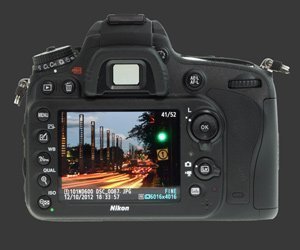
LCDs are described by their sizeA 3" LCD measures 3 inches diagonally. and by their resolutionA 920K pixel LCD has 920,000 pixels.. Larger sizes give a more comfortable experience but small differences are not easily noticeable. Between a 3" and a 3.2" LCD, usability is the same but not between 2" and 3". A higher resolution means a more crisp display and makes judging focus easier. At least 460K pixels is recommended to show fine details clearly.
DSLRs, which are a type of cameras supporting interchangeable lenses and known for their high image quality, are intended to be used through their optical-viewfinder (OVF). Recent models can also preview images on the LCD which is called Live-View. Not all Live-View are equal but, regardless, the performance of DSLRs drops in terms of autofocus speed and sometimes limited functionally when using Live-View.
Viewfinder
The viewfinder is the part of the camera used to frame images. This makes it the most used part of any camera and a critical one in terms of user-experience. There are several types of viewfinders. The rear LCD mentioned above can be used as a viewfinder on the majority of digital cameras. On small models, it is very often the only viewfinder available. Plenty of camera have more than one though and some can use an optional detachable viewfinder.
Table of Digital Camera Viewfinders
| Viewfinder Type | Pros | Cons | Cameras |
|---|---|---|---|
| LCD |
|
|
All non-DSLRs. Most DSLRs with limitations. |
| EVF |
|
|
On most large ultra-zooms. Built-in on some mirrorless cameras. Optional on many mirrorless cameras. |
| Optical Reflex |
|
|
DSLR cameras. |
| Optical Tunnel |
|
|
Some compact cameras. |

Even between the same type of viewfinder, there can be significant differences. The size of the optical viewfinder on a DSLR greatly influences how precisely one can judge focus. EVFs have the broadest range of performance from very poor 0.2" ones with 115K pixels to large 0.5" ones with a whopping 2.4 megapixels. The best show an Exposure-Priority view at all times and make the camera completely usable at eye-level.
Digital Camera Types
There are various types of digital cameras as explained in Demystifying Digital Camera Types although, lately, boundaries are blurring. Broadly speaking, the simplest models are called Point & Shoot and give the lowest image quality. They are small and often referred as Compact or Ultra-Compact for pocket-size models.
 Single Lens Reflex Single Lens Reflex |
A Digital SLR is made so that the viewfinder actually looks through the lens of the camera. All current Digital SLRAlso called a DSLR cameras allow their lenses to be changed. Digital SLR cameras are usually sold without lenses. They are known for high image quality and fast performance. These are used by professional photographers for most of their work. |
Bridge or Premium cameras give more control than a point-and-shoot while sharing similar technology. Most models therefore offer a step above in image quality but cannot compete with DSLRs. A handful of exceptions exist though.
Mirrorless cameras are the newest type of digital camera. They are designed to offer high quality and flexibility without the bulk of a DSLR. Models differ greatly with some large models offering the same image-quality as DSLRs, small ones with compact-like image-quality and plenty of models in-between. Consult the Mirrorless Camera Guide for details.


Flash
 |
 |
No flash |
Flash |
A flash on a digital camera, just like on a film camera, is a small lamp that can add light to close by objects when a picture is taken.
A pop-up flash is normally hidden and pops-up when it is required. A flash is described by the maximum distance of objects it can sufficiently illuminate when the lens is wide-open and when it is completely zoomed-in.
Most digital cameras have a built-in flash. Those that do not, always accept an optional unit. The most common interface for optional units is called the hot-shoe with a few variants, so not all flashes function or even attach to all hot-shoe.
There is little need to worry about flash when comparing digital cameras except for specialized needs such as studio or high-speed photography.
Movie Mode
The vast majority of digital cameras can record short video clips. This can range from a few seconds to minutes or even hours, although European regulations limit this to under 30 minutes per clip. These clips are made by rapidly taking a sequence of images.
The video capability of a digital camera is described by its maximum resolutionThe number of pixels in each image., frame-rateThe number of frames taken each second. and durationThe length of the longest video clip that can be captured without interruption when enough memory is available.. While it is usually the highest resolution video mode which is prominently advertised, some cameras can also record High-Speed, Slow-Motion or Time-Lapse video. High-Speed videos cannot be acheived another way, so if this is important to you, look for that feature explicitly. Keep in mind that resolution drops rapidly as frame-rate goes up, so these videos are of limited use.
 Ultra HD (4K) video: 3840x2160 resolution or more. Ultra HD (4K) video: 3840x2160 resolution or more. |
Ultra HD which is also called 4K is video captured at 4X the resolution of Full HD. Cameras marked with this icon can capture video at 3840x2160 or 4096x2160, which has a slightly wider aspect-ratio. |
 Full 1080p HD Video: 1920 x 1080 resolution or more but less than 4K. Full 1080p HD Video: 1920 x 1080 resolution or more but less than 4K. |
1080p video is the highest HD resolution and is sometimes referred to as Full HD. It has a resolution of 1920x1080 with a 16:9 wide-screen aspect-ratio. Frame rates vary between 24 and 60 FPS with 30 being the most common. Digital cameras with CMOS sensors almost always do 1080p. |
 720p HD Video: 1280 x 720 resolution or more but less than 1920 x 1080. 720p HD Video: 1280 x 720 resolution or more but less than 1920 x 1080. |
720p is still HD but with a lower resolution of 1280x720 with a 16:9 wide-screen aspect-ratio. Digital cameras that do 720p and slightly higher, without reaching 1080p, are also labelled with this icon. A frame-rate between 24 and 60 FPS is very common for 720p with 15 or 120 FPS sometimes available. |
 VGA Video: 640 x 480 or more but less than 1280 x 720. VGA Video: 640 x 480 or more but less than 1280 x 720. |
VGA video has a resolution of 640x480 or 848x480 for wide-screen aspect-ratio. This is the standard for older cameras but most cameras do at least 720p now. CCD sensors which are presently slower than CMOS sensors, rarely do more than 720p. |
Video capabilities are relatively new among DSLRs, yet their video quality is excellent. The shallow depth-of-field provided by DSLRs makes video feel more cinema-like. They can also film in very low-light compared to smaller cameras. On the flip-side, DSLR are much more sensitive to focus precision, so produce out-of-focus videos most more frequently than cameras with smaller sensors when focus is not perfect.
Next
There are more camera basics to learn for people looking for something beyond a point-and-shoot. Proceed to More Camera Basics if that is the case for you or learn how to choose between digital cameras in step 2 of this digital camera buying guide: Choosing Basics.
 Camera Basics
Please Support Neocamera
All information on Neocamera is provided free of charge yet running this website is a huge endeavor. Purchases made via affiliate links found throughout the site help keep it running and up-to-date. There is no additional cost to you, so please consider buying via these links to our affilates:




Thank you for your support!


Camera Bag


Your camera bag is empty. To add a camera or lens click on the star next to its name.
Your camera bag is empty.
Add cameras or lenses by clicking on the star next to their name.
New Cameras & Lenses

Venus Optics Laowa 4.5-10mm F/2.8 Fisheye Zoom
Sony E Mount Zoom
2026-05-15Venus Optics Laowa 4.5-10mm F/2.8 Fisheye Zoom
Nikon Z Mount Zoom
2026-05-15Venus Optics Laowa 4.5-10mm F/2.8 Fisheye Zoom
Micro Four-Thirds Mount Zoom
2026-05-15Venus Optics Laowa 4.5-10mm F/2.8 Fisheye Zoom
Leica L Mount Zoom
2026-05-15Venus Optics Laowa 4.5-10mm F/2.8 Fisheye Zoom
Fujifilm X Mount Zoom
2026-05-15Venus Optics Laowa 4.5-10mm F/2.8 Fisheye Zoom
Canon RF Mount Zoom
2026-05-15
Updates
2026.05.21

Laowa 4.5-10mm F/2.8 Fisheye Zoom Lens Review
In-depth review of the Venus Optics Laowa 4.5-10mm F/2.8 Fisheye Zoom Lens. This lens zooms from a circular to rectangular fisheye with an 180° viewing angle. This review analyses its optical quality, construction and handling.
2026.04.13

Laowa 17mm F/4 Zero-D Shift Review
In-Depth review of the Venus Optics Laowa 17mm F/4 Zero-D Shift Lens. This ultra-wide Shift lens is specifically designed for Mirrorless Digital Cameras and is available in 4 Full-Frame mounts plus 2 Medium-Format ones.
2025.11.13

Best Gifts for Photographers in 2025 by Budget
The annual Neocamera Photography Gift Guide updated to 2025. Find great gifts for photographers with any price budget.
2025.07.07

Stellar Photo Recovery Review
Review of Stellar Photo Recovery V12. This Windows and MacOS software can recover photos and videos in a huge number of formats from memory cards, USB drives, SSDs and HHDs.
2025.05.14

Huion Kamvas 13 Gen 3 Review
In-Depth review of the Huion Kamvas 13 Gen 3 Pen Display Tablet for photographers and graphic artists.
2025.01.18

Fujifilm GFX 2025 Lens Roundup
Lens Review roundup of Fujifilm GFX Medium-Format lenses. Quality, performance and handling of the GF20-35mm F/4R WR, GF30mm F/3.5 Tilt-Shift and the GF55mm F/1.7.
2024.11.18

Best 2024 Photography Gifts for Every Budget
Great gifts for photographers and photo enthusiasts selected for every budget among the best products of 2024.
2024.08.07

Eye Protection Tips for Professional Photographers
The four main considerations for professional photographers regarding eyewear.
2024.07.14

Fujifilm X100VI Review
Flagship fixed-lens compact digital camera with a 40 MP sensor and Image-Stabilization, a first for the series. Retro design featuring dual control-dials, plus direct ISO, Shutter-Speed and EC dials. Its hybrid viewfinder can switch between EVF and OVF mode.
2024.05.09

Fujifilm GFX100 II Review
Flagship 102 Megapixels Medium-Format Mirrorless Digital Camera with 8-Stop 5-Axis IBIS, 8 FPS Drive, 8K Video and 400 MP Super-Resolution capture in a weatherproof and freezeproof body with dual control-dials and dual memory-card slots.
2024.04.03

Fujifilm X-T5 Review
Newest Fujifilm flagship boasting a 40 MP APS-C sensor, 5-axis IBIS with 7-stop efficiency, 15 FPS continuous drive, 6.2K Video capture, dual control-dials and dual SDXC UHS-II slots in a sturdy weatherproof and freezeproof body.
2023.11.20

Best Digital Cameras of 2023
Find out which are the Best Digital Cameras of 2023. All the new Mirrorless Digital Cameras from entry-level to high-end professional.
2026.05.21
2026.04.13
2025.11.13
2025.07.07
2025.05.14
2025.01.18
2024.11.18
2024.08.07
2024.07.14
2024.05.09
2024.04.03
2023.11.20
NEWS
2026.05.13

Sony Levels Up 6th Generation Alpha A7R
Digital Camera
2026.05.13
Canon Launches First Full-Frame Video Mirrorless
Digital Camera
2026.05.12
Panasonic Finally Launches LX100 II Successor
Digital Camera
2026.03.24
Panasonic Launches ZS300 Compact Ultra-Zoom
Digital Camera
2026.03.10

Venus Optics Unveils Ultra Wide Perspective Control Lens Duo
Lens
2026.02.24
Nikon Release Lighter Bright Constant-Aperture Full-Frame Telephoto Zoom Lens
Lens
2026.02.05
Canon Introduces 2 Extreme Wide Full-Frame Lenses
Lens
2026.01.06
Nikon Introduces Lightweight Full-Frame Zoom Lens
Lens
2025.12.02
Sony Upgrades Alpha 7 to 5th Generation
Digital Camera ○ Lens
2025.11.29
Venus Optics Releases New Zero-D Tilt-Shift Macro Lens
Lens
2025.11.23
Best Digital Cameras of 2025
Digital Camera
2025.11.14

Photography Gift Guide 2025 Edition

