Camera Basics
 Camera Choosing
 Camera Models
 Camera Buying
 DSLR Buying

Nikon Coolpix P7700 Review
 12 Megapixels
 Stabilization: Compensates for tiny involuntary movements of the camera.
 Level: Measures camera tilt and helps to keep the horizon level.
 Continuous Drive
 Full 1080p HD Video: 1920 x 1080 resolution or more but less than 4K.
 Manual Controls: Both fully-manual (M) and semi-automatic modes (T and V).
 Custom White-Balance: Specifies exactly what should be white to the camera.
 Action Photography: Shutter speeds of 1/1500 or more.
 Night Photography: Reaches shutter-speeds longer than 4 seconds.
 Hotshoe: Allows external flash units to be attached.
 Spot Metering
 Accepts Secure Digital Extended Capacity (SDXC), SDHC and SD memory.
 Neocamera detailed review
 Discontinued: No longer produced by the manufacturer. May still be in stock or found used.
 1 - Capability2 - Usability3 - Performance
Nikon Coolpix P7700 Performance - How well does it take pictures?
Performance starts with image quality, which is the criteria used as the foundation of our digital camera ratings. Ergonomic issues may get in the way, but in the end, image quality counts the most. The Nikon Coolpix P7700 uses a larger-than-usual 1/1.7" BSI-CMOS sensor with a resolution of 12 megapixels. This gives it a small but notable advantage when it comes to image-noise and dynamic-range.
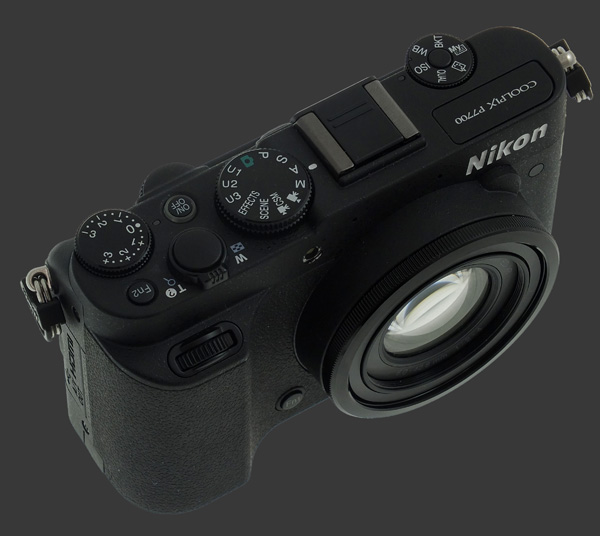
The new sensor of the P7700 performs well for its size, delivering image quality above premium compacts that use similar-sized sensors. This is impressive considering the bright stabilized 7X wide-angle optical zoom lens of the P7700. Such a performance puts this camera in an excellent position because no premium compact with a larger sensor packs so much zoom. Some, like the excellent Fuji Finepix X100, do not zoom at all.
Images from this digital camera are easily usable up to ISO 400. ISO 800 shows a slight amount of noise with a minor effect on fine details. Still, image quality remains good enough for a relatively large print. ISO 1600 is very good for a small digital camera and even a medium-sized print, like a 9x12", can come out looking good. By ISO 3200, fine details get destroyed but subjects are recognizable and even small prints are reasonable.
The expanded ISO 6400 setting produces noisy images with strong softening from noise-reduction. Still, it can produce usable 4 x 6" prints, something rarely seen from a compact camera. This is an improved performance compared to its predecessor, despite a 20% increase in resolution.
While the dynamic range of this digital camera is good for its sensor-size, it remains behind cameras equipped with Fuji's EXR technology. As such, models like the Fujifilm Finepix X10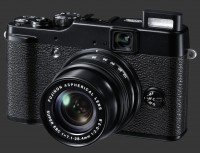
Fujifilm Finepix X10 maintain an edge for outdoor photography where light causes extremely contrasty scenes. The usual solution for photography of outdoor scenery is to wait for the time around dusk and dawn when light produces scenes of much lower contrast.
Metering of the Nikon Coolpix P7700 is quite good. Even the few times when it over-exposes, it rarely does so by much. Under-exposure is much more rare, save for low contrast scenes. There is a live-histogram which helps judge the metered exposure and it is affected by EC. As mentioned on the usability page of this review, this is of little use outside of automatic modes since it is based on the display image rather than the actual scene.
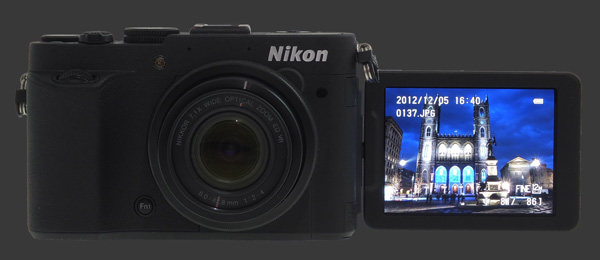
The 7X optical zoom lens is large for a compact model which lets it feature a relatively bright aperture across its zoom range. A bright F/2 aperture can be maintained up to 33mm. It drops down to F/2.8 at 50mm and reaches F/4 at 175mm. This gives at a full-stop of improvement over its predecessor and compares it well against older generation lenses which typically had F/2.8-3.5 maximum apertures. In contrast, most modern lenses drop to F/4.8 at least from 100mm on.
There is a noticeable amount of barrel distortion at wide-angle. It slowly diminishes until it turns into pincushion distortion around the middle of the zoom. Vignetting is not a problem at all. Chromatic aberrations are nowhere to be found either, even in extreme circumstances which makes us suspect the camera cleans them up.
Lens sharpness is truly excellent and is maintained consistently across the frame. The default Sharpness of 3 renders details softly. Advancing to 4 improves things without any artifacts. Going to 5 makes output look much sharper with minimal artifacts and remains very usable.
Color rendition is customizable using 3 styles and 7 levels of saturation. The default Standard style is close to reality. Of course, getting accurate colors from a digital camera depends on having accurate while-balance too. The P7700 shows better than average automatic white-balance with good presets and accurate custom white-balance.
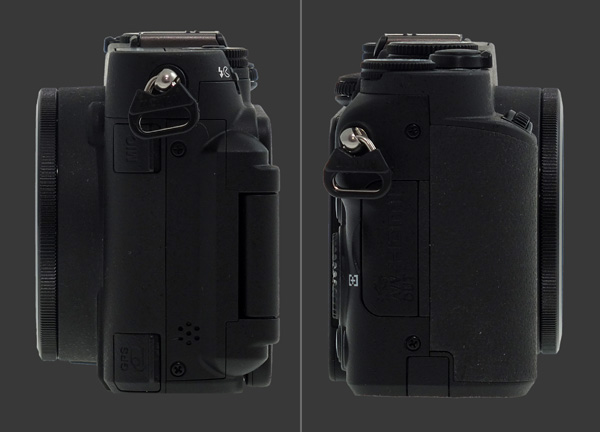
The performance of the Nikon Coolpix P7700 almost matches exactly that of its predecessor. At the time of the P7100, this made a good impression but competitors have caught up and the P7700 no longer stands out as much. Still, it remains generally quick and responsive and the previously-slow Quick Menu is no longer that slow.
Autofocus speed ranges from good to slow depending on light levels and the zoom. In bright to moderate light, the P7700 can focus in ½s. As light levels drop, this goes down to ¾s on average but sometimes takes over a full second before locking or giving up. Expect to be able to catch relatively still subjects but not ones in motion unless light is good.

Speed of the P7700 is characterized by the following numbers:
- Power On: 1s. Great for an extending lens.
- Power Off: 2s. Typical for an extending lens.
- Zoom: 2½s from wide to telephoto or vice-versa.
- Focus: Below From ½s in moderate light, down to 1s in low-light at long-end of zoom. Average.
- Shutter-Lag: Almost instant.
- Black-Out: 1s. Average.
- Shot-To-Shot: 2½s with AF, 1¾s with MF. Average.
- Playback: ½s to enter and 1s to Exit. Below average.
The camera gets back to responding to button presses quickly after shooting. As soon as the preview display is shown, this digital camera is ready. When shooting continuously, the display turns blank so the P7700 is unsuitable for action photography, which is normal for this type of camera. Battery-life is quoted at 330 shots-per-charge which is average for a premium compact.
Video-recording suffers from an unfortunate delay of 1s before starting to record. This is unusual for a camera with a dedicated video mode. Video record stops instantly without cutting off the last second of video, unlike the P7100. Recording completes in a fraction of a second. Manual focusing is possible while recording video and so is zoom, albeit at a quiet but glacial speed.
Nikon Coolpix P7700 Conclusion
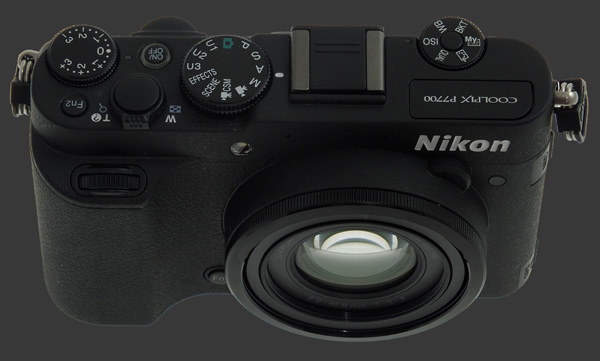
The Nikon Coolpix P7700 is an excellent premium compact camera. Its huge number of external controls make it efficient to use. The newly design bright F/2 - 4 wide-angle 7X optical zoom lens puts it in a class apart with no competitors offering a similar range.
Image quality is great for its sensor-size. Among fixed-lens digital cameras, the P7700 delivers quality which is only exceeded by the latest breed of large-sensor compacts while none of those has a comparable lens. Here will therefore lie the dilemma of choosing the P7700. One can obtain better image quality while restricting the zoom but not have both without going to a much larger ILC.
Color, white-balance and exposure are all very good. Dynamic range is also good but not best-in-class. The optics of the stabilized 28-200mm F/2-4 lens are superb with excellent sharpness, no vignetting, no chromatic aberrations and only a slight amount of distortion. Focus speed is also good and not far behind top competitors.
In terms of ergonomics, having three control dials and plenty of buttons makes it very efficient but Nikon could have done even better. There are two real usability issues though. One is the display which does not preview exposure or show a correct Live-Histogram consistently. The other is a self-timer too often.
In the end, the Nikon Coolpix P7700 provides a very compelling choice for photographers looking for advanced photographic control in a compact body. Its unique lens is key to its versatility, allowing for more creativity when framing subjects. For stills, this digital camera turns in a solid performance.
 |



 
|

 1 - Capability2 - Usability3 - Performance
Please Support Neocamera
All information on Neocamera is provided free of charge yet running this website is a huge endeavor. Purchases made via affiliate links found throughout the site help keep it running and up-to-date. There is no additional cost to you, so please consider buying via these links to our affilates:





If you found any information on this site valuable and did not purchase via our affiliate links, please considering donating via PayPal:
Any amount will be greatly appreaciated. Thank you for your support!


Nikon P7700 Highlights


 Medium digital camera
Sensor-Size: 8 x 6mm

Actual size when viewed at 100 DPI
| 12 Megapixels Fixed Lens | ISO 80-6400 |
| 7.1X Wide Optical Zoom | Shutter 1/4000-60s |
| Built-in Stabilization | Full manual controls, including Manual Focus |
| 1 Axis Digital Level | Custom white-balance with 2 axis fine-tuning |
| 8 FPS Drive, 6 Images | Spot-Metering |
| 1920x1080 @ 30 FPS Video Recording | Hot-Shoe |
| 3" LCD 920K Pixels | Stereo audio input |
| Lithium-Ion Battery | |
| Secure Digital Extended Capacity, Internal Memory |
Camera Bag


Your camera bag is empty. To add a camera or lens click on the star next to its name.
Your camera bag is empty.
Add cameras or lenses by clicking on the star next to their name.
Updates
2024.08.07

Eye Protection Tips for Professional Photographers
The four main considerations for professional photographers regarding eyewear.
2024.07.14

Fujifilm X100VI Review
Flagship fixed-lens compact digital camera with a 40 MP sensor and Image-Stabilization, a first for the series. Retro design featuring dual control-dials, plus direct ISO, Shutter-Speed and EC dials. Its hybrid viewfinder can switch between EVF and OVF mode.
2024.05.09

Fujifilm GFX100 II Review
Flagship 102 Megapixels Medium-Format Mirrorless Digital Camera with 8-Stop 5-Axis IBIS, 8 FPS Drive, 8K Video and 400 MP Super-Resolution capture in a weatherproof and freezeproof body with dual control-dials and dual memory-card slots.
2024.04.03

Fujifilm X-T5 Review
Newest Fujifilm flagship boasting a 40 MP APS-C sensor, 5-axis IBIS with 7-stop efficiency, 15 FPS continuous drive, 6.2K Video capture, dual control-dials and dual SDXC UHS-II slots in a sturdy weatherproof and freezeproof body.
2023.11.20

Best Digital Cameras of 2023
Find out which are the Best Digital Cameras of 2023. All the new Mirrorless Digital Cameras from entry-level to high-end professional.
2023.07.10

Fujifilm X-H2 Review
40 Megapixels APS-C Hybrid Mirrorless Digital Camera with 7-stop IBIS. Fastest shutter ever and 8K video capture. Large builtin EVF with 0.8X magnification and 5.8 MP, plus an Eye-Start Sensor. Packed with features and large number of controls in a weatherproof and freezeproof body.
2023.05.07

Sony FE 20-70mm F/4G Review
Review of the unique Sony FE 20-70mm F/4G lens. The optical zoom of this lens spans ultra-wide-angle and medium focal-length coverage, making it one of the most versatile Full-Frame lenses on the market.
2023.01.15

Huion Inspiroy Dial 2 Review
Review of the Huion Inspiroy Dial 2 tablet, a medium sized drawing surface with dual dials and customizable buttons. Connects via USB-C or Bluetooth 5.0 with Windows, Linux and Android support.
2022.12.08

How to Pack for a Photo Trip
Find out how to pack for a travel photography trip, carry your gear safely while meeting airline regulations.
2022.11.13

Best Digital Cameras of 2022
The best digital cameras of 2022. A short list of the most outstanding models in their respective categories. Choose one for yourself or as a gift.
2022.09.21

Pentax DA* 60-250mm F/4 SDM Review
Review of the Pentax DA* 60-250mm F/4 SDM, the constant-aperture telephoto zoom with the highest zoom-ratio on the market.
2022.09.20

Pentax DA* 50-135mm F/2.8 SDM Review
Review of the Pentax DA* 50-135mm F/2.8 SDM, the lightest professional telephoto zoom native to the K-mount.
2024.08.07
2024.07.14
2024.05.09
2024.04.03
2023.11.20
2023.07.10
2023.05.07
2023.01.15
2022.12.08
2022.11.13
2022.09.21
2022.09.20