Camera Basics
 Camera Choosing
 Camera Models
 Camera Buying
 DSLR Buying

Fujifilm Finepix X100 Review
 12 Megapixels
 Electronic View Finder
 High ISO: ISO 6400 or more is available at full-resolution.
 Continuous Drive
 720p HD Video: 1280 x 720 resolution or more but less than 1920 x 1080.
 Manual Controls: Both fully-manual (M) and semi-automatic modes (T and V).
 Custom White-Balance: Specifies exactly what should be white to the camera.
 Action Photography: Shutter speeds of 1/1500 or more.
 Night Photography: Reaches shutter-speeds longer than 4 seconds.
 Hotshoe: Allows external flash units to be attached.
 Spot Metering
 Depth-Of-Field Preview: Improve perception of DOF before shooting.
 Accepts Secure Digital Extended Capacity (SDXC), SDHC and SD memory.
 Neocamera detailed review
 Discontinued: No longer produced by the manufacturer. May still be in stock or found used.
 1 - Capability2 - Usability3 - Performance
Fujifilm Finepix X100 Introduction
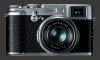

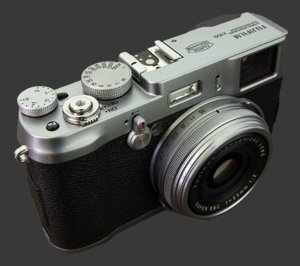
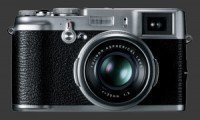
The Fuji Finepix X100 is a relatively compact digital camera with a large-sensor and a unique hybrid viewfinder. Its design follows analog range-finders with direct dials to control exposure and a boxy metal construction. Automatic, semi-automatic and manual operations are all possible with this digital camera.
The X100 features a 12 megapixels CMOS sensor with a 1.5X crop-factor, the same size as most DSLRs, for high-quality output, particularly at high ISO. The sensor is paired with a specially designed Fujinon 23mm F/2 lens, equivalent to 35mm on a full-frame camera. A leaf shutter is part of the lens which lets it sync with the flash at high-speed. Even more flexibility is provided by a built-in ND filter.
This camera review takes a close look at the Fuji Finepix X100 in terms of features, its ergonomics, usability, performance and image quality.
Fuji Finepix X100 Key Features
Sensor
- 12 Megapixels CMOS sensor
- 1.5X crop-factor
- ISO 200-6400, 1/3 EV steps
- Extended ISO 100 & 12800
- Customizable Auto ISO
- JPEG, RAW or JPEG+RAW Output
- 1280x720 @ 24 FPS 16:9 HD Video
Lens
- Fujinon 23mm, equivalent to 35mm
- Bright F/2 maximum aperture
- F/2-F/16 Aperture range, 1/3 EV steps
- 9-Blade Aperture
- Leaf-Shutter
- 10cm-2m Macro focus range
- 80cm Normal minimum focus distance
- Depth-Of-Field preview
- Optional 3-Stop ND-Filter
Exposure
- PASM Exposure modes
- 1/4000s-30s Shutter-speed1/4000s only available at F/8 or smaller.
- Bulb exposures up to 1h
- Exposure-Compensation, ±2 EV, 1/3 EV steps
- Flash-Compensation, -2/3...+2/3, 1/3 EV steps
- Multi-Segment, Spot & Average metering
- AEB, 3 Frames, ±1 EV, 1/3 steps
- ISO Bracketing, ±1 EV, 1/3 steps
- Fixed 1/3 EV exposure steps
Focus & Drive
- 49-Area Contrast-Detect autofocus
- Auto or single focus-point selection
- Single-shot, continuous or manual focus
- 2s & 10s Self-Timers
- 5 or 3 FPS Drive, Max 10 JPEG or 8 RAW
- Motion Panorama, 180° & 120° angle-of-view
- Optional AF-Assist lamp
Images Parameters
- Automatic, Preset, Kelvin and Custom WB
- WB fine-tuning, 19-steps along 2-axis
- Film Simulation: Provia, Velvia, Astia, B&W, B&W+Red Filter, B&W+Green Filter, B&W+Blue Filter, Sepia
- 100-400% Automatic or Manual Dynamic-Range
- Adjustable color-saturation, 5 steps
- Adjustable sharpness, 5 steps
- Adjustable highlight-tone, 5 steps
- Adjustable shadow-tone, 5 steps
- Adjustable noise-reduction, 5 steps
- Film Simulation Bracketing
- Optional Long-Exposure Noise-Reduction
Controls
- Direct full-stop dials for Aperture & Shutter-Speed
- Extra dial for 1/3 stop shutter-speed control
- Extra rocker for 1/3 stop aperture control
- Direct exposure-compensation dial
- Implicit Exposure-Mode based on dials
- Combined configurable AE-L/AF-L button
- Customizable Function button
- Fly-By-Wire manual focus ring
Viewfinder & Displays
- Unique Hybrid Viewfinder
- EVF Mode: 100% Coverage, 0.5X magnification
- OVF: Over 100% coverage with 90% guide, 0.5X magnification
- Eye-Start sensor automatically switches between Hybrid-Viewfinder and LCD
- 2.8" LCD, 460K Pixels, 100% coverage
- Digital-Level, 1 axis, tilt only
- Manual-Focus and Depth-Of-Field guide
- Optional Status-Display on rear LCD
- Optional HUD overlay on OVF
Body & Construction
- Solid magnesium body
- Metal tripod mount
- Built-in flash, 9m reach
- Hot-Shoe for external lighting
- Wired remote terminal
- 1080i HDMI output
- USB 2.0 connectivity
- SDXC memory card slot
- Proprietary Lithium-Ion battery
Fujifilm Finepix X100 Suitability - What is it good for?
The Fuji X100 is a interestingly capable digital camera. With its full manual-controls, including bulb exposure, manual-focus and custom white-balance, the Fuji X100 lets photographers be highly creative except for one important limitation: a fixed 23mm prime lens. This means that every photo from this digital camera shows exactly the same perspective.
The 23mm focal-length is equivalent to a 35mm lens on a full-frame camera, which is most often described as a slightly-wide normal lens. For years, the equivalent was sold along film SLRs. This focal-length provides a versatile field-of-view which lets photographers shoot in moderately tight spaces without the distortion of a wide-angle lens.

While everyone is free to point the Fuji Finepix X100 at any subject, the perspective offered by its Fujinon lens is better suited for environmental portraits, social events, reportage and general snapshots. The common theme is that this focal-length practically forces the photographer to interact with his subjects. This can lead to better photography by increasing the photographer's awareness and forcing him to search differently for composition than with a zoom lens. Anecdotally, this happened during the review period where a number of very familiar places produced completely different photographs than usual.
Beware that the 35mm-equivalent focal-length is certainly not ideal for wildlife, sports and architecture. Success of landscape photography is greatly dependent on location, more intimate vistas may work well but the breath-taking ones require more effort to compensate for the lack of a wide-angle. Multiple images though can easily be stitched into a wide-angle panorama to increase the field-of-view. Actually, the Finepix X100 can produce a low-resolution 180° panorama directly in-camera using its Motion Panorama mode.
Fujifilm Finepix X100 Capability - What can it do?
The Fuji Finepix X100 offers PASM exposure-modes including Program-Shift and Bulb. Exposure parameters other than ISO and EC can be changed in 1 or 1/3 EV steps. EC is can be set ±2 EV in 1/3 steps only. ISO is controllable in the normal 200-6400 range in 1/3 steps with ISO 100 and 12800 as expansion options. Neither expansion option is available when shooting RAW, so those are probably simulated by internal processing. There is a highly customizable Auto ISO functionality with selectable maximum up to ISO 3200 and minimum shutter-speed between 1/4 and 1/125s.
This relatively compact camera uses a leaf-shutter rather than the usual vertical-plane shutter found on most digital cameras. Leaf-shutters are found between lens elements and need to travel a shorter distance to work. This lets the X100 synchronize with flash at high-speed. The catch is that the maximum shutter-speed goes down at wide apertures which require more movement of the leaf-shutter. Specifically, F/2 allows a maximum shutter-speed of 1/1000s and F/4 allows 1/2000s while F/8 allows the full-range of shutter-speeds.
Dynamic-Range can be automatically or manually selected between 100% and 400%. This is achieved by using a lower than indicated ISO to capture more highlight details. The implication is that ISO 200 can only shoot at 100% DR, while ISO 400 can use both 100% and 200% DR. From ISO 800 to 6400, any DR may be used. Expanded ISO sensitivities are not compatible with expanded dynamic-range ones though.
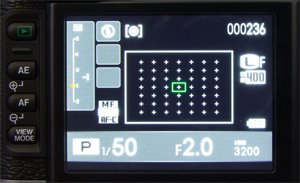
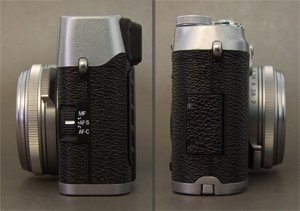
The X100 uses Contrast-Detect autofocus with 49-areas covering all but the edges of the frame. The focus area can be automatically or manually selected. The universal 3 focus-drive modes are selectable: AF-S, AF-C and MF. Single-shot autofocus works exactly as expected. Continuous autofocus continuously focuses at all times, even when the shutter-release is not pressed at all. Manual focusing works with a fly-by-wire ring. During MF, a distance scale shows the set focus-distance and nicely indicates DOF at the selected aperture. MF Assist is available in EVF mode and on the rear LCD.
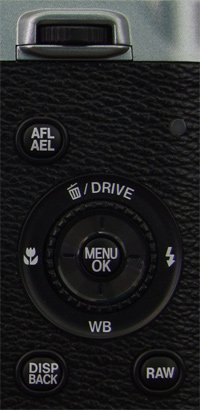 There is a combined AE-L/AF-L button that is configurable for AE-L only, AF-L only or both. Strangely, this button is overridden in MF mode to perform autofocus (AF-On). One of three metering patterns can be chosen using the AE button: Multi-Segment, Spot and Average.
The Fuji Finepix X100 offers an extensive selection of drive modes: Single, Continuous, AEB, ISO Bracketing, Film-Simulation Bracketing, Dynamic-Range Bracketing, Motion-Panorama and Movie. Both Motion-Panorama and Movie override most camera controls. In Movie mode, only Aperture and EC can be set while in Motion Panorama mode, only ISO and EC can be set. Continuous shooting is available at 5 or 3 FPS. At 5 FPS, the X100 can shoot up to 10 JPEG or 8 RAW or 8 RAW+JPEG images in a single burst. Separate from the drive-modes is a 2s or 10s self-timer which thankfully remains active after each use.
There are plenty of white-balance options on the X100: Automatic, Custom, Kelvin and 7 PresetsFine (Sunny), Shade (Cloudy), 3 Fluorescent, Incandescent, Underwater.. All settings are fine-tunable along 2 axis in 19-steps. Fine-tuning is not interactively previewed, so is unfortunately tedious to set. Kelvin white-balance is selectable between 2500K and 10000K.
A built-in 3-stop ND-filter can be activated to reduce incoming light by a factor of 8X. This allows the photographer to use wider apertures and longer shutter-speeds than otherwise possible for the same scene.
There is a small built-in flash above the lens with a reach of 9m. Flash-Compensation of ±2/3 in 1/3 EV steps is available. There are 4 flash modes which are not always all available: Auto, On, Off, Slow-Sync. The X100 is equipped with a hot-shoe for external lighting. The external flash can be set as commander for a multi-flash configuration.
Display settings are extremely customizable and set independently for the OVF and EVF. In either case, any of the following can be toggled: Framing Lines, Electronic Level, AF Distance Indicator, Histogram, Exposure-Parameters, EC, Metering, Flash, WB, Film-Simulation, Dynamic-Range, Frames Remaining, Image Size & Quality and Battery-Level.
There is a tiny customizable Function button which can be set to any one of: DOF-Preview, Self-Timer, ISO, Image Size, Image Quality, Dynamic-Range, Film Simulation, ND Filter, AF-Mode, Custom Setting Selection or Movie. The logical choice is to use it for ISO but ND-Filter is probably a reasonable choice for some. There is a RAW button which forces the next shot to be taken in RAW mode, instead of JPEG. Like RAW buttons on most cameras this one is likely to get used very little and should at least be customizable.

 |



 
|
 Next1 - Capability2 - Usability3 - Performance
Please Support Neocamera
All information on Neocamera is provided free of charge yet running this website is a huge endeavor. Purchases made via affiliate links found throughout the site help keep it running and up-to-date. There is no additional cost to you, so please consider buying via these links to our affilates:




Thank you for your support!


Fujifilm X100 Highlights


 Medium digital camera
Sensor-Size: 24 x 16mm

Actual size when viewed at 100 DPI
| 12 Megapixels Fixed Lens | ISO 100-12800 |
| Fixed 35mm lens | Shutter 1/4000-30s |
| 0.47" Hybrid EVF 1.4 Megapixels (0.50X) | Full manual controls, including Manual Focus |
| Automatic Eye-Start sensor | Custom white-balance with 2 axis fine-tuning |
| 5 FPS Drive, 10 Images | Spot-Metering |
| 1280x720 @ 24 FPS Video Recording | Hot-Shoe |
| 2.8" LCD 460K Pixels | Lithium-Ion Battery |
| Secure Digital Extended Capacity |
Camera Bag


Your camera bag is empty. To add a camera or lens click on the star next to its name.
Your camera bag is empty.
Add cameras or lenses by clicking on the star next to their name.
Updates
2026.09.08

The Wild Magic of Iceland Book Review
Review of The Wild Magic of Iceland by Norris Niman. A photographic journey through seasons.
2026.07.31

ZY Optics Pittura 30mm F/2.4 Medium-Format Lens Review
The ZY Optics Pittura 30mm F/2.4 is a manual lens designed exclusively for Medium-Format Digital Cameras. This fast prime lens captures a wide field-of-view, equivalent to a 24mm on Full-Frame. It is am affordable alternative to first-part GFX and XCD lenses.
2026.07.26

Fujifilm GFX100S II Review
Express review of the Fujifilm GFX100S II. This 102 MP Medium-Format Mirrorless Digital Camera packs an 5-Axis 8-Stop IBIS and a 5.8 MP 0.5" EVF showing 100% coverage at an extra-large 0.84X magnification. It is a more compact version of the flagship GFX100 II. This review covers exactly how these camera compare.
2026.07.14

Sony Alpha A7R VI Review
Extended In-Depth Review of the Sony Alpha A7R VI. This flagship Full-Frame Mirrorless Digital Camera combines ultra-high 67 MP resolution with very fast 30 FPS continuous shooting. It packs a 5-axis 8½-stop IBIS mechanism and an ultra-sensitive 759-Point Phase-Detect AF system. Its incredibly sharp 9.4 MP 0.64" EVF has a huge 0.9X magnification, 100% coverage, 10-bit HDR and 100% DCI-P3 color-space. Captures 8K video at 30 FPS or 4K video at 120 FPS.
2026.05.21

Laowa 4.5-10mm F/2.8 Fisheye Zoom Lens Review
In-depth review of the Venus Optics Laowa 4.5-10mm F/2.8 Fisheye Zoom Lens. This lens zooms from a circular to rectangular fisheye with an 180° viewing angle. This review analyses its optical quality, construction and handling.
2026.04.13

Laowa 17mm F/4 Zero-D Shift Review
In-Depth review of the Venus Optics Laowa 17mm F/4 Zero-D Shift Lens. This ultra-wide Shift lens is specifically designed for Mirrorless Digital Cameras and is available in 4 Full-Frame mounts plus 2 Medium-Format ones.
2025.11.13

Best Gifts for Photographers in 2025 by Budget
The annual Neocamera Photography Gift Guide updated to 2025. Find great gifts for photographers with any price budget.
2025.07.07

Stellar Photo Recovery Review
Review of Stellar Photo Recovery V12. This Windows and MacOS software can recover photos and videos in a huge number of formats from memory cards, USB drives, SSDs and HHDs.
2025.05.14

Huion Kamvas 13 Gen 3 Review
In-Depth review of the Huion Kamvas 13 Gen 3 Pen Display Tablet for photographers and graphic artists.
2025.01.18

Fujifilm GFX 2025 Lens Roundup
Lens Review roundup of Fujifilm GFX Medium-Format lenses. Quality, performance and handling of the GF20-35mm F/4R WR, GF30mm F/3.5 Tilt-Shift and the GF55mm F/1.7.
2024.11.18

Best 2024 Photography Gifts for Every Budget
Great gifts for photographers and photo enthusiasts selected for every budget among the best products of 2024.
2024.08.07

Eye Protection Tips for Professional Photographers
The four main considerations for professional photographers regarding eyewear.
2026.09.08
2026.07.31
2026.07.26
2026.07.14
2026.05.21
2026.04.13
2025.11.13
2025.07.07
2025.05.14
2025.01.18
2024.11.18
2024.08.07