Camera Basics
 Camera Choosing
 Camera Models
 Camera Buying
 DSLR Buying

Sony Cybershot DSC-H9 Review
 8 Megapixels
 Ultra-Zoom: At least 10X optical zoom.
 Electronic View Finder
 Stabilization: Compensates for tiny involuntary movements of the camera.
 Continuous Drive
 VGA Video: 640 x 480 or more but less than 1280 x 720.
 Manual Controls: Both fully-manual (M) and semi-automatic modes (T and V).
 Custom White-Balance: Specifies exactly what should be white to the camera.
 Action Photography: Shutter speeds of 1/1500 or more.
 Night Photography: Reaches shutter-speeds longer than 4 seconds.
 Spot Metering
 Accepts Memory Stick Duo memory.
 Neocamera detailed review
 Discontinued: No longer produced by the manufacturer. May still be in stock or found used.
 1 - Usability & Ergonomics2 - Image Quality & Performance
Sony Cybershot DSC-H9 Performance - How well does it take pictures?
Straight out, the Sony Cybershot DSC-H9 produces good looking image with well saturated colors. There are several color modes including Normal, Vivid and Natural. By default, the camera uses the Normal color mode. Between Normal and Natural, differences are minimal. Both these color modes produce slightly over-saturated colors compared to reality. Notwithstanding white-balance, the H9's colors are reasonably hue-accurate. Vivid mode produces highly saturated colors, for those who like their colors very punchy. Exposure was accurate and consistent.
The Sony H9 has several white-balance options including automatic and custom. The automatic white-balance performs very well in daylight. At night, the automatic white balance is very inconsistent. During our second night shoot, the H9 produced several spot-on images and just as many with a drastically incorrect white-balance. Indoors, the Sony H9's automatic white-balance system performed fairly well but regularly left a yellowish color-cast. Under artificial light, preset white-balance drastically reduced the color cast, giving more neutral looking results. Custom white-balance is very accurate under all sorts of light. Overall, automatic white-balance results are better than average in bright light but highly problematic at night.
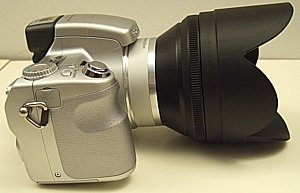
Given the compact size of its 31-465mm stabilized lens, some compromises are expected. This is a relatively bright lens with an F2.7 maximum aperture at wide-angle. The maximum aperture drops to F3.2 at 59mm (1.9X zoom), to F3.5 at 111mm, to F4 at 232mm and only drops down to F4.5 beyond 341mm.
While the sensor can capture a good amount of details, the lens does not always let them through. Particularly, the lens shows a significant amount of softness around the edges of images. Edge softness is very pronounced in the second half of the room range (8X-15X) and was even noticeable in prints starting at 6"x8" in size. In the center, details are good except near wide-angle which shows softness throughout the frame. Noticeable barrel distortion is present near wide-angle but quickly disappears past 46mm (about 1.5X zoom). Beyond that, the lens shows very little distortion, if any.
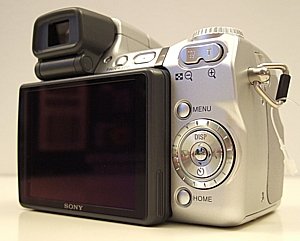
Besides above average edge softness, the H9 shows a significant amount of chromatic aberrations. Next to nearly over-exposed areas, purple fringing was quite wide and very noticeable. Purple fringing was also occasionally present in other areas, but much less pronounced there.

It is common to see purple fringing near high-contrast areas like this one, but the H9 produces very wide fringes.
For those comparing the H9 to the H5, it seems that the increased in zoom range camera at the price of much more edge softness and chromatic aberrations. The only area where the lens actually improved is distortion. The distortion near wide-angle becomes minimal faster while zooming in than on the H5.
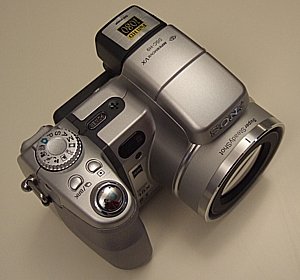
In terms of noise, the Sony H9 keeps it well under control, definitely better than most other ultra-zoom digital cameras. While fine noise can be found even at ISO 80, it increases slowly. Up to ISO 400, the H9 generally produces images usable for prints up to 9"x12". ISO 400 is only troublesome for photographs consisting of mostly dark areas. At ISO 800, noise is much more apparent but images can still be usable for small prints. Note that the Auto-ISO setting ranges from ISO 80 to 800. This means that one must be prepared to have some images not suitable for medium prints when using Auto ISO.
The Sony Cybershot DSC-H9 also has ISO 1600 and 3200 options. For bright images, ISO 1600 can produce recognizable prints in small sizes. ISO 3200 is basically useless. It produces extremely noisy images with very little details.
Speed is probably the H9's strongest point. We already mentioned the fast zoom mechanism, but the most impressive is focusing speed. In low-light, focus speeds are good as long as there is enough contrast. In brighter light, focusing speed went from very fast near telephoto to extremely fast near wide-angle. The shutter-lag is quick and shot-to-shot speed is good. Continuous drive is excellent, running around 2 FPS for up to 100 frames. The user interface is very responsive too. The only slow aspect of the H9 is the pan-and-zom feature for reviewing images.
 One special feature of the H9 is its night-shot mode. It allows to take monochrome pictures and video in complete darkness. In this mode, ISO settings, metering modes and burst modes are not available. Image quality in night-shoot mode varies enormously. The darker the scene, the more noisy images become. In complete darkness, images are extremely noisy and void from details, even much worst than the ISO 3200 setting. Since the H9 must add its own infrared light, the effective range for night-shots is very limited. Also, the infrared beam does not cover the lens' angle of view near wide-angle. This results in images that are much brighter at their center.
To compare the Sony Cybershot DSC-H9, we used two 8 megapixels digital cameras. The closest camera on-hand, in terms of features, was the Konica-Minolta Dimage A2. This is ironic because the A2 is over 3 years old and Konica-Minolta's digital camera division has been folded into Sony. Not only that, the A2's sensor is made by Sony. With this in mind, we were curious to see if the Sony H9 would be better in most respects. In terms of spec, the A2 is also a large camera with a mechanically-linked 7X wide-angle optical zoom, built-in CCD-shift stabilization and a sophisticated feature set. See the indoor crops for a detailed comparison. The other 8 megapixels camera was the Fuji Finepix F40fd. It is a point-and-shoot ultra-compact camera with 3X optical zoom. While it could not be more different from the H9, it has a modern 8 megapixels sensor, thus making it an interesting comparison candidate. See the outdoor day crops for the detailed comparison.
Sony Cybershot DSC-H9 Conclusion
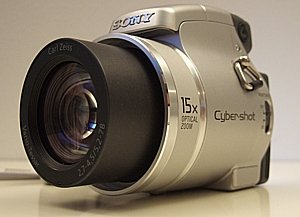 With so many features packed into a light camera body, the Sony Cybershot DSC-H9 has tremendous consumer appeal. Its 8 megapixels sensor, stabilized 15X optical zoom, 3" LCD and nicely saturated colors are designed to impress people looking for a more-is-better type of camera. The H9 has enough resolution for common print sizes and even midsize ones (12"x16"). Its set of manual controls and long zoom ensure versatility too.
Image quality is far from perfect but usable for common print sizes. The most problematic areas are excessive edge softness and high chromatic aberrations. Colors are generally pretty good in bright light. However, the white-balance system is problematic in low-light, particularly during night photography. Noise levels are below average up to ISO 400. Exposure and focus are also very accurate. An area where the H9 excels is speed. In good light, the H9 focused faster than all non-DSLR cameras that we tested. The Sony Cybershot DSC-H9 also has a tiny EVF which unfortunately has poor color accuracy.
Although the H9 has gained capabilities compared to the H5, image quality has not improved much. There is less noise and color is generally more accurate but there is more softness and chromatic aberrations. Between the two, the choice is tough, so the H9 is not an obvious upgrade path for H5 owners. The Olympus SP-550 UZ, which is the only camera to offer a wider and longer zoom range, is a good alternative to the H9. In good light, the SP-550 produces nicer images but in low-light the H9's below-average noise makes it better. Ultra-zoom cameras that offer truly better image quality are the Fuji Finepix S6000fd, Fuji Finepix S9000 and Fuji Finepix S9100. What these cameras lack in stabilization, they gain in terms of high-ISO performance, particularly the 6 megapixels S6000fd. These cameras also all share a 28-300 mechanically linked 10.7X optical zoom lens that is more efficient in use. They also all use convenient AA batteries.
 |


|

 1 - Usability & Ergonomics2 - Image Quality & Performance
Please Support Neocamera
All information on Neocamera is provided free of charge yet running this website is a huge endeavor. Purchases made via affiliate links found throughout the site help keep it running and up-to-date. There is no additional cost to you, so please consider buying via these links to our affilates:




Thank you for your support!


Sony DSC-H9 Highlights
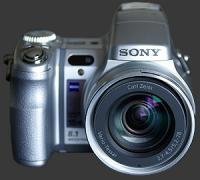


 Large digital camera
Sensor-Size: 6 x 4mm

Actual size when viewed at 100 DPI
| 8 Megapixels Ultra Zoom | ISO 80-3200 |
| 15X Optical Zoom | Shutter 1/4000-30s |
| Built-in Stabilization | Full manual controls |
| 0.20" Built-in EVF 200K Pixels | Custom white-balance |
| 2 FPS Drive, 100 Images | Spot-Metering |
| 640x480 @ 30 FPS Video Recording | Lithium-Ion Battery |
| 3" LCD 230K Pixels | Memory Stick Duo, Internal Memory |
Camera Bag


Your camera bag is empty. To add a camera or lens click on the star next to its name.
Your camera bag is empty.
Add cameras or lenses by clicking on the star next to their name.
Updates
2026.09.08

The Wild Magic of Iceland Book Review
Review of The Wild Magic of Iceland by Norris Niman. A photographic journey through seasons.
2026.07.31

ZY Optics Pittura 30mm F/2.4 Medium-Format Lens Review
The ZY Optics Pittura 30mm F/2.4 is a manual lens designed exclusively for Medium-Format Digital Cameras. This fast prime lens captures a wide field-of-view, equivalent to a 24mm on Full-Frame. It is am affordable alternative to first-part GFX and XCD lenses.
2026.07.26

Fujifilm GFX100S II Review
Express review of the Fujifilm GFX100S II. This 102 MP Medium-Format Mirrorless Digital Camera packs an 5-Axis 8-Stop IBIS and a 5.8 MP 0.5" EVF showing 100% coverage at an extra-large 0.84X magnification. It is a more compact version of the flagship GFX100 II. This review covers exactly how these camera compare.
2026.07.14

Sony Alpha A7R VI Review
Extended In-Depth Review of the Sony Alpha A7R VI. This flagship Full-Frame Mirrorless Digital Camera combines ultra-high 67 MP resolution with very fast 30 FPS continuous shooting. It packs a 5-axis 8½-stop IBIS mechanism and an ultra-sensitive 759-Point Phase-Detect AF system. Its incredibly sharp 9.4 MP 0.64" EVF has a huge 0.9X magnification, 100% coverage, 10-bit HDR and 100% DCI-P3 color-space. Captures 8K video at 30 FPS or 4K video at 120 FPS.
2026.05.21

Laowa 4.5-10mm F/2.8 Fisheye Zoom Lens Review
In-depth review of the Venus Optics Laowa 4.5-10mm F/2.8 Fisheye Zoom Lens. This lens zooms from a circular to rectangular fisheye with an 180° viewing angle. This review analyses its optical quality, construction and handling.
2026.04.13

Laowa 17mm F/4 Zero-D Shift Review
In-Depth review of the Venus Optics Laowa 17mm F/4 Zero-D Shift Lens. This ultra-wide Shift lens is specifically designed for Mirrorless Digital Cameras and is available in 4 Full-Frame mounts plus 2 Medium-Format ones.
2025.11.13

Best Gifts for Photographers in 2025 by Budget
The annual Neocamera Photography Gift Guide updated to 2025. Find great gifts for photographers with any price budget.
2025.07.07

Stellar Photo Recovery Review
Review of Stellar Photo Recovery V12. This Windows and MacOS software can recover photos and videos in a huge number of formats from memory cards, USB drives, SSDs and HHDs.
2025.05.14

Huion Kamvas 13 Gen 3 Review
In-Depth review of the Huion Kamvas 13 Gen 3 Pen Display Tablet for photographers and graphic artists.
2025.01.18

Fujifilm GFX 2025 Lens Roundup
Lens Review roundup of Fujifilm GFX Medium-Format lenses. Quality, performance and handling of the GF20-35mm F/4R WR, GF30mm F/3.5 Tilt-Shift and the GF55mm F/1.7.
2024.11.18

Best 2024 Photography Gifts for Every Budget
Great gifts for photographers and photo enthusiasts selected for every budget among the best products of 2024.
2024.08.07

Eye Protection Tips for Professional Photographers
The four main considerations for professional photographers regarding eyewear.
2026.09.08
2026.07.31
2026.07.26
2026.07.14
2026.05.21
2026.04.13
2025.11.13
2025.07.07
2025.05.14
2025.01.18
2024.11.18
2024.08.07