Camera Basics
 Camera Choosing
 Camera Models
 Camera Buying
 DSLR Buying

Sony Cybershot DSC-H5 Review
 7 Megapixels
 Ultra-Zoom: At least 10X optical zoom.
 Electronic View Finder
 Stabilization: Compensates for tiny involuntary movements of the camera.
 VGA Video: 640 x 480 or more but less than 1280 x 720.
 Manual Controls: Both fully-manual (M) and semi-automatic modes (T and V).
 Custom White-Balance: Specifies exactly what should be white to the camera.
 Action Photography: Shutter speeds of 1/1500 or more.
 Night Photography: Reaches shutter-speeds longer than 4 seconds.
 Spot Metering
 Runs on standard AA batteries
 Accepts Memory Stick Duo memory.
 Neocamera detailed review
 Discontinued: No longer produced by the manufacturer. May still be in stock or found used.
 1 - Capability2 - Usability3 - Performance
Sony Cybershot DSC-H5 Introduction
The Sony Cybershot DSC-H5 holds great consumer appeal because of its high specifications. With a 12X optical zoom lens, a 3" LCD screen and a 7 megapixels image sensor, it has nearly the maximum specifications of all digital cameras. Another aspect that will appeal to consumers is its relatively light and compact form factor (the H5 is smaller than most cameras with 12X optical zoom). To round off the specifications, this camera is equipped with complete manual controls and a DVD-quality movie mode.
Important features of the Sony Cybershot DSC-H5 are:
- Optical image stabilization.
- Full manual controls: P, S, A and M modes.
- Aperture range: F2.8 (wide) F3.7 (tele) to F8.
- Shutter speed range: 1/1000 to 30 seconds.
- ISO: 80, 100, 200, 400, 800, 1000 and Auto (80-320).
- Exposure compensation: -2..+2 stops, 1/3 stop increments.
- White-Balance: auto, daylight, cloudy, fluorescent, incandescent, flash and custom.
- Metering: multi-segment, center-weighed and spot.
- Auto focus: single, continuous and monitor.
- Focus: multi-point focus, center-focus, selectable focus-point and manual focus.
- Flash mode: auto, forced, off, slow sync, with or without redeye.
- Unlimited 640x480 30 FPS movie mode with zoom and sound.
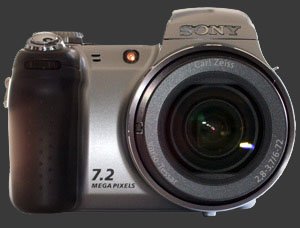
Sony Cybershot DSC-H5 Suitability - What is it good for?
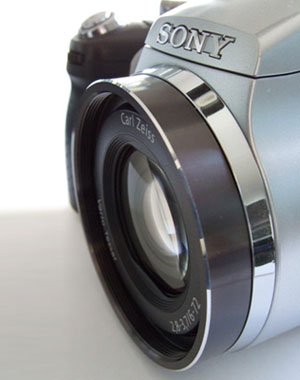
As a 7 megapixels digital camera, the Sony H5 is expected to produce prints at least 10"x13" in size. The 12X stabilized zoom starts at a 35mm equivalent focal-length and goes up to 420mm. This zoom range covers most commonly used focal-lengths plus telephoto and super-telephoto. Such a long zoom is ideally suited for wildlife photography and is an asset for macro and street photography. Presently, 12X optical zoom is the largest available stabilized zoom of any digital camera. In terms of macro, the H5 can get as close as 2cm (0.8") from its subject when the lens is at its widest, capturing a very small area. Since the H5 does not cover wide-angle focal-lengths, it is not ideal for architectural photography.
With a full set of manual controls including manual exposure, semiautomatic exposure, custom white balance, manual focus and metering options, the Sony Cybershot DSC-H5 is quite suitable for creative photography. Additionally, two automatic modes and several scene modes allow for point-and-shoot photography. A powerful top-mounted pop-up flash serves to illuminate subjects in low-light and provide fill-flash to reduce contrast in bright light. The wide-range of ISO, from 80 to 1000, makes the H5 usable for outdoor and typical indoor lightIncandescent.
Since available shutter-speeds go from 1/1000s to 30s, the H5 can be used in very low-light - using a tripod, of course - and for shooting slow moving subjects. The Sony Cybershot DSC-H5 is less suitable for action photography since it lacks the top shutter-speeds required to freeze high-speed action like racing and fast sports. Even though the H5 has a continuous drive mode running at 1.1 FPS, it is too slow to reliably capture a decisive moment. Buffering is also very shallow at a maximum of 5 images, meaning that action cannot be followed for long.
The Sony H5 has a high-quality 640x480 30 FPS movie mode which is now typical of modern digital cameras. Unlike most digital cameras, this one allows its zoom to be used during filming. In movie mode, the camera zooms slowly and refocuses slowly on its subject to avoid recording the sound of its internal motors. The movie mode also allows metering, white-balance and focus modes to be set before recording. Even manual focus can be chosen and the focus distance changed during filming. This makes the H5 one of the most capable digital cameras for movie recording.
 |
 |
 |
 |
 |
 |
1X 35mm |
2X 70mm |
4X 140mm |
8X 280mm |
10X 350mm |
12X 420mm |
 |


|
 Next1 - Capability2 - Usability3 - Performance
Please Support Neocamera
All information on Neocamera is provided free of charge yet running this website is a huge endeavor. Purchases made via affiliate links found throughout the site help keep it running and up-to-date. There is no additional cost to you, so please consider buying via these links to our affilates:




If you found any information on this site valuable and did not purchase via our affiliate links, please considering donating via PayPal:
Any amount will be greatly appreaciated. Thank you for your support!


Sony DSC-H5 Highlights


 Large digital camera
Sensor-Size: 6 x 4mm

Actual size when viewed at 100 DPI
| 7 Megapixels Ultra Zoom | ISO 80-1000 |
| 12X Optical Zoom | Shutter 1/2000-30s |
| Built-in Stabilization | Full manual controls |
| 0.20" Built-in EVF 200K Pixels | Custom white-balance |
| 1.1 FPS Drive, 7 Images | Spot-Metering |
| 640x480 @ 30 FPS Video Recording | Standard AA Battery |
| 3" LCD 230K Pixels | Memory Stick Duo, Internal Memory |
Camera Bag


Your camera bag is empty. To add a camera or lens click on the star next to its name.
Your camera bag is empty.
Add cameras or lenses by clicking on the star next to their name.
Updates
2024.08.07

Eye Protection Tips for Professional Photographers
The four main considerations for professional photographers regarding eyewear.
2024.07.14

Fujifilm X100VI Review
Flagship fixed-lens compact digital camera with a 40 MP sensor and Image-Stabilization, a first for the series. Retro design featuring dual control-dials, plus direct ISO, Shutter-Speed and EC dials. Its hybrid viewfinder can switch between EVF and OVF mode.
2024.05.09

Fujifilm GFX100 II Review
Flagship 102 Megapixels Medium-Format Mirrorless Digital Camera with 8-Stop 5-Axis IBIS, 8 FPS Drive, 8K Video and 400 MP Super-Resolution capture in a weatherproof and freezeproof body with dual control-dials and dual memory-card slots.
2024.04.03

Fujifilm X-T5 Review
Newest Fujifilm flagship boasting a 40 MP APS-C sensor, 5-axis IBIS with 7-stop efficiency, 15 FPS continuous drive, 6.2K Video capture, dual control-dials and dual SDXC UHS-II slots in a sturdy weatherproof and freezeproof body.
2023.11.20

Best Digital Cameras of 2023
Find out which are the Best Digital Cameras of 2023. All the new Mirrorless Digital Cameras from entry-level to high-end professional.
2023.07.10

Fujifilm X-H2 Review
40 Megapixels APS-C Hybrid Mirrorless Digital Camera with 7-stop IBIS. Fastest shutter ever and 8K video capture. Large builtin EVF with 0.8X magnification and 5.8 MP, plus an Eye-Start Sensor. Packed with features and large number of controls in a weatherproof and freezeproof body.
2023.05.07

Sony FE 20-70mm F/4G Review
Review of the unique Sony FE 20-70mm F/4G lens. The optical zoom of this lens spans ultra-wide-angle and medium focal-length coverage, making it one of the most versatile Full-Frame lenses on the market.
2023.01.15

Huion Inspiroy Dial 2 Review
Review of the Huion Inspiroy Dial 2 tablet, a medium sized drawing surface with dual dials and customizable buttons. Connects via USB-C or Bluetooth 5.0 with Windows, Linux and Android support.
2022.12.08

How to Pack for a Photo Trip
Find out how to pack for a travel photography trip, carry your gear safely while meeting airline regulations.
2022.11.13

Best Digital Cameras of 2022
The best digital cameras of 2022. A short list of the most outstanding models in their respective categories. Choose one for yourself or as a gift.
2022.09.21

Pentax DA* 60-250mm F/4 SDM Review
Review of the Pentax DA* 60-250mm F/4 SDM, the constant-aperture telephoto zoom with the highest zoom-ratio on the market.
2022.09.20

Pentax DA* 50-135mm F/2.8 SDM Review
Review of the Pentax DA* 50-135mm F/2.8 SDM, the lightest professional telephoto zoom native to the K-mount.
2024.08.07
2024.07.14
2024.05.09
2024.04.03
2023.11.20
2023.07.10
2023.05.07
2023.01.15
2022.12.08
2022.11.13
2022.09.21
2022.09.20