



 Camera Basics
 Camera Choosing
 Camera Models
 Camera Buying
 DSLR Buying

Sony Alpha A100 Summary
 10 Megapixels
 Single Lens Reflex
 Stabilization: Compensates for tiny involuntary movements of the camera.
 Continuous Drive
 Manual Controls: Both fully-manual (M) and semi-automatic modes (T and V).
 Custom White-Balance: Specifies exactly what should be white to the camera.
 Action Photography: Shutter speeds of 1/1500 or more.
 Night Photography: Reaches shutter-speeds longer than 4 seconds.
 Hotshoe: Allows external flash units to be attached.
 Spot Metering
 Depth-Of-Field Preview: Improve perception of DOF before shooting.
 Accepts Compact Flash memory.
 Neocamera detailed review
 Discontinued: No longer produced by the manufacturer. May still be in stock or found used.
Sony Alpha A100 Assessment
The Sony Alpha A100 is a superb and well valued DSLR camera. This 10 megapixel digital SLR is packed with useful features and technology such as body-based stabilization and a hardware dust-reduction system. With body-based stabilization, all lenses automatically benefit from stabilization, even ultra-wide-angle lenses, at no additional cost. It also has some clever options such as low-key and high-key tone-curves, ambient and flash-based exposure compensation and a hardware dynamic range optimizer. Except for above average noise-levels staring at ISO 800, the Alpha A100 shows truly superb image quality. Other downsides are very minor such as artifacts for long-exposures noise-reduction, which can be turned off. The dynamic-range optimizer is also a good idea but since it is not entirely reliable, we recommend turning it off when there is no time to experiment. Then again, no other camera has this feature anyway.
All-in-all, we can easily recommend the Sony Alpha A100 except for action photography, particularly indoors, where ISO 800 and 1600 are normally used. For action photography, the Canon EOS 30D not only does better at high-ISO but also shoots faster at 5 FPS versus this Alpha's 3 FPS. Another alternative is the lower-end Canon Digital Rebel XT which has very clean high-ISO performance but is not as advanced as the A100. For those rarely using ISO sensitivities above 400, the Sony Alpha A100 is truly unmatched.
Neocamera detailed review Read the full Sony Alpha A100 review here.
| PROS | CONS |
|---|---|
| Superb photo quality |
Quite noisy and low-saturation at ISO 1600 |
| Great color accuracy | Slightly above average noise at ISO 800 for a DSLR |
| Very good dynamic range | Long exposure noise-reduction image artifacts |
| Excellent metering and exposure | Dynamic range optimizer not reliable |
| Low image noise up to ISO 400 | Rare multi-segment exposure errors |
| Effectively stabilizes all lenses | |
| Hardware dust-reduction | |
| Very fast and responsive | |
| Fast focusing | |
| Good ergonomics | |
| Eye-start auto-focus | |
| Excellent build quality | |
| Selectable low-key and high-key tone-curve | |
| Ambient and flash-based exposure compensation | |
| Good battery life | |
 Excellent Excellent Excellent Excellent |
|
Recent Similar Cameras


Sony Alpha A100 Sony Alpha A100 Hands-On
 Neocamera hands-on review
The Sony Alpha A100 has more technology features than any other available DSLR. The most important one is body-based anti-shake inherited from Konica-Minolta. This is extremely valuable in low-light and when using long lenses. Remember though that any stabilization feature compensates for the photographer's movements and does nothing against subject motion. Long lenses can be bought without stabilization, saving a significant sum of money and wide-angle lenses get stabilization which is rarely available for such focal-lengths. Next up is dust-reduction, this is a solution to a common problem for cameras with interchangeable lenses. Until now, only Olympus had such system.
There are subtle features which do not get much attention but can greatly help photography. The first are two tone-mapping mode which strangely appear as part of the selection of ISO sensitivity. It was the same way with the Maxxum 5D which is the first camera with these options. The low-key option creates a tone reproduction curve designed to preserve more detail in dark areas. The high-key options does the opposite, preserving more details in bright areas. Another interesting option is wether exposure-compensation adjusts ambient light or flash. When exposure compensation is set to adjust ambient light, flash power is kept constant as the exposure is changed. In the other mode, which is common with most cameras, the flash is used to adjust exposure in low-light conditions. These two interpretation of exposure compensation can produce rather different looking images.
Finally, there is the dynamic-range optimizer (DRO). It idea is a useful but unfortunately it has been reported to not be entirely reliable. Plus, the results are a matter of taste. Just like adjust saturation, contrast and sharpness, it must be done after some experimentation. The main difference is that DRO works differently from scene to scene. Hence, for consistent results, better keep it off. In some cases, having a scene where both shadow and highlight details are clearly visible results in a flatter and less pleasing image.
The bottom line is that this is a great camera except for hand-held low-light photography where high-ISO sensitivities are frequently used. Action photographers will also be better satisfied with a faster continuous drive. Below ISO 800, this camera is nearly perfect and provides excellent value for its price and capabilities.
Sony Alpha A100 Related Information
Please Support Neocamera
All information on Neocamera is provided free of charge yet running this website is a huge endeavor. Purchases made via affiliate links found throughout the site help keep it running and up-to-date. There is no additional cost to you, so please consider buying via these links to our affilates:




If you found any information on this site valuable and did not purchase via our affiliate links, please considering donating via PayPal:
Any amount will be greatly appreaciated. Thank you for your support!


Sony A100 Highlights
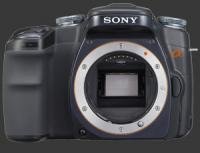


 SLR digital camera
Sensor-Size: 24 x 16mm

Actual size when viewed at 100 DPI
| 10 Megapixels DSLR | ISO 80-1600 |
| Sony A Mount 1.5X FLM | Shutter 1/4000-30s |
| 2-Axis Built-in Stabilization | Full manual controls, including Manual Focus |
| 95% Coverage Medium Viewfinder | Custom white-balance with 1 axis fine-tuning |
| Automatic Eye-Start sensor | Spot-Metering |
| Built-in Dust Reduction | Hot-Shoe |
| 3 FPS Drive, Unlimited Images | Lithium-Ion Battery |
| 2.5" LCD 230K Pixels | Compact Flash |


Camera Bag


Your camera bag is empty. To add a camera or lens click on the star next to its name.
Your camera bag is empty.
Add cameras or lenses by clicking on the star next to their name.
Updates
2024.08.07

Eye Protection Tips for Professional Photographers
The four main considerations for professional photographers regarding eyewear.
2024.07.14

Fujifilm X100VI Review
Flagship fixed-lens compact digital camera with a 40 MP sensor and Image-Stabilization, a first for the series. Retro design featuring dual control-dials, plus direct ISO, Shutter-Speed and EC dials. Its hybrid viewfinder can switch between EVF and OVF mode.
2024.05.09

Fujifilm GFX100 II Review
Flagship 102 Megapixels Medium-Format Mirrorless Digital Camera with 8-Stop 5-Axis IBIS, 8 FPS Drive, 8K Video and 400 MP Super-Resolution capture in a weatherproof and freezeproof body with dual control-dials and dual memory-card slots.
2024.04.03

Fujifilm X-T5 Review
Newest Fujifilm flagship boasting a 40 MP APS-C sensor, 5-axis IBIS with 7-stop efficiency, 15 FPS continuous drive, 6.2K Video capture, dual control-dials and dual SDXC UHS-II slots in a sturdy weatherproof and freezeproof body.
2023.11.20

Best Digital Cameras of 2023
Find out which are the Best Digital Cameras of 2023. All the new Mirrorless Digital Cameras from entry-level to high-end professional.
2023.07.10

Fujifilm X-H2 Review
40 Megapixels APS-C Hybrid Mirrorless Digital Camera with 7-stop IBIS. Fastest shutter ever and 8K video capture. Large builtin EVF with 0.8X magnification and 5.8 MP, plus an Eye-Start Sensor. Packed with features and large number of controls in a weatherproof and freezeproof body.
2023.05.07

Sony FE 20-70mm F/4G Review
Review of the unique Sony FE 20-70mm F/4G lens. The optical zoom of this lens spans ultra-wide-angle and medium focal-length coverage, making it one of the most versatile Full-Frame lenses on the market.
2023.01.15

Huion Inspiroy Dial 2 Review
Review of the Huion Inspiroy Dial 2 tablet, a medium sized drawing surface with dual dials and customizable buttons. Connects via USB-C or Bluetooth 5.0 with Windows, Linux and Android support.
2022.12.08

How to Pack for a Photo Trip
Find out how to pack for a travel photography trip, carry your gear safely while meeting airline regulations.
2022.11.13

Best Digital Cameras of 2022
The best digital cameras of 2022. A short list of the most outstanding models in their respective categories. Choose one for yourself or as a gift.
2022.09.21

Pentax DA* 60-250mm F/4 SDM Review
Review of the Pentax DA* 60-250mm F/4 SDM, the constant-aperture telephoto zoom with the highest zoom-ratio on the market.
2022.09.20

Pentax DA* 50-135mm F/2.8 SDM Review
Review of the Pentax DA* 50-135mm F/2.8 SDM, the lightest professional telephoto zoom native to the K-mount.

