Camera Basics
 Camera Choosing
 Camera Models
 Camera Buying
 DSLR Buying

Pentax K20D Review
 15 Megapixels
 Single Lens Reflex
 Stabilization: Compensates for tiny involuntary movements of the camera.
 Continuous Drive
 Manual Controls: Both fully-manual (M) and semi-automatic modes (T and V).
 Custom White-Balance: Specifies exactly what should be white to the camera.
 Action Photography: Shutter speeds of 1/1500 or more.
 Night Photography: Reaches shutter-speeds longer than 4 seconds.
 Hotshoe: Allows external flash units to be attached.
 Spot Metering
 Depth-Of-Field Preview: Improve perception of DOF before shooting.
 Weatherproof - Seals protect from dust, humidity and light splashing.
 Accepts Secure Digital High Capacity (SDHC) and SD memory.
 Neocamera detailed review
 Discontinued: No longer produced by the manufacturer. May still be in stock or found used.
 1 - Capability2 - Usability3 - Performance
Pentax K20D Performance - How well does it take pictures?
Ultimately, it is the image quality that makes a camera worth buying. For an SLR, image quality greatly depends on the lens used. While color, noise, exposure and contrast are properties of the camera, distortion, vignetting and chromatic aberrations are properties of the lens. Sharpness depends on the weakest link. That is, the camera cannot capture more details than the lens lets through. Conversely, it is possible for a lens to transmit more details than the sensor can capture.
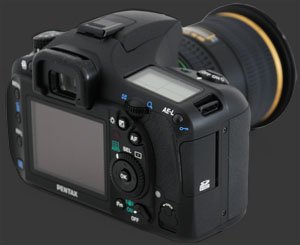
Exposure is generally good with the K20D, specially with subjects that fall within the camera's dynamic range. When a subject has more contrast then the K20D can capture, it consistently exposes conservatively. This means that highlights are rarely overexposed but images may appear darker than expected. Since this is not optimal for printing unmodified images, more positive exposure-compensation than usual is required for scenes with very bright highlights.
Changed from the K10D: The Pentax K20D shows good hue accuracy but does not produce exact color saturation. Specifically, the neutral setting is slightly undersaturated while the next higher settingSaturation+1 is just a bit oversaturated. The K20D has 6 color modes, fiveBright, Natural, Portrait, Landscape and Vibrant. of which are just presets of image parameters, plus one monochrome mode.
New to the K20D: Color saturation, hue and contrast can be adjusted in 9 steps independently of each other with a relatively wide latitude. There are a total of 18 sharpness settings available on the K20D. They are paired as 9 standard sharpness settings and 9 fine sharpness settings. Standard sharpening shows wider edges than fine sharpening. This provides exceptional precision for controlling image sharpness. Fine-sharpness +2 produced the most pleasing results with virtually no visible artifacts.
New to the K20D: Pentax has provided an excellent interface for setting image parameters. The main feature is a digital preview which is dynamically updated whenever an image parameter is changed. Another important detail is that the K20D changes the color of any setting that is not at its default value to yellow. Settings at their default values are shown in green. The final touch is a 6-sided color space representation which shows how colors are affected by image parameters.
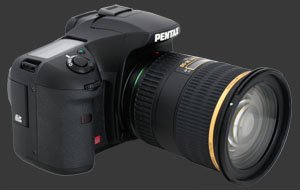
The white-balance system is very accurate when preset and manually set. Automatic white-balance is generally good except under artificial light where it leaves a warm color cast. Unfortunately, this problem occurs with most digital SLR cameras. However, since the K20D has a digital white-balance preview feature, it is very easy to select an accurate white-balance and fine-tune it until satisfied.
Noise levels are extremely low until ISO 400, very low but noticeable in shadow-areas at ISO 800 and low at ISO 1600. The K20D reaches higher ISO sensitivities than it predecessor: ISO 3200 is quite noisy with a slight color shift due to chroma-noise. Still, small prints at ISO 3200 should be possible. ISO 6400 is very noisy and probably is not worth using. Compared to other high-resolution DSLR cameras, the Pentax K20D is about average in terms of image noise but it manages to keep more detail than most. There are some cameras which take the opposite approach and smooth-out both noise and details heavy-handedly. Pentax, on the other hand, has taken the bold step of providing a camera with noise-reduction disabled by default. People who prefer the other approach can enable the desired level of noise-reduction Off, Weakest, Weak or Strong..
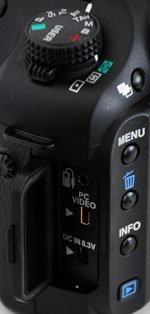 In operation, the Pentax K20D is speedy and responsive. There is rarely a moment where the photographer has to wait for the K20D. The focusing system is very fast and accurate, with some variation depending on the lens used. Shutter-lag is always instant. Image playback and zoom is fast as well.
The K20D officially shoots continuously at 3 FPS but we found that shooting in high-speed continuous-drive varied somewhat. New to the K20D: There is a low-speed continuous drive which hits 2 FPS more consistently. Finally, the K20D has a 20 FPS burst-mode which captures images at 1.5 megapixels without flipping the mirror. Instead, the LCD screen is used as a coarse preview. No information is displayed while shooting in this mode.
Although there is no formal procedure for measuring the performance of image stabilization, we can say that the Shake Reduction system in the K20D appears to be normally effective to at least 2 stops, with 3 stop of effectiveness being quite common and 4 stops a hit-or-miss.
Pentax has made some changes to the K10D's Shake Reduction system which results in slight performance differences between these two cameras. Broadly, the performance is very close on average. It took hundreds of test shots to accurately understand the subtlety. The K10D's Shake Reduction is more consistent at each stop but its effectiveness drops faster. Case in point, the K20D produced more sharp shots at 4 stops over the normal hand-holding limit but the K10D produced more sharp shots at 2 stops.
Pentax K20D Conclusion
As an evolutionary step to the excellent K10D, the Pentax K20D remains an excellent camera. Only the continuous buffer limit has been reduced, everything else has either been improved or remained the same. While the Pentax K20D remains one of the best cropped-sensor DSLRs around, the competition has gotten hotter and there are now greater differences between flagship models.
This feature-rich DSLR leads its class in terms of resolution and produces images full of details while keeping noise in check. This makes it one of the best cameras for most non-action photography. Its truly superb ergonomics make very efficient in use, plus it nearly always responds instantly.
The action photographer, however, will be more attracted to a DSLR that can shoot at 5 FPS or more, of which there are now several. Another area where the K20D lags behind the competition is its viewfinder coverage which is at 95%, while both the Nikon D300 and the Olympus E-3 provide 100% coverage.
One of the K20D's sore points is the performance of its built-in stabilization system which is not as reliable as advertised. Since there are no stabilized Pentax lenses, nothing can be done if it does not provide sufficient stabilization.
The bottom line is that the K20D has one of the most complete feature set of any DSLR. It brings some unique features and exposure modes into a very thoughtful and ergonomic design. Plus, since image quality and performance are great, there is no doubt the K20D is a worthy digital SLR.
 |


|

 1 - Capability2 - Usability3 - Performance
Please Support Neocamera
All information on Neocamera is provided free of charge yet running this website is a huge endeavor. Purchases made via affiliate links found throughout the site help keep it running and up-to-date. There is no additional cost to you, so please consider buying via these links to our affilates:




If you found any information on this site valuable and did not purchase via our affiliate links, please considering donating via PayPal:
Any amount will be greatly appreaciated. Thank you for your support!


Pentax K20D Highlights
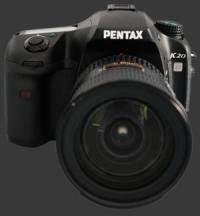


 SLR digital camera
Sensor-Size: 24 x 16mm

Actual size when viewed at 100 DPI
| 15 Megapixels DSLR | ISO 100-6400 |
| Pentax K Mount 1.5X FLM | Shutter 1/4000-30s |
| 2-Axis Built-in Stabilization | Full manual controls, including Manual Focus |
| 95% Coverage Large Viewfinder | Custom white-balance with 2 axis fine-tuning |
| Weatherproof | Spot-Metering |
| Built-in Dust Reduction | Hot-Shoe & Sync-Port |
| 3 FPS Drive, 38 Images | Lithium-Ion Battery |
| 2.7" LCD 230K Pixels | Secure Digital High Capacity |
Camera Bag


Your camera bag is empty. To add a camera or lens click on the star next to its name.
Your camera bag is empty.
Add cameras or lenses by clicking on the star next to their name.
Updates
2024.04.03

Fujifilm X-T5 Review
Newest Fujifilm flagship boasting a 40 MP APS-C sensor, 5-axis IBIS with 7-stop efficiency, 15 FPS continuous drive, 6.2K Video capture, dual control-dials and dual SDXC UHS-II slots in a sturdy weatherproof and freezeproof body.
2023.11.20

Best Digital Cameras of 2023
Find out which are the Best Digital Cameras of 2023. All the new Mirrorless Digital Cameras from entry-level to high-end professional.
2023.07.10

Fujifilm X-H2 Review
40 Megapixels APS-C Hybrid Mirrorless Digital Camera with 7-stop IBIS. Fastest shutter ever and 8K video capture. Large builtin EVF with 0.8X magnification and 5.8 MP, plus an Eye-Start Sensor. Packed with features and large number of controls in a weatherproof and freezeproof body.
2023.05.07

Sony FE 20-70mm F/4G Review
Review of the unique Sony FE 20-70mm F/4G lens. The optical zoom of this lens spans ultra-wide-angle and medium focal-length coverage, making it one of the most versatile Full-Frame lenses on the market.
2023.01.15

Huion Inspiroy Dial 2 Review
Review of the Huion Inspiroy Dial 2 tablet, a medium sized drawing surface with dual dials and customizable buttons. Connects via USB-C or Bluetooth 5.0 with Windows, Linux and Android support.
2022.12.08

How to Pack for a Photo Trip
Find out how to pack for a travel photography trip, carry your gear safely while meeting airline regulations.
2022.11.13

Best Digital Cameras of 2022
The best digital cameras of 2022. A short list of the most outstanding models in their respective categories. Choose one for yourself or as a gift.
2022.09.21

Pentax DA* 60-250mm F/4 SDM Review
Review of the Pentax DA* 60-250mm F/4 SDM, the constant-aperture telephoto zoom with the highest zoom-ratio on the market.
2022.09.20

Pentax DA* 50-135mm F/2.8 SDM Review
Review of the Pentax DA* 50-135mm F/2.8 SDM, the lightest professional telephoto zoom native to the K-mount.
2022.09.10

Pentax DA* 11-18mm F/2.8 DC AW Review
Review of the Pentax DA* 11-18mm F/2.8 DC AW, the widest professional ultra-wide zoom native to the K-mount.
2021.11.24

50 Gifts Under $50 For Photographers in 2021
50 Gifts photographers will love. All for under $50 USD. 2021 Edition.
2021.11.17

Best Digital Cameras for 2021
Neocamera shows which are the very best Digital Cameras for 2021 in every category: Mirrorless, DSLR, Premium Compact, Ultra-Zoom and Rugged.
2024.04.03
2023.11.20
2023.07.10
2023.05.07
2023.01.15
2022.12.08
2022.11.13
2022.09.21
2022.09.20
2022.09.10
2021.11.24
2021.11.17