Camera Basics
 Camera Choosing
 Camera Models
 Camera Buying
 DSLR Buying

Fujifilm Finepix S100FS Review
 11 Megapixels
 Ultra-Zoom: At least 10X optical zoom.
 Electronic View Finder
 Stabilization: Compensates for tiny involuntary movements of the camera.
 Continuous Drive
 VGA Video: 640 x 480 or more but less than 1280 x 720.
 Manual Controls: Both fully-manual (M) and semi-automatic modes (T and V).
 Custom White-Balance: Specifies exactly what should be white to the camera.
 Action Photography: Shutter speeds of 1/1500 or more.
 Night Photography: Reaches shutter-speeds longer than 4 seconds.
 Hotshoe: Allows external flash units to be attached.
 Spot Metering
 Accepts Secure Digital High Capacity (SDHC) and SD memory.
 Accepts xD memory.
 Neocamera detailed review
 Discontinued: No longer produced by the manufacturer. May still be in stock or found used.
 1 - Capability2 - Usability3 - Performance
Fujifilm Finepix S100FS Performance - How well does it take pictures?
Pictures from the Fuji Finepix S100FS are amazing. This camera produces images with extremely low image noise. While this is normal among modern digital cameras at low ISO, this one keeps noise low up to ISO 800 while retaining a good amount of details. At ISO 1600, noise becomes intrusive and starts eating away details. Still, small prints look good at ISO 1600. ISO 3200 is not much noisier but somewhat softer. A usable small print can be made from ISO 3200 and even 6400. It won't be so clean but, at those ISO sensitivities, this is a great performance.
Enhanced dynamic range is a big selling point of this digital camera. Frankly, it is surprising that only Fuji has been advancing on this issue, it should be important to any camera. The Fuji Finepix S100FS uses sophisticated firmware to extract up to 400% more dynamic range from its SuperCCD. The great thing is that it actually works. The Fuji S100FS can capture more dynamic range than any fixed-lens digital camera.
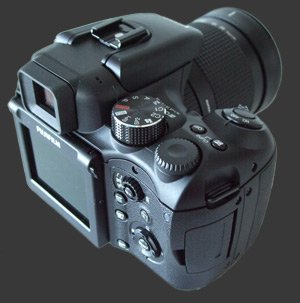
Exposure is also excellent with less need to use EC than most cameras. This is somewhat helped by the camera's expandable dynamic range too. As dynamic range is increased, the Fuji S100FS adds to highlight details more than to shadow details. Since the camera knows what the luminance distribution of the scene is like, at can choose the dynamic range automatically.
Color reproduction of the Fuji S100FS depends on the chosen film-simulation mode. In Provia mode, which is the default, colors are realistic but a bit undersaturated. In Velvia mode, you get bright and saturated colors. It is technically oversaturated but not overdone. Soft mode gives natural colors with less contrast and gives a slightly darker image overall.
Another great asset is the 14.3X stabilized optical zoom lens of the S100FS. It is exceptionally sharp throughout its focal length and degrades very little towards the corners. This lens starts at a bright F2.8 maximum aperture and diminishes slowly as it is zoomed in. It only drops to F4 past 200mm. At the telephoto end, the maximum aperture is F5.3 but that it at 400mm.
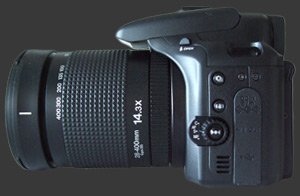
The problem with most Fuji lenses, including this one, is pronounced chromatic aberrations. This shows up as wider-than-average fringes of purple. On the other hand, although such aberrations are larger than with most cameras, they do occur less often. The expanded dynamic range probably helps because chromatic aberrations are found in areas of over-exposure which themselves occur less with the Fuji Finepix S100FS.
The performance of the Fuji S100FS is reasonable, but far from stellar. It turns on in about 3 seconds, which is average. Focus speeds are good, taking between 1/2 and 1s, on the telephoto end. This is not class leading as other ultra-zooms focus faster than the S100FS. Once pre-focused, shutter-lag is very short. In shooting mode, all controls respond instantly. Shot-to-shot speeds are about average for a high-end camera, about 2 seconds.
Entering and exiting playback mode is quite fast. Since this is a shooting-priority camera, it instantly goes back into shooting mode when pressing the shutter halfway. Although scrolling through images is fast, it takes about 1 second for the basic image info to appear. Pressing any button other than the left or right arrow while info is not displayed has no effect. This is the only aspect of this camera's performance which is slow. The S100FS uses a proprietary lithium-ion battery. The result is that battery-life is short for an ultra-zoom.
Fujifilm Finepix S100FS Conclusion
It is clear that the Fuji Finepix S100FS delivers superb results for a fixed-lens camera. Image noise is very low, dynamic range is outstanding, color is good, exposure is excellent and its lens is very sharp. This camera is also reasonably fast, without being the fastest though. This is a well-built camera with good ergonomics. The S100FS is also quite capable, with a mechanical lens and optical image stabilization, a complete set of manual controls and several unique features.
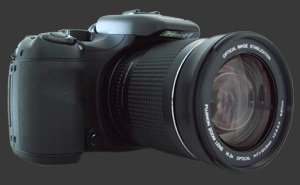
While it may not be perfect, there is little not to like about this camera other than the use of a small viewfinder and the use a lithium-ion battery. The dilemma with this model is that its size, weight and price makes it comparable to a DSLR. Some people even mistake it for a DSLR!
Thinking about the compromises between a DSLR and a fixed-lens camera in general, the core compromise is mainly image quality and speed vs size and price. With the Fuji Finepix S100FS, you get a fixed-lens camera at the price of an entry-level DSLR with a similar weight. Even though the image quality of the S100FS is superb, DSLRs still do better. The biggest gap though is in terms of speed. Even an entry-level DSLR is significantly faster than the Fuji S100FS. However, the S100FS has several advantages. The biggest advantage is its integrated lens which covers 28-400mm. A comparable SLR lens, such as the Pentax DA 18-250mm F3.5-6.3 is still half-a-stop slower and not as sharp, so you get better image noise but lose on details at some focal-lengths. Obviously, a DSLR can accommodate a set of high-quality lenses that will trump the S100FS but that adds much more cost and weight. Then there are other features common to fixed-lens cameras such as live-preview and a movie-mode.
 |


|

 1 - Capability2 - Usability3 - Performance
Please Support Neocamera
All information on Neocamera is provided free of charge yet running this website is a huge endeavor. Purchases made via affiliate links found throughout the site help keep it running and up-to-date. There is no additional cost to you, so please consider buying via these links to our affilates:




Thank you for your support!


Fujifilm S100FS Highlights
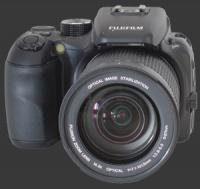


 Large digital camera
Sensor-Size: 9 x 7mm

Actual size when viewed at 100 DPI
| 11 Megapixels Ultra Zoom | ISO 100-3200 |
| 14.3X Mechanically Linked Wide Optical Zoom | Shutter 1/4000-30s |
| Built-in Stabilization | Full manual controls, including Manual Focus |
| 0.20" Built-in EVF 200K Pixels | Custom white-balance with 2 axis fine-tuning |
| 3 FPS Drive, 7 Images | Spot-Metering |
| 640x480 @ 30 FPS Video Recording | Hot-Shoe & Sync-Port |
| 2.5" LCD 230K Pixels | Lithium-Ion Battery |
| Secure Digital High Capacity, xD Internal Memory |
Camera Bag


Your camera bag is empty. To add a camera or lens click on the star next to its name.
Your camera bag is empty.
Add cameras or lenses by clicking on the star next to their name.
Updates
2026.05.21

Laowa 4.5-10mm F/2.8 Fisheye Zoom Lens Review
In-depth review of the Venus Optics Laowa 4.5-10mm F/2.8 Fisheye Zoom Lens. This lens zooms from a circular to rectangular fisheye with an 180° viewing angle. This review analyses its optical quality, construction and handling.
2026.04.13

Laowa 17mm F/4 Zero-D Shift Review
In-Depth review of the Venus Optics Laowa 17mm F/4 Zero-D Shift Lens. This ultra-wide Shift lens is specifically designed for Mirrorless Digital Cameras and is available in 4 Full-Frame mounts plus 2 Medium-Format ones.
2025.11.13

Best Gifts for Photographers in 2025 by Budget
The annual Neocamera Photography Gift Guide updated to 2025. Find great gifts for photographers with any price budget.
2025.07.07

Stellar Photo Recovery Review
Review of Stellar Photo Recovery V12. This Windows and MacOS software can recover photos and videos in a huge number of formats from memory cards, USB drives, SSDs and HHDs.
2025.05.14

Huion Kamvas 13 Gen 3 Review
In-Depth review of the Huion Kamvas 13 Gen 3 Pen Display Tablet for photographers and graphic artists.
2025.01.18

Fujifilm GFX 2025 Lens Roundup
Lens Review roundup of Fujifilm GFX Medium-Format lenses. Quality, performance and handling of the GF20-35mm F/4R WR, GF30mm F/3.5 Tilt-Shift and the GF55mm F/1.7.
2024.11.18

Best 2024 Photography Gifts for Every Budget
Great gifts for photographers and photo enthusiasts selected for every budget among the best products of 2024.
2024.08.07

Eye Protection Tips for Professional Photographers
The four main considerations for professional photographers regarding eyewear.
2024.07.14

Fujifilm X100VI Review
Flagship fixed-lens compact digital camera with a 40 MP sensor and Image-Stabilization, a first for the series. Retro design featuring dual control-dials, plus direct ISO, Shutter-Speed and EC dials. Its hybrid viewfinder can switch between EVF and OVF mode.
2024.05.09

Fujifilm GFX100 II Review
Flagship 102 Megapixels Medium-Format Mirrorless Digital Camera with 8-Stop 5-Axis IBIS, 8 FPS Drive, 8K Video and 400 MP Super-Resolution capture in a weatherproof and freezeproof body with dual control-dials and dual memory-card slots.
2024.04.03

Fujifilm X-T5 Review
Newest Fujifilm flagship boasting a 40 MP APS-C sensor, 5-axis IBIS with 7-stop efficiency, 15 FPS continuous drive, 6.2K Video capture, dual control-dials and dual SDXC UHS-II slots in a sturdy weatherproof and freezeproof body.
2023.11.20

Best Digital Cameras of 2023
Find out which are the Best Digital Cameras of 2023. All the new Mirrorless Digital Cameras from entry-level to high-end professional.
2026.05.21
2026.04.13
2025.11.13
2025.07.07
2025.05.14
2025.01.18
2024.11.18
2024.08.07
2024.07.14
2024.05.09
2024.04.03
2023.11.20