Camera Basics
 Camera Choosing
 Camera Models
 Camera Buying
 DSLR Buying

Fujifilm Finepix F80 EXR Review
 12 Megapixels
 Ultra-Zoom: At least 10X optical zoom.
 Stabilization: Compensates for tiny involuntary movements of the camera.
 720p HD Video: 1280 x 720 resolution or more but less than 1920 x 1080.
 Manual Controls: Both fully-manual (M) and semi-automatic modes (T and V).
 Custom White-Balance: Specifies exactly what should be white to the camera.
 Action Photography: Shutter speeds of 1/1500 or more.
 Night Photography: Reaches shutter-speeds longer than 4 seconds.
 Spot Metering
 Accepts Secure Digital High Capacity (SDHC) and SD memory.
 Neocamera detailed review
 Discontinued: No longer produced by the manufacturer. May still be in stock or found used.
 1 - Capability2 - Usability3 - Performance
Fujifilm Finepix F80 EXR Introduction
The Fuji Finepix F80 EXR introduces a more compact 12 megapixels EXR sensor compared to the F200EXR in order to provide a longer 10X optical zoom lens. The new sensor seems to be faster than before as it allows both 720p video-recording and a few clever multi-shot modes.
This ultra-compact digital camera is a sturdy ultra-zoom with advanced controls including Manual exposure, custom white-balance, control over dynamic range and noise using its special 3 mode EXR sensor which either produces a high-resolution image, a low-noise image or a high-dynamic range one. The low-noise and high-dynamic range modes produce 6 megapixels images which are suitable for the majority of common display and print sizes. Having up to 800% more dynamic range than conventional cameras lets the Fuji F80EXR capture scenes in much more circumstances than its non-EXR peers. Low light properties for this digital camera include a full-resolution sensitivity range of 100 to 1600 and an extended range up to 12800 at lower resolutions.
The Fuji Finepix F80 EXR's major features include:
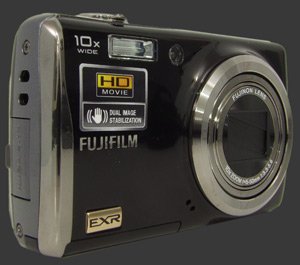
- 12 Megapixels SuperCCD EXR sensor.
- 6 Megapixels high-dynamic-range mode.
- 6 Megapixels low-noise mode.
- 10X wide-angle optical zoom, equivalent to 27-270 in 35mm terms.
- CCD-shift image stabilization.
- ISO 100 to 1600 at 12 megapixels, 3200 at 6 megapixels and 6400 to 12800 at 3 megapixels.
- Auto ISO with a maximum of 400, 800 or 1600.
- Automatic and manual dynamic-range, selectable between 100%, 200% or 400%
- Automatic dynamic-range expansion up to 800% in 6 megapixels high-dynamic-range mode.
- 1/2000-8s Shutter-speed range.
- Automatic, aperture-priority and manual exposure modes.
- Multi-segment, average, spot and face-detect metering.
- Exposure compensation -2..+2 stops in 1/3 EV increments.
- Automatic white-balance, preset white-balance and custom white-balance.
- Provia, Velvia, Astia, B&W and Sepia film-simulation modes.
- 1.6 FPS continuous shooting at 12 megapixels, keeps first or last 5 images.
- 4.2 FPS continuous shooting at 3 megapixels, keeps first or last 23 images.
- 2s or 10s self-timer.
- 1280x720 30 FPS 720p HDTV movie-mode.
- Built-in flash with auto, forced-on, forced-off, red-eye and slow-synchro modes.
- 3” LCD 230K Pixels.
- Lithium-ion battery operated.
- Supports SD-HC cards.
Fujifilm Finepix F80 EXR Suitability - What is it good for?
The Fuji F80 is a general-purpose camera suitable for typical travel and social photography. The wide-angle to telephoto 10X optical zoom lens offers a flexible range suitable for landscape, architecture, portraits and street photography. In addition to high-ISO capability of Fuji F-series cameras, the F80 EXR also works extremely well for outdoor scenes due to its sensor design which can capture a wide dynamic-range.
The full ISO range on this digital camera goes from 100 all the way to 12800. Only ISO 100 to 1600 are available at 12 megapixels. ISO 3200 is available at a very useful 6 megapixels and both 6400 and 12800 are available at the sufficient-for-small prints resolution of 3 megapixels. Note that very few cameras other than DSLRs produce usable images above 800, this is discussed on page 2. A complex interaction between various features means that not all combinations of ISO, dynamic-range, noise properties and modes are available, this is discussed at length further.
The Fuji F80 EXR is one of the first ultra-compacts to feature expanded dynamic range. This is achieved via a special sensor design which allows to read half of the photosites partway during the exposure. This is similar to the taking of multiple exposures for merging images into an HDR image. The difference being is that the full exposure taken exposes for the darkest scene details. When the sensor is read in this way the dynamic range goes to 800%, which equals 3 extra stops, but image resolution drops to 6 megapixels because one half of the photosites are used to complement the other half. Outside of this mode, this digital camera can control dynamic range between 100% and 400% by using clever processing while producing a full 12 megapixels image. Specifically, the F80 can retain 2 more stops of highlight details than what is usually possible. The trade-off is that the extra dynamic range is obtained by boosting sensitivity, therefore, this approach tends to increase noise in parts of the image.
With a shutter-speed range going from 1/2000s to 8s, the extremes of fast action and low-light do not get all covered, but most situations do. Social photography is the strong point of the Fuji F80 EXR with high-ISO and a wide-angle lens which make an ideal combination for indoor parties. Still, very low-light captures are possible as long as the F80 can be convinced to focus, given a maximum ISO of 12800 and shutter-speed of 8s.
The Fuji Finepix F80 is capable of dealing with a wide variety of lighting situations in terms of both color and contrast. With its automatic, preset and manual white-balance options, colors can be accurately captured in any situation. Flexible metering options, including spot-metering, allow the photographer to control how the F80 deals with unevenly-lit scenes. The Fuji F80 EXR is also equipped with several scene modes.
Three particular modes deserve to be mentioned: The natural light and flash takes two pictures of a scene, one with and one without flash. This saves time when not being certain which outcome would be better; the Pro-Low-Light mode shoots 4 images and combines them to simulate higher ISO while keeping noise relatively low compared to using the same ISO normally. In order to compensate for partial movement during capture, the field of view is reduced in this mode. Another mode is the Pro-Focus mode which combines 4 shots to make an image with increased background blur. Also kudos to Fuji for providing separate tripod and hand-held night photography modes.
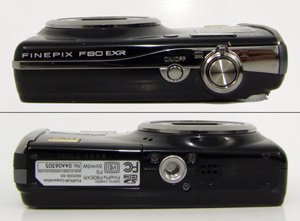
The other notable feature of the Fuji F80 EXR is a 720p HDTV 16:9 video mode. This records M-JPEG video at 1280x720 @ 30 FPS. Sound is recorded and, unlike the majority of ultra-compacts, the F80 can zoom and focus while filming.
The Fuji F80 automatically rotates images taken with the camera in portrait orientation, which is new to Fuji and it was about time. There is an extremely efficient system for manually rotating multiple images without exiting and re-entering the menu between each image.
This digital camera is also equipped with the very latest in face-detection. Face-detection is now quite common, particularly among small cameras. The basic principle is that the camera tries to recognize faces and sets the focus and exposure accordingly. Face-detection is quite effective and recognizes both front-facing and sideway-facing faces. Fuji uses face-detection during playback too so that users can verify that face-detection worked. In face-detect mode, the F80 EXR uses a special metering mode to keep faces well-exposed. The same system is used to remove red-eye during playback. The newest addition here is face-recognition which allows faces to be registered with the camera for identification during capture. It is not perfect as it does not recognize side-facing ones and strong facial expressions but does a long way. Even if a face is not recognized, the F80 EXR still detects it in most orientations.
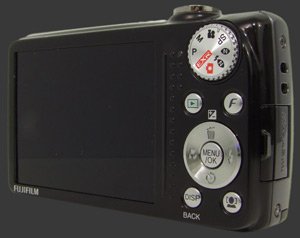
The Fuji Finepix F80 EXR looks almost exactly like the F200 and all buttons are in the same locations and use the same labels. The buttons and dials did get bigger and slightly easier to use. That being said, the way to operate the camera did change slightly and setting the self=timer and changing single settings such as ISO do take one extra button click now.
 |



 
|
 Next1 - Capability2 - Usability3 - Performance
Please Support Neocamera
All information on Neocamera is provided free of charge yet running this website is a huge endeavor. Purchases made via affiliate links found throughout the site help keep it running and up-to-date. There is no additional cost to you, so please consider buying via these links to our affilates:




Thank you for your support!


Fujifilm F80 EXR Highlights


 Ultra-Compact digital camera
Sensor-Size: 6 x 5mm

Actual size when viewed at 100 DPI
| 12 Megapixels Ultra Compact | ISO 100-1600 |
| 10X Wide Optical Zoom | Shutter 1/2000-8s |
| Built-in Stabilization | Full manual controls |
| 1.6 FPS Drive, 5 Images | Custom white-balance |
| 1280x720 @ 24 FPS Video Recording | Spot-Metering |
| 3" LCD 230K Pixels | Lithium-Ion Battery |
| Secure Digital High Capacity, Internal Memory |
Camera Bag


Your camera bag is empty. To add a camera or lens click on the star next to its name.
Your camera bag is empty.
Add cameras or lenses by clicking on the star next to their name.
Updates
2025.11.13

Best Gifts for Photographers in 2025 by Budget
The annual Neocamera Photography Gift Guide updated to 2025. Find great gifts for photographers with any price budget.
2025.07.07

Stellar Photo Recovery Review
Review of Stellar Photo Recovery V12. This Windows and MacOS software can recover photos and videos in a huge number of formats from memory cards, USB drives, SSDs and HHDs.
2025.05.14

Huion Kamvas 13 Gen 3 Review
In-Depth review of the Huion Kamvas 13 Gen 3 Pen Display Tablet for photographers and graphic artists.
2025.01.18

Fujifilm GFX 2025 Lens Roundup
Lens Review roundup of Fujifilm GFX Medium-Format lenses. Quality, performance and handling of the GF20-35mm F/4R WR, GF30mm F/3.5 Tilt-Shift and the GF55mm F/1.7.
2024.11.18

Best 2024 Photography Gifts for Every Budget
Great gifts for photographers and photo enthusiasts selected for every budget among the best products of 2024.
2024.08.07

Eye Protection Tips for Professional Photographers
The four main considerations for professional photographers regarding eyewear.
2024.07.14

Fujifilm X100VI Review
Flagship fixed-lens compact digital camera with a 40 MP sensor and Image-Stabilization, a first for the series. Retro design featuring dual control-dials, plus direct ISO, Shutter-Speed and EC dials. Its hybrid viewfinder can switch between EVF and OVF mode.
2024.05.09

Fujifilm GFX100 II Review
Flagship 102 Megapixels Medium-Format Mirrorless Digital Camera with 8-Stop 5-Axis IBIS, 8 FPS Drive, 8K Video and 400 MP Super-Resolution capture in a weatherproof and freezeproof body with dual control-dials and dual memory-card slots.
2024.04.03

Fujifilm X-T5 Review
Newest Fujifilm flagship boasting a 40 MP APS-C sensor, 5-axis IBIS with 7-stop efficiency, 15 FPS continuous drive, 6.2K Video capture, dual control-dials and dual SDXC UHS-II slots in a sturdy weatherproof and freezeproof body.
2023.11.20

Best Digital Cameras of 2023
Find out which are the Best Digital Cameras of 2023. All the new Mirrorless Digital Cameras from entry-level to high-end professional.
2023.07.10

Fujifilm X-H2 Review
40 Megapixels APS-C Hybrid Mirrorless Digital Camera with 7-stop IBIS. Fastest shutter ever and 8K video capture. Large builtin EVF with 0.8X magnification and 5.8 MP, plus an Eye-Start Sensor. Packed with features and large number of controls in a weatherproof and freezeproof body.
2023.05.07

Sony FE 20-70mm F/4G Review
Review of the unique Sony FE 20-70mm F/4G lens. The optical zoom of this lens spans ultra-wide-angle and medium focal-length coverage, making it one of the most versatile Full-Frame lenses on the market.
2025.11.13
2025.07.07
2025.05.14
2025.01.18
2024.11.18
2024.08.07
2024.07.14
2024.05.09
2024.04.03
2023.11.20
2023.07.10
2023.05.07