Camera Basics
 Camera Choosing
 Camera Models
 Camera Buying
 DSLR Buying

Fujifilm Finepix F80 EXR Review
 12 Megapixels
 Ultra-Zoom: At least 10X optical zoom.
 Stabilization: Compensates for tiny involuntary movements of the camera.
 720p HD Video: 1280 x 720 resolution or more but less than 1920 x 1080.
 Manual Controls: Both fully-manual (M) and semi-automatic modes (T and V).
 Custom White-Balance: Specifies exactly what should be white to the camera.
 Action Photography: Shutter speeds of 1/1500 or more.
 Night Photography: Reaches shutter-speeds longer than 4 seconds.
 Spot Metering
 Accepts Secure Digital High Capacity (SDHC) and SD memory.
 Neocamera detailed review
 Discontinued: No longer produced by the manufacturer. May still be in stock or found used.
 1 - Capability2 - Usability3 - Performance
Fujifilm Finepix F80 EXR Usability - How easy is it to use?
What keeps this digital camera secure is the supplied wrist-strap which has a tightening element. The camera itself does not have a grip whatsoever. Due to the large rear LCD and mode-dial, the F80 leaves no room on the rear for the thumb which unfortunately must rest on the mode-dial itself. This occasionally causes it to rotate out of its intended position.

The shutter-release and surrounding zoom controller are easy to use and very responsive. Photographs are taken nearly instantly and the lens zooms rapidly from one end of the zoom-range to the other. Also, all other buttons provide instant feedback, unless the camera is writing an image to memory which is indicated by an orange light.
Except for the power button, located near the combined shutter-release and zoom control, camera controls are located on the rear of the Fuji F80: a mode-dial, 4-way control and 4 buttons. Each of these controls is straight forward. Play enters Playback mode, F brings up the Finepix menu, Disp toggles the display mode and Face-toggles face-detection.
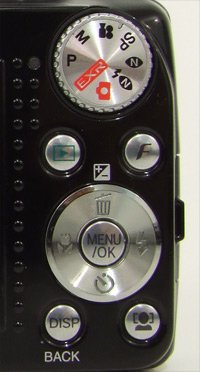 Directions on the 4-way controller are assigned a function: up for EC, right cycles through flash-modes, down cycles between self-timers (Off, 2s, 10s) and left toggles macro focusing. The central button is used to activate the menu system and to confirm menu-selection.
The Finepix menu has 3 options: ISO, image size and film-simulation. This is a smaller selection than the F200EXR has which unfortunately means the important white-balance, metering and dynamic-range options are slower to change as they require using the full-length menu system.
The mode-dial has 8 positions, choosing most modes therefore involves rotating the mode dial and selecting a specific mode using the menu system. The Fuji F80's headline mode, for example, EXR has 4 specific modes: Auto, HR, SN and DR. Auto selects both a scene-mode and a EXR-mode for each picture. The chosen mode is displayed when the shutter is pressed halfway.
The Fuji F80's capabilities are spread across various modes. This is where things get twisted, particularly in EXR mode. In non-EXR modes, the F80 normally uses its sensor's HR (high-resolution) mode, meaning that all photosites are read simultaneously and each one is turned into a pixel. In these modes, this Fuji can be set to output images at 12, 6 or 3 MP. The camera does not give any indication of which EXR mode is used below 12 megapixels. It does give some hints though by enabling a different set of dynamic-range options when the flash is off. It would be preferable if things were clearly shown.
P mode can be used as automatic or aperture priority. A menu option selects between the two. In both cases ISO can be set from 100 to 1600 at full-resolution and up to 12800 at lower-resolutions. Since the Fuji F80 does not actually have a physical aperture, it reduces light coming in by sliding a neutral-density filter. Therefore, changing aperture does not affect depth-of-field and that, only two aperture options exist. This is why there is an Aperture-priority mode but no Shutter-priority mode: there are too few aperture settings for the Fuji to allow the selection of arbitrary shutter-speeds. Because the Fuji Finepix F80 must expose for the brightest image area, all dynamic-range options are not always available. At ISO 100, only 100% dynamic-range can be used, at ISO 200 options for dynamic-range expand to 200%. Between ISO 400 and 3200, up to 400% dynamic range can be chosen. At ISO 6400 and 12800, only 100% dynamic range can be selected.
M mode, this time, is actually manual mode. This rare mode among ultra-compacts lets the photographer set aperture and shutter-speed independently, although the 2 aperture settings do not affect depth-of-field due to the lack of a physical aperture. Still, the Fuji F80EXR has an excellent exposure latitude considering ISO goes up to 12800 and shutter-speed up to 8s.
Auto, Natural Light and Natural Light & Flash are fully automatic modes that do not allow ISO, DR, WB or EC to be selected. Auto allows the ISO limit to be set between 400 and 1600. There are 18 scene modes available, all of them fully automatic as well. Movie-mode is straight-forwards, supporting 1280x720 30 30 FPS and 640x480 30 FPS.
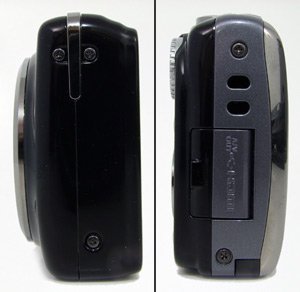
There being only one EXR mode seems like Fuji made it an after-thought in this camera's design, rather than a fully-present feature. The EXR mode has 4 sub-modes: Auto, HR (Resolution Priority), SN (High-ISO and Low Noise) and DR (Dynamic Range). Auto-EXR mode is as close to magic as any camera technology ever was. It takes full-control of the camera, including activating continuous-autofocus, scene-mode recognition, auto image size selection, face-detection and disabling EC, WB and ISO settings. Not only that, Auto-EXR drains the battery at super-speed. Still, image aspect ratio can be selected between 4:3, 3:2 and 16:9. Image quality, the self-timer and the flash-mode can be set.
HR mode is nearly identical to automatic P mode, the notable difference being that ISO is limited to 800 max. Resolution can be set to either 12, 6 or 3 megapixels with 4:3, 3:2 or 16:9 aspect ratio. It is not clear why 6MP HR mode would be any different than 6MP SN mode. SN mode limits resolution to 6 megapixels and ISO to 1600. It is still not clear why SN mode cannot use ISO 3200 to 12800, nor can dynamic-range be changed in HR and SN modes and it is fixed at 100% instead.
DR mode allows the selection of dynamic-range from 100% to 800%, which represents 3 extra stops beyond the F80's base dynamic-range. Resolution is limited to 6 megapixels and only automatic ISO settings (400 to 1600 max) can be selected. White-balance, exposure-compensation, macro mode and self-timers can be set as well. The Flash-mode is fixed to off though. Now, it is expected that expanded dynamic-range not be available at high-ISO due to high noise-levels, however it is too bad that DR mode is mutually exclusive with manual controls and that shutter-speeds slower than 1/4s are not achievable in this mode.
The full menu of the Fuji Finepix F80 is organized as a two menu systems, one for camera settings and one for setup options. The 3 ” LCD screen is excellent and the anti-reflective coating is among the best. Images on the screen are sharp and fluid.
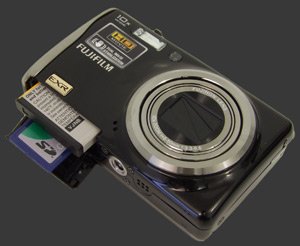
This camera is well constructed with a sturdy plastic body. Both battery and memory are found behind the compartment door. The battery is held in place with a latch so that it does not fall out while changing memory cards. Another nice touch is that the latch is colored yellow, as is one side of the battery to know which way to insert it. The Fuji Finepix F80 comes with a charger for its battery. This is better than in-camera charging which locks down the camera while a battery is being charged. The F80 drops support for xD cards and supports both SD and SDHC memory.
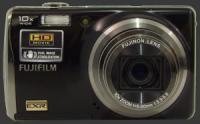 |



 
|

 Next1 - Capability2 - Usability3 - Performance
Please Support Neocamera
All information on Neocamera is provided free of charge yet running this website is a huge endeavor. Purchases made via affiliate links found throughout the site help keep it running and up-to-date. There is no additional cost to you, so please consider buying via these links to our affilates:




If you found any information on this site valuable and did not purchase via our affiliate links, please considering donating via PayPal:
Any amount will be greatly appreaciated. Thank you for your support!


Fujifilm F80 EXR Highlights


 Ultra-Compact digital camera
Sensor-Size: 6 x 5mm

Actual size when viewed at 100 DPI
| 12 Megapixels Ultra Compact | ISO 100-1600 |
| 10X Wide Optical Zoom | Shutter 1/2000-8s |
| Built-in Stabilization | Full manual controls |
| 1.6 FPS Drive, 5 Images | Custom white-balance |
| 1280x720 @ 24 FPS Video Recording | Spot-Metering |
| 3" LCD 230K Pixels | Lithium-Ion Battery |
| Secure Digital High Capacity, Internal Memory |
Camera Bag


Your camera bag is empty. To add a camera or lens click on the star next to its name.
Your camera bag is empty.
Add cameras or lenses by clicking on the star next to their name.
Updates
2024.04.03

Fujifilm X-T5 Review
Newest Fujifilm flagship boasting a 40 MP APS-C sensor, 5-axis IBIS with 7-stop efficiency, 15 FPS continuous drive, 6.2K Video capture, dual control-dials and dual SDXC UHS-II slots in a sturdy weatherproof and freezeproof body.
2023.11.20

Best Digital Cameras of 2023
Find out which are the Best Digital Cameras of 2023. All the new Mirrorless Digital Cameras from entry-level to high-end professional.
2023.07.10

Fujifilm X-H2 Review
40 Megapixels APS-C Hybrid Mirrorless Digital Camera with 7-stop IBIS. Fastest shutter ever and 8K video capture. Large builtin EVF with 0.8X magnification and 5.8 MP, plus an Eye-Start Sensor. Packed with features and large number of controls in a weatherproof and freezeproof body.
2023.05.07

Sony FE 20-70mm F/4G Review
Review of the unique Sony FE 20-70mm F/4G lens. The optical zoom of this lens spans ultra-wide-angle and medium focal-length coverage, making it one of the most versatile Full-Frame lenses on the market.
2023.01.15

Huion Inspiroy Dial 2 Review
Review of the Huion Inspiroy Dial 2 tablet, a medium sized drawing surface with dual dials and customizable buttons. Connects via USB-C or Bluetooth 5.0 with Windows, Linux and Android support.
2022.12.08

How to Pack for a Photo Trip
Find out how to pack for a travel photography trip, carry your gear safely while meeting airline regulations.
2022.11.13

Best Digital Cameras of 2022
The best digital cameras of 2022. A short list of the most outstanding models in their respective categories. Choose one for yourself or as a gift.
2022.09.21

Pentax DA* 60-250mm F/4 SDM Review
Review of the Pentax DA* 60-250mm F/4 SDM, the constant-aperture telephoto zoom with the highest zoom-ratio on the market.
2022.09.20

Pentax DA* 50-135mm F/2.8 SDM Review
Review of the Pentax DA* 50-135mm F/2.8 SDM, the lightest professional telephoto zoom native to the K-mount.
2022.09.10

Pentax DA* 11-18mm F/2.8 DC AW Review
Review of the Pentax DA* 11-18mm F/2.8 DC AW, the widest professional ultra-wide zoom native to the K-mount.
2021.11.24

50 Gifts Under $50 For Photographers in 2021
50 Gifts photographers will love. All for under $50 USD. 2021 Edition.
2021.11.17

Best Digital Cameras for 2021
Neocamera shows which are the very best Digital Cameras for 2021 in every category: Mirrorless, DSLR, Premium Compact, Ultra-Zoom and Rugged.
2024.04.03
2023.11.20
2023.07.10
2023.05.07
2023.01.15
2022.12.08
2022.11.13
2022.09.21
2022.09.20
2022.09.10
2021.11.24
2021.11.17