Camera Basics
 Camera Choosing
 Camera Models
 Camera Buying
 DSLR Buying

Fujifilm Finepix HS10 Review
 10 Megapixels
 Ultra-Zoom: At least 10X optical zoom.
 Electronic View Finder
 High ISO: ISO 6400 or more is available at full-resolution.
 Stabilization: Compensates for tiny involuntary movements of the camera.
 Continuous Drive
 Full 1080p HD Video: 1920 x 1080 resolution or more but less than 4K.
 Manual Controls: Both fully-manual (M) and semi-automatic modes (T and V).
 Custom White-Balance: Specifies exactly what should be white to the camera.
 Action Photography: Shutter speeds of 1/1500 or more.
 Night Photography: Reaches shutter-speeds longer than 4 seconds.
 Hotshoe: Allows external flash units to be attached.
 Spot Metering
 Runs on standard AA batteries
 Accepts Secure Digital High Capacity (SDHC) and SD memory.
 Neocamera detailed review
 Discontinued: No longer produced by the manufacturer. May still be in stock or found used.
 1 - Capability2 - Usability3 - Performance
Fujifilm Finepix HS10 Introduction


The Fuji Finepix HS10 is an SLR-styled ultra-zoom with the most versatile zoom range to date. It's 30X optical zoom has an amazing 24-720mm equivalent range, starting ultra-wide and reaching beyond most super-telephoto lenses. The lens is mechanically-linked for smooth, quick and precise control. Like most ultra-zooms of a similar form-factor, the HS10 has a complement of manual controls.
Internally, the HS10 shows a departure from traditional Fuji ultra-zooms, now using a BSI-CMOS sensor that allows for a number of features which require fast processing, no longer using their reputable SuperCCD.
These new CMOS-driven features include:
- Full 1080p HDVT video recording at 1920x1080 @ 30 FPS
- High-speed movie options from 60 to 1000 FPS
- 10 FPS Continuous drive
- Sweeping panorama
- Pro Low-Light
- Motion removal
- Multi-motion
The basic feature set includes:
- 10 Megapixels high-speed BSI-CMOS sensor
- ISO sensitivity ranging from 100 to 6400, all at full-resolution
- Mechanically-linked 30X stabilized optical zoom lens with electronic focus ring
- Shutter speeds from 1/4000s to 30s at base ISO, dropping by one stop for each ISO stop
- Selectable dynamic range from 100% to 400%
- Complete set of manual controls
- Hot-shoe for external flashes
Fujifilm Finepix HS10 Suitability - What is it good for?
The Fuji Finepix HS10 is defined by its unique lens. The huge range with built-in stabilization allows it to cover a range of photographic subjects like no other. Ultra-wide is perfect for architecture, sweeping landscapes, indoor shots and monuments. On the other extreme a reach of 720mm makes it suitable for wildlife and even birding. To reach a similar range on a DSLR would require the use of a lens weighing several kilos and costing in the thousands of dollars. Needless to say, all other photo applications are covered: portraits, street photography, sports and more.
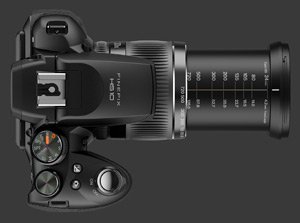
The mechanical-link allows smooth and quick framing of subjects. Notice that we did not say precise because the HS10 suffers from a cropped view-finder, so unlike the flagship S200EXR, framing is not so exact. Having no zoom motor not only saves energy, it also produces completely silent zooming while filming video.
The digital camera is designed for efficient access to its manual controls and offers a large number of buttons to directly control the camera without entering the menu. It is this kind of efficiency that makes it usable in a hurry.
High-speed features such as a 10 FPS drive mode and pre-capture makes it more usable that similar cameras for action. The low-light side of things is covered by its ISO 100 to 6400 range which is good for many uses. At the extreme of low-light, the HS10 stops being usable before its peers due to a slowest shutter-speed that is reduced by one stop for each ISO. At ISO 100, the HS10 can take 30s exposures, at ISO 200 it gets reduced to 15s, by ISO 6400 the limit is a paltry 1/2s. We suspect this is the case because the noise-characteristics of the CMOS sensor would ruin images otherwise.
Pictures from the HS10 can be printed nicely in sizes up to 16 "x12" thanks to 10 megapixels of resolution and a little too much smearing from noise-reduction at all ISO sensitivities. Near the wide-angle end, the camera can focus as close as 1 cm using super-macro mode. The Fuji HS10 also allows control over the dynamic range it captures. Possible options are 100%, 200% and 400%, although these are not available at all ISO settings and reduce image quality in shadow areas.
Both storage and power use the most convenient and readily available formats: SDHC for memory and most types of AA batteries for power. The power meter can be tuned to the specific type of battery in use and the HS10 can rejuvenate rechargeable batteries.
Fujifilm Finepix HS10 Capability - What can it do?
Beyond taking pictures in a large variety of conditions, it packs some useful and interesting features. Below is a list of its most useful features, followed by explanations, when required.
- Dynamic range: 100%, 200% and 400%.
- White-balance: Auto, 6 preset and custom, all fine-tunable in 7 steps on Red-Cyan and Blue-Yellow scales.
- Metering: multi-segment, spot and average.
- Focus control: single auto focus, continuous auto focus, manual focus.
- Auto focus modes: center, multi-pointCamera chooses a point to focus on, areaUser selects an area to focus on or tracking.
- Drive modes: single frame, first 7-frames, best-frame capture.
- Exposure compensation: +2 to -2 EV, in 1/3 stop increments.
- Flash compensation: -2/3..+2/3, 1/3 EV steps.
- Exposure bracket: 3 shots, 1/3, 2/3 or 1 EV steps.
- Flash modes: auto, on, off, slow-sync.
- Face detection with or without redeye removal.
- Photography modes: fully automatic, program automatic, shutter priority, aperture priority, manual, custom, 19 scene-modes and sweeping panorama.
- Color, tone and sharpness each adjustable in 3 steps.
- Other: Auto exposure lock or toggle and focus check.
The Fuji Finepix HS10 offers adjustable dynamic range using something often called highlight-correction. The magic happens using the camera's processor rather than a special sensor design as with the EXR models. At ISO 100, only a normal dynamic range is obtainable, at ISO 200 once can boost the DR to 200% and at ISO 400 and above, up to 400% DR can be captured. This gives two more stops of highlight headroom.
Color is controllable using traditional color (saturation), tone (contrast) and sharpness parameters. There are only 3 steps on each scale, so flexibility is limited. The overall color can be adjusted between normal, chrome (very vivid), black-and-white and sepia. White-balance is very flexible on the other hand.
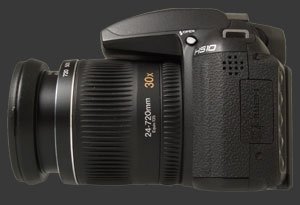
Best-frame-capture is a sophisticated mode to capture an ideal frame from continuous action. It starts working as soon as the shutter is pressed halfway, continuously capturing images of which only a few are stored, then adding more images after the shutter is fully pressed. The speed at which it does this is controllable between 3 and 10 FPS and number of before and after frames is selectable, as long as the total is 7 images. So one can get 5 images before, 1 image during and 1 image after or 3 images before, 1 during and 3 after, or any other combination which adds up to 7. There is a noticeable lag in this and the continuous drive mode but it is much better than with most fixed-lens cameras. At least the display mostly keeps up.
The 19 scene modes are divided into a set of 16 and a set of 3. Any of the 16 can be accessed by any of the to SP positions on the mode-dial. The other 3 are called, Advanced Scene Modes: Pro Low-Light, Multi Motion and Motion Remover. Pro Low-Light takes 4 images to combine them into one image with reduced noise. This is similar to what image software call stacking. The two remaining advanced modes limit image resolution to 5 megapixels. Multi-Motion takes 5 images during 1/2 to 20 seconds. The result is similar to multiple exposure but with a mask for the background. So anything that moves appears multiple times and the background looks as if it was exposed once. The Motion-Remover mode uses the same principle, except that it tries to removing any moving subjects by combining parts of a burst of images.
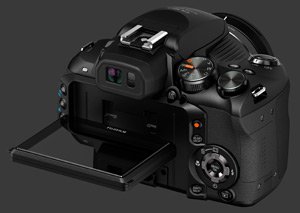
The sweeping panorama mode is designed to capture a panorama continuously in any direction. The output is limited to 720 pixels in landscape orientation and 1280 pixels wide in portrait mode, in the shortest dimension. In practice, this mode is extremely difficult to use since it requires steadiness and smooth panning. Most times it seems to fail for an unknown reason and, even when it does produce a panorama, artifacts are obvious.
The AE-L button either locks the exposure while it is pressed or sets it until it is pressed again. The Focus-Check button magnifies the center of the live-preview, to facilitate manual focusing or validating the auto-focus. While the display has improved compared to previous models, neither the LCD nor EVF is precise enough to make this entirely accurate.
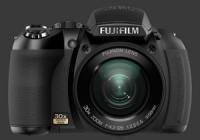 |



 
|
 Next1 - Capability2 - Usability3 - Performance
Please Support Neocamera
All information on Neocamera is provided free of charge yet running this website is a huge endeavor. Purchases made via affiliate links found throughout the site help keep it running and up-to-date. There is no additional cost to you, so please consider buying via these links to our affilates:




Thank you for your support!


Fujifilm HS10 Highlights


 Large digital camera
Sensor-Size: 6 x 5mm

Actual size when viewed at 100 DPI
| 10 Megapixels Ultra Zoom | ISO 100-6400 |
| 30X Mechanically Linked Ultra-Wide Optical Zoom | Shutter 1/4000-30s |
| Built-in Stabilization | Full manual controls, including Manual Focus |
| 0.20" Built-in EVF 200K Pixels | Custom white-balance with 2 axis fine-tuning |
| Automatic Eye-Start sensor | Spot-Metering |
| 10 FPS Drive, 7 Images | Hot-Shoe |
| 1920x1080 @ 30 FPS Video Recording | Standard AA Battery |
| 3" LCD 230K Pixels | Secure Digital High Capacity, Internal Memory |
Camera Bag


Your camera bag is empty. To add a camera or lens click on the star next to its name.
Your camera bag is empty.
Add cameras or lenses by clicking on the star next to their name.
Updates
2026.09.08

The Wild Magic of Iceland Book Review
Review of The Wild Magic of Iceland by Norris Niman. A photographic journey through seasons.
2026.07.31

ZY Optics Pittura 30mm F/2.4 Medium-Format Lens Review
The ZY Optics Pittura 30mm F/2.4 is a manual lens designed exclusively for Medium-Format Digital Cameras. This fast prime lens captures a wide field-of-view, equivalent to a 24mm on Full-Frame. It is am affordable alternative to first-part GFX and XCD lenses.
2026.07.26

Fujifilm GFX100S II Review
Express review of the Fujifilm GFX100S II. This 102 MP Medium-Format Mirrorless Digital Camera packs an 5-Axis 8-Stop IBIS and a 5.8 MP 0.5" EVF showing 100% coverage at an extra-large 0.84X magnification. It is a more compact version of the flagship GFX100 II. This review covers exactly how these camera compare.
2026.07.14

Sony Alpha A7R VI Review
Extended In-Depth Review of the Sony Alpha A7R VI. This flagship Full-Frame Mirrorless Digital Camera combines ultra-high 67 MP resolution with very fast 30 FPS continuous shooting. It packs a 5-axis 8½-stop IBIS mechanism and an ultra-sensitive 759-Point Phase-Detect AF system. Its incredibly sharp 9.4 MP 0.64" EVF has a huge 0.9X magnification, 100% coverage, 10-bit HDR and 100% DCI-P3 color-space. Captures 8K video at 30 FPS or 4K video at 120 FPS.
2026.05.21

Laowa 4.5-10mm F/2.8 Fisheye Zoom Lens Review
In-depth review of the Venus Optics Laowa 4.5-10mm F/2.8 Fisheye Zoom Lens. This lens zooms from a circular to rectangular fisheye with an 180° viewing angle. This review analyses its optical quality, construction and handling.
2026.04.13

Laowa 17mm F/4 Zero-D Shift Review
In-Depth review of the Venus Optics Laowa 17mm F/4 Zero-D Shift Lens. This ultra-wide Shift lens is specifically designed for Mirrorless Digital Cameras and is available in 4 Full-Frame mounts plus 2 Medium-Format ones.
2025.11.13

Best Gifts for Photographers in 2025 by Budget
The annual Neocamera Photography Gift Guide updated to 2025. Find great gifts for photographers with any price budget.
2025.07.07

Stellar Photo Recovery Review
Review of Stellar Photo Recovery V12. This Windows and MacOS software can recover photos and videos in a huge number of formats from memory cards, USB drives, SSDs and HHDs.
2025.05.14

Huion Kamvas 13 Gen 3 Review
In-Depth review of the Huion Kamvas 13 Gen 3 Pen Display Tablet for photographers and graphic artists.
2025.01.18

Fujifilm GFX 2025 Lens Roundup
Lens Review roundup of Fujifilm GFX Medium-Format lenses. Quality, performance and handling of the GF20-35mm F/4R WR, GF30mm F/3.5 Tilt-Shift and the GF55mm F/1.7.
2024.11.18

Best 2024 Photography Gifts for Every Budget
Great gifts for photographers and photo enthusiasts selected for every budget among the best products of 2024.
2024.08.07

Eye Protection Tips for Professional Photographers
The four main considerations for professional photographers regarding eyewear.
2026.09.08
2026.07.31
2026.07.26
2026.07.14
2026.05.21
2026.04.13
2025.11.13
2025.07.07
2025.05.14
2025.01.18
2024.11.18
2024.08.07