Camera Basics
 Camera Choosing
 Camera Models
 Camera Buying
 DSLR Buying

Nikon Coolpix P310 Review
 16 Megapixels
 Stabilization: Compensates for tiny involuntary movements of the camera.
 Continuous Drive
 Full 1080p HD Video: 1920 x 1080 resolution or more but less than 4K.
 Manual Controls: Both fully-manual (M) and semi-automatic modes (T and V).
 Custom White-Balance: Specifies exactly what should be white to the camera.
 Action Photography: Shutter speeds of 1/1500 or more.
 Accepts Secure Digital Extended Capacity (SDXC), SDHC and SD memory.
 Neocamera detailed review
 Discontinued: No longer produced by the manufacturer. May still be in stock or found used.
 1 - Capability2 - Usability3 - Performance
Nikon Coolpix P310 Performance - How well does it take pictures?
Performance starts with image quality, which is the criteria used as the foundation of our digital camera ratings. Ergonomic issues may get in the way, but in the end, image quality counts the most. The Nikon Coolpix P310 does quite well in this respect. Image noise appears at all sensitivities but does not considerably impact details until ISO 800. Sharpness is well maintained as ISO increases, indicating gentle noise-reduction is applied on the BSI-CMOS sensor's output.
In absolute terms, this particular model is behind some top compact digital cameras. However, its ultra-bright F/1.8 lens allows it to use at least one ISO stop less than most cameras under the same circumstances. This compensates for the higher sensor-noise. ISO 100 to 400 images can be printed up to 16x12" with beautiful results. ISO 800 can make nice 9x12" prints. Maximum print sizes drop after that but small prints are possible until ISO 3200.
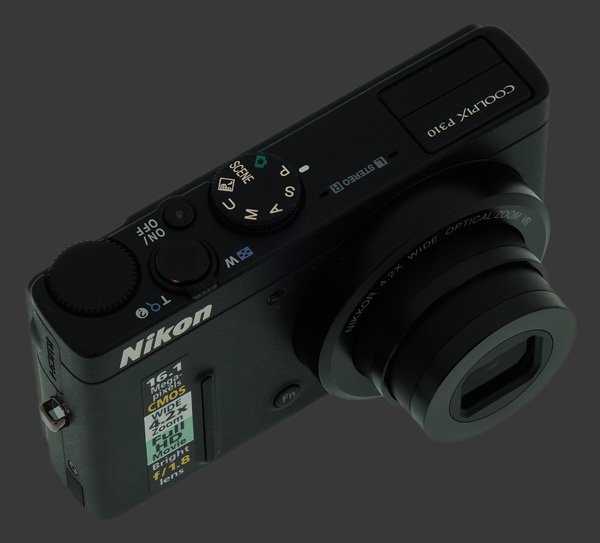
The dynamic range of this digital camera is similar to most cameras in its class, save for those equipped with Fuji's SuperCCD EXR sensor which have an edge for outdoor photography where sunlight can cause extremely contrast. The general solution for photography of outdoor scenery is to wait for the right time, around dusk and dawn, when light balances out and produces scenes of much lower contrast. Metering of the Coolpix P310 is rather good. As usual, dark subjects can occasionally cause over-exposure and low-contrast ones can cause under-exposure. Even so, it rarely missed by much.
The 4.2X optical zoom lens is extremely compact considering its bright maxim aperture. Even at its longest length, which is the widest focal-length, the lens protrudes by less than one inch from its barrel. This lens is very sharp in its center with strong corner softness wide open, improving slowly when stopped down passed F/2.8. One stop further, corner softness is very limited. A pleasant surprise is that the P310 does not show any vignetting, which is typically seen in bright wide-angle lenses. Distortion is not noticeable either.
The Nikon Coolpix P310 only has one control over colors, Saturation which is adjustable in 7 steps. The default middle Saturation value of the Standard Picture-Style provides the best color accuracy. There are also 7 steps of Contrast and Sharpness. Nicer images are made by incrementing both by one step over their respective default settings.
Automatic White-Balance performance is impressive, handling outdoor and indoor lighting without trouble. The preset white-balance options are also good but rarely needed due to the excellent AWB. Under difficult lighting, custom white-balance must be used which gives perfectly neutral results.

The high-speed CMOS sensor of the Nikon Coolpix P310 is but to good use with plenty of multi-frame features, including noise-reduction, Easy Panorama, HDR and 7 FPS continuous shooting. Shots are all taken in very quick succession, up to a maximum of 7 FPS at full-resolution and 120 FPS at VGA resolution if shutter-speeds allow it. The internal memory buffer can accumulate up to five images of 16 megapixels which it then sends to the flash card at a moderate pace, about 6s per full burst.
The Nikon Coolpix P310 is more responsive than its predecessor and larger more-expensive sibling, the Nikon Coolpix P7100
Nikon Coolpix P7100. It performs respectably well and the interface reacts quickly to button presses and dial turns.
The performance of this compact digital camera is characterized by the following measurements:
- Power On: 1½s. Good for camera with retracting lens. It takes this long because the power button must be held down for a short while.
- Autofocus: ½s in moderate to good light. Up to 1s in low-light. Above average but clearly improved from the P300. Low-light slows things down but in well lit conditions, the P310 locks focus swiftly.
- Zoom: Under 2s from widest to longest. Good for an electronic zoom but not terrible impressive since there is only a 4X range.
- Image Shutter-Lag: Quick but noticeable. Definitely good.
- Video Shutter-Lag: 2s. Glacial. The most troublesome area. This is most likely due to the lack of a video mode again which means the camera does not know when to make itself ready to record. This is also the same reason, there is no way to setup video framing.
- Black Out: ¾s. Average but makes it hard to follow moving subjects.
- Shot-to-Shot speed: 2s. Average. At this speed with a class 10 or better SDHC card, the internal buffer does not fill up.
- Time-to-first shot: 2s. Excellent considering most of that time is spend powering on. Slows down if the zoom memory option is enabled in the Setup menu.
- Playback: ¾s to enter and ½s to exit, assuming the lens is still extended. Average.
- Power Off: ¾s. Great good for camera with retracting lens. This is from wide-angle. It takes longer with the lens zoomed in.
Battery-life is quoted at 230 shots-per-charge which is below average for a modern digital camera. It can easily be sufficient for a day of shooting. Since the battery charges in-camera though, keeping a spare always charged is unfortunately tedious.
Nikon Coolpix P310 Conclusion
The Nikon Coolpix P310 is a truly small compact digital camera with efficient photographic controls. It delivers excellent results thanks to an ultra-bright F/1.8 lens which lets it photograph the same scene at lower a ISO than most other cameras. The ultra-wide angle optical zoom lens starting at 24mm makes it a great compact for architecture and indoor photography. The BSI-CMOS sensor is put to good use and provides well-rounded video capabilities, including full 1080p HD video with stereo sound.
Image quality is good, even without counting the advantage provided by the lens. Color accuracy and white-balance are robust and metering is very reliable. Outside of some corner softness which gets pronounced at wide apertures, the lens delivers good sharpness with no visible vignetting and distortion. Camera controls are very responsive and operating speed is above average. Autofocus speeds are also greatly improved although not to levels needed for action photography.
The interface has a small number of imperfections but notable problems are limited to the lack of an exposure-priority display and accurate histogram as well as the lack of a dedicated video mode. This makes HD video framing impossible to setup and is the most likely cause of a 2 second video-recording delay.
 |



 
|

 1 - Capability2 - Usability3 - Performance
Please Support Neocamera
All information on Neocamera is provided free of charge yet running this website is a huge endeavor. Purchases made via affiliate links found throughout the site help keep it running and up-to-date. There is no additional cost to you, so please consider buying via these links to our affilates:





If you found any information on this site valuable and did not purchase via our affiliate links, please considering donating via PayPal:
Any amount will be greatly appreaciated. Thank you for your support!


Nikon P310 Highlights


 Compact digital camera
Sensor-Size: 6 x 5mm

Actual size when viewed at 100 DPI
| 16 Megapixels Fixed Lens | ISO 100-6400 |
| 4.2X Ultra-Wide Optical Zoom | Shutter 1/2000-4s |
| Built-in Stabilization | Full manual controls |
| 7 FPS Drive, 5 Images | Custom white-balance |
| 1920x1080 @ 30 FPS Video Recording | Lithium-Ion Battery |
| 3" LCD 920K Pixels | Secure Digital Extended Capacity, Internal Memory |
Camera Bag


Your camera bag is empty. To add a camera or lens click on the star next to its name.
Your camera bag is empty.
Add cameras or lenses by clicking on the star next to their name.
Updates
2024.04.03

Fujifilm X-T5 Review
Newest Fujifilm flagship boasting a 40 MP APS-C sensor, 5-axis IBIS with 7-stop efficiency, 15 FPS continuous drive, 6.2K Video capture, dual control-dials and dual SDXC UHS-II slots in a sturdy weatherproof and freezeproof body.
2023.11.20

Best Digital Cameras of 2023
Find out which are the Best Digital Cameras of 2023. All the new Mirrorless Digital Cameras from entry-level to high-end professional.
2023.07.10

Fujifilm X-H2 Review
40 Megapixels APS-C Hybrid Mirrorless Digital Camera with 7-stop IBIS. Fastest shutter ever and 8K video capture. Large builtin EVF with 0.8X magnification and 5.8 MP, plus an Eye-Start Sensor. Packed with features and large number of controls in a weatherproof and freezeproof body.
2023.05.07

Sony FE 20-70mm F/4G Review
Review of the unique Sony FE 20-70mm F/4G lens. The optical zoom of this lens spans ultra-wide-angle and medium focal-length coverage, making it one of the most versatile Full-Frame lenses on the market.
2023.01.15

Huion Inspiroy Dial 2 Review
Review of the Huion Inspiroy Dial 2 tablet, a medium sized drawing surface with dual dials and customizable buttons. Connects via USB-C or Bluetooth 5.0 with Windows, Linux and Android support.
2022.12.08

How to Pack for a Photo Trip
Find out how to pack for a travel photography trip, carry your gear safely while meeting airline regulations.
2022.11.13

Best Digital Cameras of 2022
The best digital cameras of 2022. A short list of the most outstanding models in their respective categories. Choose one for yourself or as a gift.
2022.09.21

Pentax DA* 60-250mm F/4 SDM Review
Review of the Pentax DA* 60-250mm F/4 SDM, the constant-aperture telephoto zoom with the highest zoom-ratio on the market.
2022.09.20

Pentax DA* 50-135mm F/2.8 SDM Review
Review of the Pentax DA* 50-135mm F/2.8 SDM, the lightest professional telephoto zoom native to the K-mount.
2022.09.10

Pentax DA* 11-18mm F/2.8 DC AW Review
Review of the Pentax DA* 11-18mm F/2.8 DC AW, the widest professional ultra-wide zoom native to the K-mount.
2021.11.24

50 Gifts Under $50 For Photographers in 2021
50 Gifts photographers will love. All for under $50 USD. 2021 Edition.
2021.11.17

Best Digital Cameras for 2021
Neocamera shows which are the very best Digital Cameras for 2021 in every category: Mirrorless, DSLR, Premium Compact, Ultra-Zoom and Rugged.
2024.04.03
2023.11.20
2023.07.10
2023.05.07
2023.01.15
2022.12.08
2022.11.13
2022.09.21
2022.09.20
2022.09.10
2021.11.24
2021.11.17