Camera Basics
 Camera Choosing
 Camera Models
 Camera Buying
 DSLR Buying

Nikon D5100 Review
 16 Megapixels
 Single Lens Reflex
 High ISO: ISO 6400 or more is available at full-resolution.
 Continuous Drive
 Full 1080p HD Video: 1920 x 1080 resolution or more but less than 4K.
 Manual Controls: Both fully-manual (M) and semi-automatic modes (T and V).
 Custom White-Balance: Specifies exactly what should be white to the camera.
 Action Photography: Shutter speeds of 1/1500 or more.
 Night Photography: Reaches shutter-speeds longer than 4 seconds.
 Hotshoe: Allows external flash units to be attached.
 Spot Metering
 Accepts Secure Digital Extended Capacity (SDXC), SDHC and SD memory.
 Neocamera detailed review
 Discontinued: No longer produced by the manufacturer. May still be in stock or found used.
 1 - Capability2 - Usability3 - Performance
Nikon D5100 Introduction
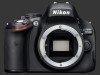

The Nikon D5100 is an upper-entry-level DSLR with a state-of-the-art 16 megapixels CMOS sensor capable of ISO sensitivities from 100 to 25600, plus 2 extra stops for NightVision, and full 1080p HD video recording. It has an electronic-only lens-mount and most features usually found among entry-level digital SLRs.
The D5100 is targeted at novice photographers who want top image-quality in an affordable camera with a simple interface. Since most such people are likely to be upgrading from fixed-lens cameras which can record videos, this DSLR is equipped with the latest video-recording advancements, including continuous autofocus and external stereo sound input.
This detailed digital camera review takes a close look at the Nikon D5100's features, ergonomics, usability, image quality, performance, photographic controls and video recording features.
Nikon D5100 Major Features
- 16 Megapixels image sensor, 1.5X crop-factor.
- Standard ISO range from 100 to 6400
- Expanded ISO 12800 and 25600
- NightVision B&W mode up to ISO 102400
- 1/4000s to 30s shutter-speeds, plus bulb mode
- Multi-segment, center-weighed and spot metering modes
- Standard PASM exposure modes, with Program-Shift
- Fully automatic mode and 16 additional scene modes
- Exposure-Compensation: ±5 EV in 1/3 or 1/2 EV steps
- Flash-Compensation: -3..+1 in 1/3 or 1/2 EV steps
- Normal, redeye, slow, slow with redeye and rear-curtain sync flash modes
- Automatic and preset white-balance, all fine-tunable along 2 axis in 13 steps
- 7 sub-types of fluorescent white-balanceSodium-Vapor, Warm White, White, Cool White, Day White, Daylight and Mercury Vapor.
- Custom white-balance using immediate capture or reference image
- Customizable sharpness, contrast, brightness, saturation and hue
- Single-shot, continuous and manual focus drives
- AE Bracketing, 3 frames, maximum ±2 EV
- 11-point phase-detect autofocus system
- 4 FPS continuous drive, maximum 100 frames
- Self-Timer: 2, 5, 10 or 20s delay, 1-9 frames
- 1920x1080 @ 30 FPS 1080p HD video capture
- Contrast-Detect autofocus while filming
- Internal mono microphone
- Stereo sound input mini-jack
- Partial Live-View with Subject Tracking and Face-Detect autofocus
- Rotating 3” LCD with 920K Pixels
- 95% coverage viewfinder with 0.78X magnification
- Built-in flash and hot-shoe
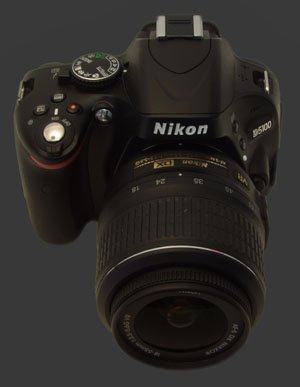
Features, continued:
- Auto-Exposure/Auto-Focus Lock button, selectable AEL & AFL, AEL, AFL, AEL Hold and AF On function
- Customizable function button
- JPEG and RAW modes
- Rangefinder manual focus assist
- Adaptive D-Lighting
- Built-in HDR capture
- Multiple-Exposure, 2-3 shots
- WB & Adaptive D-Light virtual bracketing
- Optional distortion correction
- Hardware dust-reduction
- Lithium-ion battery
- SDXC Memory support
While the D5100 is similar in ergonomics and features to the D3100, Nikon keeps playing with the design and feature set, so this review is substantially different. Still, it shows that these two cameras have the same basic design, although we can certainly say the D3100 has better ergonomics.
Nikon D5100 Suitability - What is it good for?
The Nikon D5100 is a simple and versatile DSLR due to a wide selection of lenses, extensive ISO range and full manual controls. It is quite suitable for most types of photographic subjects, although not ideal for action photography due to its limited speed continuous-drive. The Nikon D5100 is fully compatible with Nikon lenses with built-in focus-motors and Nikon Speedlights. See Nikon and third-party lenses with built-in super-sonic motors to view compatible models.
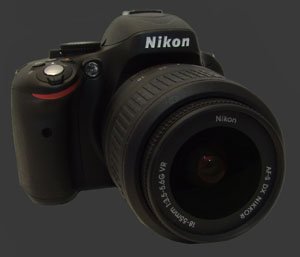 This DSLR can record 1080p HD video with stereo sound when using an external microphone. Nikon coincidently sells the ME-1 hot-shoe mounted unidirectional microphone to that effect. Like both the lower-end D3100 reviewed here and higher-end D7000 review here, this digital SLR can autofocus continuously while filming using contrast-detection.
For specific photographic subjects, lens versatility is key and the Nikon lens lineup covers a wide variety of focal-lengths from the ultra-wide to super telephoto. Most third-party manufacturers produce lenses for Nikon mounts too. Keep in mind that an internal focus motor is required for autofocus with the D5100, so not all lenses which fit work completely. With Nikon, image stabilization is provided by VR (Vibration Reduction) which is not available on all lenses.
Being one of the smallest DSLRs currently available, the D5100 brings more discretion than is afforded by a typical SLR. While this is a feature that professionals can appreciate, the D5100 is not made for efficiency and requires more button pressed and trips through the many system them most DSLR cameras.
Nikon D5100 Capability - What can it do?
As noted in the introduction, the Nikon D5100 has all basic DSLR capabilities, including spot metering and AEB. It also has a built-in dust-reduction mechanism which is now standard on all non-Sigma DSLRs. This Nikon DSLR features a lens mount with no mechanical coupling for driving auto focus lenses without a built-in motor.
This limits the D5100's choice of lenses to recent Nikon and third-party offerings. Lenses using a mechanical coupling still work but only in Manual Focus mode. The D5100 includes a Rangefinder to help focus manually. This mode swaps the exposure indicator in the viewfinder with a focus direction indicator.
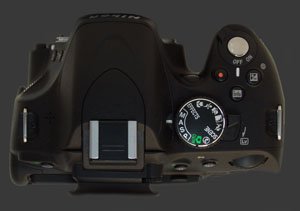
The Nikon D5100's rotating power-switch surrounds the shutter-release and works in the most obvious way. The shutter-release on this DSLR is a standard 2-stage release with a distinct halfway point. Pressing the shutter-release halfway normally locks focus and exposure but an option allows to disable exposure-locking.
There is also a combined AE-L/AF-L button which can be set to lock both exposure and focus, to lock either focus or exposure, to lock and hold exposure or to activate the auto focus Setting this button to trigger auto focus has the unexpected side-effect of disabling AF activation when pressing the shutter-release halfway. For people who like to lock focus and exposure independently and to lock both without changing settings, you must set the AE-L/AF-L function to AE-L Only and lock exposure first when desired.
Exposure modes on the Nikon D5100 are controlled by a typical mode-dial. The available modes include the four ubiquitous exposure modes: program (P), shutter-priority (S), aperture-priority (A) and full manual (M) mode. In Manual mode, the shutter-speed selection includes a Bulb mode that keeps the shutter open as long as the shutter-release is pressed. The mode-dial also includes a fully Auto mode, six direct scene modes, one extended scene mode and an effects position.
The Auto mode almost completely automatic. Specifically, only 3 flash modes are available and focus modes are limited to AF-A and MF. Auto mode disables ISO settings, white-balance, exposure-compensation, flash-compensation, program-shift, metering options and image parameters.
The Auto-ISO behavior of the D3100 is a little strange, except in Auto mode where it behaves as usual. Users normally select between Auto and a set sensitivity. The camera then honors the selected ISO or, in the case of Auto-ISO, selects an appropriate ISO for the subject. With the D5100, normal exposure modes require that a specific ISO to be chosen. The selected ISO is honored when the Auto ISO option is set to OFF in the Camera Settings menu. Otherwise, the selected ISO becomes the default and the camera is free to choose a different ISO.
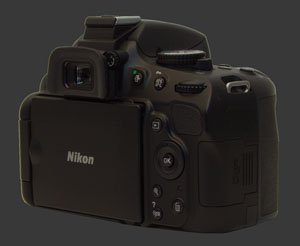

The Nikon D3100 has detailed control over white-balance including automatic white-balance, preset white-balanceIncandescent, Fluorescent, Sunlight, Flash, Cloudy and Shade., and custom white-balance. All white-balance options except custom white-balance can be fine-tuned in 13-steps from magenta to green and blue to amber. There is a single custom white-balance register which can be set by taking a picture of a white object or by using an existing picture as reference.
Exposure compensation can be adjusted ±5 using the EC button combined with the command dial. This ties for the most latitude among digital cameras. Contrarily to its predecessors, the Nikon D5100 supports 1/3 and 1/2 EV increments which are used for aperture, shutter-speed, EC, FC and bracketing steps. ISO always advanced in 1/3 EV steps though.
Diagonal from the EC button is the Info button. This one normally invokes or dismisses the status screen which also appears when touching certain buttons like EC. This is unfortunate since it adds glare right bellow your eye when composing a photograph. In Live-View mode, the Info button cycles through different display modes.
The Status screen is read-only, although an extremely similar screen appears when pressing the [I] button twice. This makes Info mostly redundant since the [I] button shows the status screen after one press. It also shows an editable display with the same information on the second press! It would be preferable if the Info button would be used by something more useful like ISO, WB or Drive-Mode.
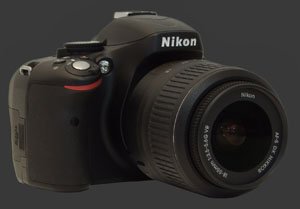
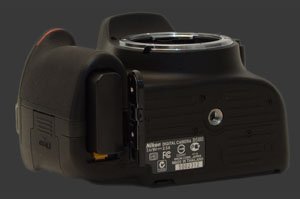
Active D-Lighting is Nikon's automatic image contrast correction feature. This feature brightens darker areas to produce a less contrasty image. For high contrast scenes this can produce an image with more detail while increasing noise in shadow areas. Low contrast scenes are unaffected by D-Lighting. Medium contrast scenes are a little hit-or-miss with Active D-Lighting because they can lose their punch when the contrast is reduced.
Drive modes on the D5100 are selected via the menu system or editable status screen. This is the biggest step backwards compared to the D3100, which has a hardware lever for this, and makes it particularly inefficient when shooting from a tripod since the self-timer resets itself after each use.
This digital SLR offers the standard Single-Shot and Continuous drive modes, plus a highly flexible self-timer, 2s Delayed Remote, Quick-Response Remote and Quiet Shutter-Release. In continuous drive mode, the Nikon D5100 can shoot up to 100 JPEG images or 16 RAW files at 4 FPS. The self-timer has a customizable delay of 2s, 5s, 10s or 20s and can fire between 1 and 9 shots. Quiet-Shutter slows down the mirror and only lets it return into position when the shutter is released.
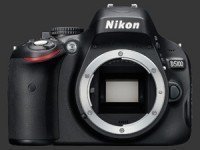
The Nikon D3100 supports JPEG and RAW images. JPEG images are available in 3 quality levels. There are also 3 image sizes available. A combined JPEG+RAW mode is also available. The image sensor is protected by a moving plate which serves to shake off dust, reducing its accumulation. While we have not measured its efficiency, these systems are generally not 100% effective and they only remove light dust-particles. Any stuck particle requires manual cleaning.
 |



 
|
 Next1 - Capability2 - Usability3 - Performance
Please Support Neocamera
All information on Neocamera is provided free of charge yet running this website is a huge endeavor. Purchases made via affiliate links found throughout the site help keep it running and up-to-date. There is no additional cost to you, so please consider buying via these links to our affilates:




Thank you for your support!


Nikon D5100 Highlights


 SLR digital camera
Sensor-Size: 24 x 16mm

Actual size when viewed at 100 DPI
| 16 Megapixels DSLR | ISO 100-25600 |
| Nikon F Mount 1.5X FLM | Shutter 1/4000-30s |
| 95% Coverage Small Viewfinder | Full manual controls, including Manual Focus |
| Built-in Dust Reduction | Custom white-balance with 2 axis fine-tuning |
| 4 FPS Drive, 100 Images | Spot-Metering |
| 1920x1080 @ 30 FPS Video Recording | Hot-Shoe |
| 3" LCD 920K Pixels | Stereo audio input |
| Lithium-Ion Battery | |
| Secure Digital Extended Capacity |
Camera Bag


Your camera bag is empty. To add a camera or lens click on the star next to its name.
Your camera bag is empty.
Add cameras or lenses by clicking on the star next to their name.
Updates
2025.11.13

Best Gifts for Photographers in 2025 by Budget
The annual Neocamera Photography Gift Guide updated to 2025. Find great gifts for photographers with any price budget.
2025.07.07

Stellar Photo Recovery Review
Review of Stellar Photo Recovery V12. This Windows and MacOS software can recover photos and videos in a huge number of formats from memory cards, USB drives, SSDs and HHDs.
2025.05.14

Huion Kamvas 13 Gen 3 Review
In-Depth review of the Huion Kamvas 13 Gen 3 Pen Display Tablet for photographers and graphic artists.
2025.01.18

Fujifilm GFX 2025 Lens Roundup
Lens Review roundup of Fujifilm GFX Medium-Format lenses. Quality, performance and handling of the GF20-35mm F/4R WR, GF30mm F/3.5 Tilt-Shift and the GF55mm F/1.7.
2024.11.18

Best 2024 Photography Gifts for Every Budget
Great gifts for photographers and photo enthusiasts selected for every budget among the best products of 2024.
2024.08.07

Eye Protection Tips for Professional Photographers
The four main considerations for professional photographers regarding eyewear.
2024.07.14

Fujifilm X100VI Review
Flagship fixed-lens compact digital camera with a 40 MP sensor and Image-Stabilization, a first for the series. Retro design featuring dual control-dials, plus direct ISO, Shutter-Speed and EC dials. Its hybrid viewfinder can switch between EVF and OVF mode.
2024.05.09

Fujifilm GFX100 II Review
Flagship 102 Megapixels Medium-Format Mirrorless Digital Camera with 8-Stop 5-Axis IBIS, 8 FPS Drive, 8K Video and 400 MP Super-Resolution capture in a weatherproof and freezeproof body with dual control-dials and dual memory-card slots.
2024.04.03

Fujifilm X-T5 Review
Newest Fujifilm flagship boasting a 40 MP APS-C sensor, 5-axis IBIS with 7-stop efficiency, 15 FPS continuous drive, 6.2K Video capture, dual control-dials and dual SDXC UHS-II slots in a sturdy weatherproof and freezeproof body.
2023.11.20

Best Digital Cameras of 2023
Find out which are the Best Digital Cameras of 2023. All the new Mirrorless Digital Cameras from entry-level to high-end professional.
2023.07.10

Fujifilm X-H2 Review
40 Megapixels APS-C Hybrid Mirrorless Digital Camera with 7-stop IBIS. Fastest shutter ever and 8K video capture. Large builtin EVF with 0.8X magnification and 5.8 MP, plus an Eye-Start Sensor. Packed with features and large number of controls in a weatherproof and freezeproof body.
2023.05.07

Sony FE 20-70mm F/4G Review
Review of the unique Sony FE 20-70mm F/4G lens. The optical zoom of this lens spans ultra-wide-angle and medium focal-length coverage, making it one of the most versatile Full-Frame lenses on the market.
2025.11.13
2025.07.07
2025.05.14
2025.01.18
2024.11.18
2024.08.07
2024.07.14
2024.05.09
2024.04.03
2023.11.20
2023.07.10
2023.05.07