



 Camera Basics
 Camera Choosing
 Camera Models
 Camera Buying
 DSLR Buying
M.Zuiko 14-150mm F/4-5.6 ED - Olympus Micro Four-Thirds Lens Roundup
M.Zuiko 14-150mm F/4-5.6 ED
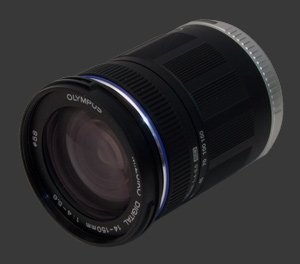





The M.Zuiko 14-150mm F4-5.6 ED ultra-zoom lens provides a 10.7X optical zoom covering the equivalent of a 28-300mm lens on full-frame camera. This is an extremely versatile range usable for landscapes, interiors, portraits, street photography, close-up and larger wild animals. The F/4-5.6 maximum apertures are a little dim yet give some control over depth-of-field.
This lens is almost exactly the size of the M.Zuiko 40-150mm described later, despite having roughly 3X the zoom range. This one is noticeably heavier and a tad better built with a metal lens-mount. The zoom ring is tight and moves smoothly and the focus ring completely smooth. This lens uses a 58mm thread.
Wide-open, sharpness is good in the center and soft at corners near its wide-angle end. Corners do improve slightly stopping down but remain soft throughout the aperture range. Zooming in to 40mm, sharpness in the center is very good and a slight amount of softness is visible at F/5.6 in the corners. Stopping down to F/6.7, corners get quite sharp. At the 150mm end, things are soft all over the frame wide-open but improves dramatically stopping down ½ a stop to F/6.7. At F/8, things are a noticeably sharper and F/9.5 gives the maximum sharpness. This time, corner softness is minimal when compared to the center, regardless of the aperture.
Distortion is extremely well controlled. Unfortunately vignetting is terrible at both ends of the zoom and remains disturbing until stopped down to F/11. In the middle of the zoom range, between 30 and 60mm, it is much less noticeable.
Naturally, there is the question of using the 14-42mm and 40-150mm versus the 14-150mm. Referring to our analysis of the 14-42mm, it is clear that the shorter lens does much better near 14mm while the ultra-zoom performs exceptionally well at 40mm. Towards the telephoto end, it seems the 40-150mm has a slight edge in terms of sharpness. The level of vignetting shown by the 14-150mm at some focal-lengths is clearly too much. This hands over the winning performance to the pair of lenses rather than the ultra-zoom. This is unsurprising since ultra-zoom lenses always offer a compromise of reduced performance versus increased versatility.



What is shown below are 5 crops taken from a photograph, repeatedly captured for each combination of focal-length and aperture. The smaller pieces are cropped from the extreme corners of the image, while the middle wide crop comes from the center of the image. Select an aperture in a row for a desired focal-length to see the crops from the corresponding image. When judging quality, keep in mind that these crops come from a 12 MP image which is normally used to print an image up to 16x12". On a computer display, these may appear much larger which magnifies image defects.
M.Zuiko 14-150mm F/4-5.6 ED Sharpness






 Next
Next Lens Reviews
Please Support Neocamera
All information on Neocamera is provided free of charge yet running this website is a huge endeavor. Purchases made via affiliate links found throughout the site help keep it running and up-to-date. There is no additional cost to you, so please consider buying via these links to our affilates:




Thank you for your support!


Updates
2025.11.13

Best Gifts for Photographers in 2025 by Budget
The annual Neocamera Photography Gift Guide updated to 2025. Find great gifts for photographers with any price budget.
2025.07.07

Stellar Photo Recovery Review
Review of Stellar Photo Recovery V12. This Windows and MacOS software can recover photos and videos in a huge number of formats from memory cards, USB drives, SSDs and HHDs.
2025.05.14

Huion Kamvas 13 Gen 3 Review
In-Depth review of the Huion Kamvas 13 Gen 3 Pen Display Tablet for photographers and graphic artists.
2025.01.18

Fujifilm GFX 2025 Lens Roundup
Lens Review roundup of Fujifilm GFX Medium-Format lenses. Quality, performance and handling of the GF20-35mm F/4R WR, GF30mm F/3.5 Tilt-Shift and the GF55mm F/1.7.
2024.11.18

Best 2024 Photography Gifts for Every Budget
Great gifts for photographers and photo enthusiasts selected for every budget among the best products of 2024.
2024.08.07

Eye Protection Tips for Professional Photographers
The four main considerations for professional photographers regarding eyewear.
2024.07.14

Fujifilm X100VI Review
Flagship fixed-lens compact digital camera with a 40 MP sensor and Image-Stabilization, a first for the series. Retro design featuring dual control-dials, plus direct ISO, Shutter-Speed and EC dials. Its hybrid viewfinder can switch between EVF and OVF mode.
2024.05.09

Fujifilm GFX100 II Review
Flagship 102 Megapixels Medium-Format Mirrorless Digital Camera with 8-Stop 5-Axis IBIS, 8 FPS Drive, 8K Video and 400 MP Super-Resolution capture in a weatherproof and freezeproof body with dual control-dials and dual memory-card slots.
2024.04.03

Fujifilm X-T5 Review
Newest Fujifilm flagship boasting a 40 MP APS-C sensor, 5-axis IBIS with 7-stop efficiency, 15 FPS continuous drive, 6.2K Video capture, dual control-dials and dual SDXC UHS-II slots in a sturdy weatherproof and freezeproof body.
2023.11.20

Best Digital Cameras of 2023
Find out which are the Best Digital Cameras of 2023. All the new Mirrorless Digital Cameras from entry-level to high-end professional.
2023.07.10

Fujifilm X-H2 Review
40 Megapixels APS-C Hybrid Mirrorless Digital Camera with 7-stop IBIS. Fastest shutter ever and 8K video capture. Large builtin EVF with 0.8X magnification and 5.8 MP, plus an Eye-Start Sensor. Packed with features and large number of controls in a weatherproof and freezeproof body.
2023.05.07

Sony FE 20-70mm F/4G Review
Review of the unique Sony FE 20-70mm F/4G lens. The optical zoom of this lens spans ultra-wide-angle and medium focal-length coverage, making it one of the most versatile Full-Frame lenses on the market.
2025.11.13
2025.07.07
2025.05.14
2025.01.18
2024.11.18
2024.08.07
2024.07.14
2024.05.09
2024.04.03
2023.11.20
2023.07.10
2023.05.07
Camera Bag


Your camera bag is empty. To add a camera or lens click on the star next to its name.
Your camera bag is empty.
Add cameras or lenses by clicking on the star next to their name.
NEWS
2025.12.02

Sony Upgrades Alpha 7 to 5th Generation
Digital Camera ○ Lens
2025.11.29

Venus Optics Releases New Zero-D Tilt-Shift Macro Lens
Lens
2025.11.23
Best Digital Cameras of 2025
Digital Camera
2025.11.14

Photography Gift Guide 2025 Edition
2025.11.06
Canon Announces Third-Generation R6 Mirrorless
Digital Camera ○ Lens
2025.10.23
Fujifilm Launches X-T30 III Plus New Wide Zoom
Digital Camera ○ Lens
2025.10.21
Peak Design Unveils Field Plate and Form Straps
2025.10.16
Nikon Unveils Z-Mount DX Lens Duo
Lens
2025.10.16
Venus Optics Unveils Fast Telephoto Prime Lens
Lens
2025.10.01

Think Tank Photo FocusPoint RollTop Backpacks
Bag
2025.09.30
Sony Produces Super Macro GMaster Lens
Lens
2025.09.17
Venus Optics Created First Telephoto Ultra-Macro Lens
Lens

