Camera Basics
 Camera Choosing
 Camera Models
 Camera Buying
 DSLR Buying

Sony Alpha A200 Review
 10 Megapixels
 Single Lens Reflex
 Stabilization: Compensates for tiny involuntary movements of the camera.
 Continuous Drive
 Manual Controls: Both fully-manual (M) and semi-automatic modes (T and V).
 Custom White-Balance: Specifies exactly what should be white to the camera.
 Action Photography: Shutter speeds of 1/1500 or more.
 Night Photography: Reaches shutter-speeds longer than 4 seconds.
 Hotshoe: Allows external flash units to be attached.
 Spot Metering
 Accepts Compact Flash memory.
 Neocamera detailed review
 Discontinued: No longer produced by the manufacturer. May still be in stock or found used.
 1 - Capability2 - Usability3 - Performance
Sony Alpha A200 Introduction
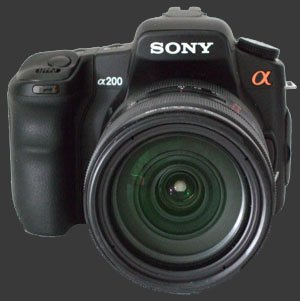 The Sony Alpha A200 is largely based on the Alpha A100, Sony's first DSLR, which was largely based on Konica-Minolta's Maxxum 5D. Each step produced a DSLR increasingly Sony-styled. The A200 gives off an even more Sony-like appearance while retaining features pioneered by Minolta, like the Anti-Shake and the Eye-Start sensor. Plus, like all Sony digital SLR cameras, the A200 uses the original Minolta A-mount and is compatible with most Minolta auto-focus lenses.
Now that 10 megapixels is the norm among DSLRs, we counted 15 such models, which means that the A200 has many more competitors than the A100 did at the time of its launch. As such, the Sony Alpha A200 features a new image sensor and auto-focus system for improved performance. At the same time, Sony reduced the price of the A200 compared to its predecessor by removing features and customization options. The result is a lower cost DSLR aimed at more novice users. Advanced users, will definitely prefer the higher-end Sony Alpha A700 instead.
As expected from a modern DSLR, the Sony Alpha A200 is a full-featured digital camera with full-manual controls, custom white-balance, high-ISO, a wide range of shutter-speeds including a bulb mode, exposure-compensation, interchangeable lenses, continuous drive, an optical viewfinder and a large LCD. Here, Neocamera takes an in-depth look at how the Sony Alpha A200 fares among entry-level DSLR cameras.
The most important feature of this DSLR is its built-in stabilization. Among DSLRs, only Pentax and Olympus also implement this feature on select models. Built-in stabilization can bring both unequaled flexibility and cost savings. There are many types of lenses which do not have any stabilized counterparts, in particular, prime lenses and most bright zooms. This means that photography is possible in darker conditions than without built-in stabilization. The cost saving aspect can also be very important as it economizes up to $500 USD per lens. It can also make a standard zoom usable when a bright and more expensive zoom would normally be required.
The Alpha A200 also features an extremely convenient eye-start sensor, a dynamic-range-optimizer (DRO), a dust-reduction system and all features found on most entry-level DSLRs. The 2.7" LCD serves as a status display in shooting mode and rotates automatically when shooting in portrait orientation.
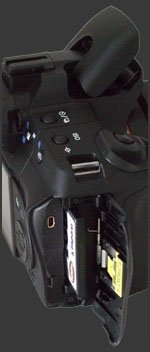
This Sony DSLR uses Compact Flash memory and a Sony Info-Lithium battery. The advantage of Info-Lithium batteries is that they give a precise measurement of the remaining charge. The natural disadvantages of such batteries are that they are expensive and hard to find. Nevertheless, Sony claims 750 shots per charge using the CIPA standard.

The A200's standard feature set includes:
- 10 Megapixels image sensor, 1.5X crop-factor.
- Minolta A-mount, supports nearly all AF Konica-Minolta lenses.
- ISO 100 to 3200, plus Auto ISO (100-400). Up from 1600, on the A100.
- 1/4000s to 30s shutter-speeds, plus bulb mode.
- Multi-segment, center-weighed and spot metering.
- Exposure compensation: -2..+2, 1/3 EV inc.
- Flash compensation: -2..+2, 1/3 EV inc.
- Exposure bracketing, 3 images, 0.3 or 0.7 EV inc.
- White-balance bracketing, high and low increments.
- Automatic white-balance.
- Preset and Kelvin white-balance, both fine-tunable along green-to-magenta scale.
- Custom white-balance.
- 9-point auto-focus system.
- Automatic, manual or center focus-point selection
- Single-shot, continuous, auto-detect and manual focus modes. Gone is DMF from the A100.
- Standard P, S, A and M exposure modes.
- Unlimited 2.8 FPS continuous drive. Down from 3 FPS on the A100.
- 10-second and 2-second self-timers. No longer with automatic mirror-lockup.
- Dedicated Auto-Exposure-Lock (AEL) and Auto-Focus-Lock (AFL) buttons.
- Customizable saturation, sharpness and contrast, 7 steps.
- 2.7" LCD 230K Pixels with automatic rotation of status screen. Up from 2.5" on the A100.
- Eye-start sensor automatically controls LCD and optionally starts auto focus.
- 0.83X Magnification viewfinder, 95% coverage.
- Image review with magnification and histogram.
- JPEG and RAW modes.
- Built-in flash.
- Flash off, auto, fill, slow-sync, rear-sync and wireless modes.
- Lithium-ion battery.
- Compact flash memory.
- Gone is depth-of-field preview from the A100.
- Many customization options gone too.
Sony Alpha A200 Suitability - What is it good for?
Since DSLR cameras represent the high-end of digital cameras, they are generally suitable for most types of photography. The versatility of interchangeable lenses gives SLR cameras their greatest potential. The Sony Alpha A200 is no exception, it is suitable for every type of photographic subject.
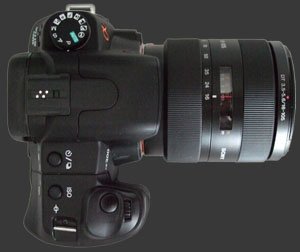
Much of a DSLR's versatility depends on available lenses. Among Sony lenses are several highly desirable - and expensive - ones by Carl-Zeiss. Sony sells the A200 alone, with a 18-70mm F3.5-5.6 or with a 18-70mm F3.5-5.6 and a 75-300 F4.5-5.6. These are all medium quality lenses with typical narrow apertures. One of the most unique lens among Sony's lineup is the 16-105mm F3.5-5.6 which is equivalent to 24-157mm in 35mm terms. What is special about it is that there are very little zooms which start this wide and none with a 6X or more zoom range. Another impressive lens from Sony is the ultra-wide 11-18mm F4.5-5.6 which shows excellent sharpness and very little distortion for such focal-length. Numerous lenses are also available from third-party companies such as Sigma. Most out-of-production Konica-Minolta auto focus lenses are also compatible with the A200.
Feature-wise, a few DSLR cameras are better suited for action-photography. Even though the Alpha A200 can shoot at 2.8 FPS indefinitely, many cameras can shoot faster. Specifically, the 12 megapixels Sony Alpha A700, the 10 megapixels Nikon D200 both shoot continuously at 5 FPS. Some recent DSLRs shoot even faster. Like all forms of stabilization, Sony's built-in stabilization only compensates for the photographer's movements, never the subject's. In other words, it is not effective for action photography.
The Alpha A200 is nor the largest nor the smallest 10 megapixels DSLR. In terms of weight, it is also near the middle of its class. Given its size and weight, the Sony A200 has a solid feel without being tiresome to carry. It is certainly no more noticeable than most consumer-oriented DSLR cameras.
Sony Alpha A200 Capability - What can it do?
As noted in the introduction, the Sony Alpha A200 has everything expected from a DSLR plus a few unique features. Headline features include built-in stabilization, renamed Super-Steady-Shot from Konica-Minolta's Anti-Shake, an eye-start sensor, also inherited from Konica-Minolta, a dust-reduction mechanism, an unlimited 2.8 FPS continuous drive and a dynamic-range-optimizer, called DRO.
The camera's only LCD has multiple duties: playing back images, changing camera settings and displaying status information. In shooting mode, the LCD displays the camera status until it is cleverly deactivated by the eye-start sensor situated under the optical viewfinder. As soon as your eye, or any other object, gets near the viewfinder, the LCD is immediately turned off. This no-user-intervention approach is great because it does exactly what needs to be done smoothly. This saves power and prevents the LCD from interfering with the viewfinder's normal use. Using the LCD as a status display makes it easier to check the camera's status between hand-held shots than with a top mounted LCD. However, when using a tripod below eye-level, a top-mounted LCD would be preferable. Another neat trick with the status display is that it automatically rotates with the camera for improved readability.
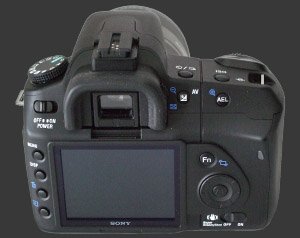
The eye-start sensor also optionally serves to start the focusing system. This is designed to shorten the time to lock focus by letting the camera start focusing before the shutter-release is half-pressed. How useful this is depends on your shooting style: If you keep your eye to the viewfinder for a while before taking a shot, focus lag can be greatly reduced; If you hang the camera from your neck between shots, you may be annoyed at hearing the camera continuously focus. Either way, this feature can be deactivated in the setup menu.
The DRO can adjust the brightness level of photographs before being converted to JPEG. The DRO is designed to help with dynamic-range problems. Recall that a camera can only capture a small dynamic range compared to reality. The DRO has 3 modes: Off, Standard and Advanced. Obviously, in the Off mode, the DRO does nothing. The Standard mode adjusts the brightness levels of the image based on the overall image contrast and brightness. The Advanced mode analyses the image and adjusts it differently depending on local brightness and contrast.
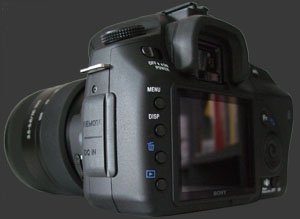
The DRO is both powerful and dangerous. The power of the DRO is that it can easily produce pleasing images from high-contrast subjects with shadow and highlight details. The weakness of the DRO is that its effect is hard to predict and may be detrimental to the mood of an image. For example, a high-contrast scene can be rendered relatively flat, thus removing some of the photograph's punch. Also, the DRO cannot fill-in details which have not been captured. Note that the DRO works by modifying the camera's internal RAW conversion used to produce JPEG images. Hence, DRO does not affect RAW images.
The white-balance options of the Alpha A200 are similar to most digital SLR cameras. The automatic white-balance option is fixed while any preset and even Kelvin white-balance can be adjusted on a green-to-magenta scale. The presets have 7 positions along the scale, while the Kelvin white-balance has 19. When calibrating custom white-balance, this camera actually reports the Kelvin temperature and the Green-to-Magenta bias. This is useful to return exactly to a previously measured white-balance.
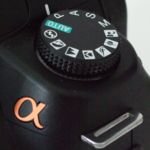 The exposure-mode-dial of the Sony Alpha A200 has 12 positions. Among those are the typical Program (P), Aperture-priority (A), Shutter-priority (S) and Manual (M) modes. There is also an Auto mode which is similar to P but prevents access to some functions. The last remaining positions are for the following scene modes: Portrait, Landscape, Macro, Sports, Sunset, Night portrait and No-Flash. These scene modes affect the way exposure is chosen and image parameters such as color-mode, contrast, sharpness and saturation.
The Auto-Exposure-Lock (AEL) button can be customized to either hold or toggle the exposure-lock. In Hold-mode, the exposure is locked until the AEL button is released. In Toggle-mode, the AEL is locked until the AEL button is pressed again. The Toggle-mode is the easiest way to expose for stitched panoramas. Unlike the A100, entering playback mode does not cancel the AEL. Other missing features include spot-metering using AEL and the option to control whether EC affects ambient-lighting only or ambient-plus-flash.
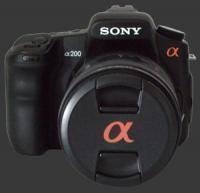
 The popup flash is fairly standard among DSLRs but the hot-shoe is not. The Sony A200 supports only flashes designed for the Minolta hot-shoe, just like the rest of the Alpha line. Naturally, Sony flashes are compatible. The built-in flash can be controlled with Flash-Compensation in 1/3 EV steps from -2 to +2 EV. Unfortunately, the camera menu must be used to set Flash-Compensation. This is most likely a serious limitation for frequent flash users.
This DSLR supports the standard drive modessingle, continuous and self-timer plus 3 bracket modes. In continuous drive mode, it can shoot an unlimited number of JPEG images or up to 6 RAW images. Continuous shooting speed is always 2.8 FPS. The self-timer can trigger after 2 or 10 seconds. Sadly, the 10-second self-timer no longer resets after each use to avoid the common mistake of forgetting to reset it. The bracketing modes are: single-step exposure bracket, continuous exposure bracket and white-balance bracket. Each bracketing mode takes 3 shots with either a small step or a large step. The small step is 0.3 EV for exposure-bracketing and 5 mired for white-balance bracketing. The large step is 0.7 EV for exposure-bracketing and 10 mired for white-balance bracketing. Single-step bracket requires the shutter to be pressed for each image in the bracket. Continuous bracket takes all 3 images continuously while the shutter is being pressed. The white-balance bracket is done virtually by taking a single shot and saving it with 3 different white-balance biases.
This is one of the few DSLR cameras to provide control over dynamic range. While the Alpha A200's DRO uses processing to attack the problem, the Fuji Finepix S5 Pro's SuperCCD SR provides a hardware solution.
 |


|
 Next1 - Capability2 - Usability3 - Performance
Please Support Neocamera
All information on Neocamera is provided free of charge yet running this website is a huge endeavor. Purchases made via affiliate links found throughout the site help keep it running and up-to-date. There is no additional cost to you, so please consider buying via these links to our affilates:




Thank you for your support!


Sony A200 Highlights


 SLR digital camera
Sensor-Size: 24 x 16mm

Actual size when viewed at 100 DPI
| 10 Megapixels DSLR | ISO 100-3200 |
| Sony A Mount 1.5X FLM | Shutter 1/4000-30s |
| 2-Axis Built-in Stabilization | Full manual controls, including Manual Focus |
| 95% Coverage Medium Viewfinder | Custom white-balance with 1 axis fine-tuning |
| Automatic Eye-Start sensor | Spot-Metering |
| Built-in Dust Reduction | Hot-Shoe |
| 2.8 FPS Drive, Unlimited Images | Lithium-Ion Battery |
| 2.7" LCD 230K Pixels | Compact Flash |
Camera Bag


Your camera bag is empty. To add a camera or lens click on the star next to its name.
Your camera bag is empty.
Add cameras or lenses by clicking on the star next to their name.
Updates
2026.09.08

The Wild Magic of Iceland Book Review
Review of The Wild Magic of Iceland by Norris Niman. A photographic journey through seasons.
2026.07.31

ZY Optics Pittura 30mm F/2.4 Medium-Format Lens Review
The ZY Optics Pittura 30mm F/2.4 is a manual lens designed exclusively for Medium-Format Digital Cameras. This fast prime lens captures a wide field-of-view, equivalent to a 24mm on Full-Frame. It is am affordable alternative to first-part GFX and XCD lenses.
2026.07.26

Fujifilm GFX100S II Review
Express review of the Fujifilm GFX100S II. This 102 MP Medium-Format Mirrorless Digital Camera packs an 5-Axis 8-Stop IBIS and a 5.8 MP 0.5" EVF showing 100% coverage at an extra-large 0.84X magnification. It is a more compact version of the flagship GFX100 II. This review covers exactly how these camera compare.
2026.07.14

Sony Alpha A7R VI Review
Extended In-Depth Review of the Sony Alpha A7R VI. This flagship Full-Frame Mirrorless Digital Camera combines ultra-high 67 MP resolution with very fast 30 FPS continuous shooting. It packs a 5-axis 8½-stop IBIS mechanism and an ultra-sensitive 759-Point Phase-Detect AF system. Its incredibly sharp 9.4 MP 0.64" EVF has a huge 0.9X magnification, 100% coverage, 10-bit HDR and 100% DCI-P3 color-space. Captures 8K video at 30 FPS or 4K video at 120 FPS.
2026.05.21

Laowa 4.5-10mm F/2.8 Fisheye Zoom Lens Review
In-depth review of the Venus Optics Laowa 4.5-10mm F/2.8 Fisheye Zoom Lens. This lens zooms from a circular to rectangular fisheye with an 180° viewing angle. This review analyses its optical quality, construction and handling.
2026.04.13

Laowa 17mm F/4 Zero-D Shift Review
In-Depth review of the Venus Optics Laowa 17mm F/4 Zero-D Shift Lens. This ultra-wide Shift lens is specifically designed for Mirrorless Digital Cameras and is available in 4 Full-Frame mounts plus 2 Medium-Format ones.
2025.11.13

Best Gifts for Photographers in 2025 by Budget
The annual Neocamera Photography Gift Guide updated to 2025. Find great gifts for photographers with any price budget.
2025.07.07

Stellar Photo Recovery Review
Review of Stellar Photo Recovery V12. This Windows and MacOS software can recover photos and videos in a huge number of formats from memory cards, USB drives, SSDs and HHDs.
2025.05.14

Huion Kamvas 13 Gen 3 Review
In-Depth review of the Huion Kamvas 13 Gen 3 Pen Display Tablet for photographers and graphic artists.
2025.01.18

Fujifilm GFX 2025 Lens Roundup
Lens Review roundup of Fujifilm GFX Medium-Format lenses. Quality, performance and handling of the GF20-35mm F/4R WR, GF30mm F/3.5 Tilt-Shift and the GF55mm F/1.7.
2024.11.18

Best 2024 Photography Gifts for Every Budget
Great gifts for photographers and photo enthusiasts selected for every budget among the best products of 2024.
2024.08.07

Eye Protection Tips for Professional Photographers
The four main considerations for professional photographers regarding eyewear.
2026.09.08
2026.07.31
2026.07.26
2026.07.14
2026.05.21
2026.04.13
2025.11.13
2025.07.07
2025.05.14
2025.01.18
2024.11.18
2024.08.07