



 Camera Basics
 Camera Choosing
 Camera Models
 Camera Buying
 DSLR Buying

Panasonic Lumix DMC-GF1 Summary
 12 Megapixels
 Electronic View Finder
 Continuous Drive
 720p HD Video: 1280 x 720 resolution or more but less than 1920 x 1080.
 Manual Controls: Both fully-manual (M) and semi-automatic modes (T and V).
 Custom White-Balance: Specifies exactly what should be white to the camera.
 Action Photography: Shutter speeds of 1/1500 or more.
 Night Photography: Reaches shutter-speeds longer than 4 seconds.
 Hotshoe: Allows external flash units to be attached.
 Spot Metering
 Depth-Of-Field Preview: Improve perception of DOF before shooting.
 Accepts Secure Digital High Capacity (SDHC) and SD memory.
 Neocamera detailed review
 Discontinued: No longer produced by the manufacturer. May still be in stock or found used.
Panasonic Lumix DMC-GF1 Assessment
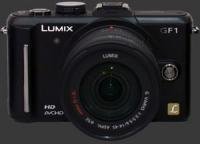
The Panasonic Lumix DMC-GF1 is one of the rare digital cameras to support interchangeable lenses and not be a DSLR. The goal of this design is to give the flexibility of changing lenses with the portability of a compact camera and still produce high-quality photographs.
The final rating of this camera therefore depends greatly on whether it is being compared to a compact camera or against a DSLR. The differences between this one and similar models boil down to handling as they all currently share the same sensor and lens mount. So this is either the best performing compact camera ever, a good DSLR or an average (by default) interchangeable lens camera.
| Category | Rating |
|---|---|
| Large Fixed-Lens Camera |  Excellent Excellent |
| Interchangeable Lens Camera |  Average Average |
| DSLR |  Good Good |
For the final rating, the GF1 was put in the large digital camera category because it is not a DSLR but when we take into account the size of the lens, even the smallest, it does form a rather sizable camera. Anecdotally, the reason the rating would be higher in the DSLR category is because the rating system considers performance of all DSLRs which have been around for much longer.
There are not many competitors to look at. The GF1 has a larger, SLR-shaped sibling, the GH1, that looks more like an ultra-zoom than anything. It has nearly the same feature set except that it can shoot 1080p video instead of the GF1's 720p. There was an older model, the G1, which did not have a movie-mode at all. It is interesting to see that these cameras are evolving to offer a more distinct proposition than their predecessors.
There are certainly a few things that will be changed as the interchangeable lens camera market picks up. It is about rethinking what the camera can do when there is no reflex viewfinder to accommodate. The main usability draw-back of the Panasonic GF1 is the lack of a built-in viewfinder which makes it harder to steady the camera and see subjects in bright light. For this, Panasonic has an optional EVF that goes into the hot-shoe instead of an add-on flash. This EVF provides reasonable visibility but is far from being best-in-class, something that belongs to the Panasonic Lumix DMC-GH1 with its 1.5 MP EVF, the highest resolution ever made.
The bottom line is that the GF1 outperforms fixed-lens cameras in most regards and by a fair margin when it comes to image quality. Speed is good but there are some very fast models in this category which will run circles around a GF1. Compared to a DSLR, things are different because of the Panasonic Lumix GF1's smaller sensor, it shows more noise and less dynamic range than virtually all DSLR cameras. The proposition though is that this digital camera can be taken to more places and is considerably more discrete than the average DSLR.
Neocamera detailed review Read the full review of the Panasonic GF1 here.
| PROS | CONS |
|---|---|
| Very good image quality, just below average for a DSLR | Reduced dynamic range compared to a DSLR, causes highlight clipping |
| One of the smallest interchangeable lens digital cameras | Button-dial is clunky and exposure may change accidentally |
| Very good metering and white-balance systems | Shutter-button difficult to reach when using strap |
| Accurate image colors in standard mode | Digital preview not so good or useful |
| Quick autofocus | Slow shutter-lag |
| Excellent LCD refresh | Relatively weak flash |
| Good LCD visibility | Not exposure priority |
| Very flexible display option | Useless continuous drive as LCD cannot keep up |
| Continuous autofocus possible in movie-mode | Cluttered view, too many icons overlaid |
| Good build quality other than the built-in flash | Cannot autofocus with most Four-Third lenses |
| Startup almost as fast as a DSLR | Limited selection of lenses at this time |
| Short battery life | |
| Excellent Excellent |
|
Recent Similar Cameras


Panasonic Lumix DMC-GF1 Related Information
| Sister Models |
|---|
| Panasonic Lumix DMC-GH1 - 1080p HD movie mode |
| Panasonic Lumix DMC-G1 - No movie mode |
| Reviews | |
|---|---|
| Neocamera | ePhotozine |
| Digital Camera Review | Photography Blog |
| Imaging Resource | Photo Review |
| Trusted Reviews | |
 |



 
|
Please Support Neocamera
All information on Neocamera is provided free of charge yet running this website is a huge endeavor. Purchases made via affiliate links found throughout the site help keep it running and up-to-date. There is no additional cost to you, so please consider buying via these links to our affilates:




Thank you for your support!


Panasonic DMC-GF1 Highlights


 Mirrorless digital camera
Sensor-Size: 17 x 13mm

Actual size when viewed at 100 DPI
| 12 Megapixels Mirrorless | ISO 100-3200 |
| Micro Four-Thirds Mount 2X FLM | Shutter 1/4000-60s |
| 0.20" Optional EVF 200K Pixels (0.58X) | Full manual controls, including Manual Focus |
| Built-in Dust Reduction | Custom white-balance with 2 axis fine-tuning |
| 3 FPS Drive, Unlimited Images | Spot-Metering |
| 1280x720 @ 30 FPS Video Recording | Hot-Shoe |
| 3" LCD 460K Pixels | Lithium-Ion Battery |
| Secure Digital High Capacity |
Camera Bag


Your camera bag is empty. To add a camera or lens click on the star next to its name.
Your camera bag is empty.
Add cameras or lenses by clicking on the star next to their name.
Updates
2026.09.08

The Wild Magic of Iceland Book Review
Review of The Wild Magic of Iceland by Norris Niman. A photographic journey through seasons.
2026.07.31

ZY Optics Pittura 30mm F/2.4 Medium-Format Lens Review
The ZY Optics Pittura 30mm F/2.4 is a manual lens designed exclusively for Medium-Format Digital Cameras. This fast prime lens captures a wide field-of-view, equivalent to a 24mm on Full-Frame. It is am affordable alternative to first-part GFX and XCD lenses.
2026.07.26

Fujifilm GFX100S II Review
Express review of the Fujifilm GFX100S II. This 102 MP Medium-Format Mirrorless Digital Camera packs an 5-Axis 8-Stop IBIS and a 5.8 MP 0.5" EVF showing 100% coverage at an extra-large 0.84X magnification. It is a more compact version of the flagship GFX100 II. This review covers exactly how these camera compare.
2026.07.14

Sony Alpha A7R VI Review
Extended In-Depth Review of the Sony Alpha A7R VI. This flagship Full-Frame Mirrorless Digital Camera combines ultra-high 67 MP resolution with very fast 30 FPS continuous shooting. It packs a 5-axis 8½-stop IBIS mechanism and an ultra-sensitive 759-Point Phase-Detect AF system. Its incredibly sharp 9.4 MP 0.64" EVF has a huge 0.9X magnification, 100% coverage, 10-bit HDR and 100% DCI-P3 color-space. Captures 8K video at 30 FPS or 4K video at 120 FPS.
2026.05.21

Laowa 4.5-10mm F/2.8 Fisheye Zoom Lens Review
In-depth review of the Venus Optics Laowa 4.5-10mm F/2.8 Fisheye Zoom Lens. This lens zooms from a circular to rectangular fisheye with an 180° viewing angle. This review analyses its optical quality, construction and handling.
2026.04.13

Laowa 17mm F/4 Zero-D Shift Review
In-Depth review of the Venus Optics Laowa 17mm F/4 Zero-D Shift Lens. This ultra-wide Shift lens is specifically designed for Mirrorless Digital Cameras and is available in 4 Full-Frame mounts plus 2 Medium-Format ones.
2025.11.13

Best Gifts for Photographers in 2025 by Budget
The annual Neocamera Photography Gift Guide updated to 2025. Find great gifts for photographers with any price budget.
2025.07.07

Stellar Photo Recovery Review
Review of Stellar Photo Recovery V12. This Windows and MacOS software can recover photos and videos in a huge number of formats from memory cards, USB drives, SSDs and HHDs.
2025.05.14

Huion Kamvas 13 Gen 3 Review
In-Depth review of the Huion Kamvas 13 Gen 3 Pen Display Tablet for photographers and graphic artists.
2025.01.18

Fujifilm GFX 2025 Lens Roundup
Lens Review roundup of Fujifilm GFX Medium-Format lenses. Quality, performance and handling of the GF20-35mm F/4R WR, GF30mm F/3.5 Tilt-Shift and the GF55mm F/1.7.
2024.11.18

Best 2024 Photography Gifts for Every Budget
Great gifts for photographers and photo enthusiasts selected for every budget among the best products of 2024.
2024.08.07

Eye Protection Tips for Professional Photographers
The four main considerations for professional photographers regarding eyewear.

