Camera Basics
 Camera Choosing
 Camera Models
 Camera Buying
 DSLR Buying

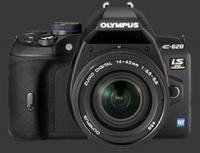
Olympus Evolt E-620 Review
 12 Megapixels
 Single Lens Reflex
 Stabilization: Compensates for tiny involuntary movements of the camera.
 Continuous Drive
 Manual Controls: Both fully-manual (M) and semi-automatic modes (T and V).
 Custom White-Balance: Specifies exactly what should be white to the camera.
 Action Photography: Shutter speeds of 1/1500 or more.
 Night Photography: Reaches shutter-speeds longer than 4 seconds.
 Hotshoe: Allows external flash units to be attached.
 Spot Metering
 Depth-Of-Field Preview: Improve perception of DOF before shooting.
 Accepts Compact Flash memory.
 Accepts xD memory.
 Neocamera detailed review
 Discontinued: No longer produced by the manufacturer. May still be in stock or found used.
 1 - Usability & Ergonomics2 - Image Quality & Performance
Olympus Evolt E-620 Introduction
The Olympus E-620 is among the smallest DSLRs. At the same time, it is designed to be more flexible and advanced than most entry-level models.
The promise of the Four-Thirds system, on which the E-620 is based is to deliver quality images in a smaller package by using a smaller 2X crop sensor and mounting lenses exclusively designed for that sensor size. The Olympus E-620 is built around a sensor with 12 megapixels and sensitivity up to ISO 3200. It features built-in image stabilization and dust-reduction, which was pioneered by Olympus. Despite its smaller size, this digital camera has a wealth of features and a large number of direct controls for efficient operation.
Olympus Evolt E-620 Ergonomics - How easy is it to use?
The Olympus E-620 is built as a diminutive camera with all the components of a traditional DSLR. The short grip provides a comfortable hold on the camera which is well secured by a finger indentation on the grip and an outward curve on the back. On the top of the grip one finds in very close proximity the shutter-release and EC button. Both are comfortable to reach and switching between them is quick. The camera's short height also means that in will rest on the lower palm of your hand.
This DSLR is littered with buttons, the only thing missing compared to a high-end model is a second control-dial. it only leaves a small but comfortable space for the thumb on its back. The camera itself as more angles than most modern cameras do. This helps access buttons easily.
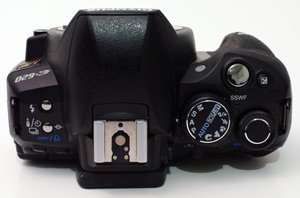
The top of the camera has the usual prism bump with a standard hot-shoe. To the left is the flash-release button which also serves to select the flash-mode and apply FC when used with the EC button. Just behind it is the drive-mode button which includes continuous, self-timers and remote-trigger options. Bracketing is controlled separately which is a great thing, particularly to allow it to be used in conjunction with the self-timer. Speaking of bracketing, the E-620 supports exposure and flash bracketing, as well as virtual bracketing of WB and ISO. A virtual bracket is made from a single exposure with the file being saved 3 times with different parameters. This is similar to converting a RAW image multiple times in different ways. Strangely this form of bracketing works in RAW mode as well.
To the other side of the viewfinder chamber, which also has the E-620's built-in flash, is the mode-dial which is on top of the power-switch. Next to the mode-dial, we find the only control-wheel. The dials and power-switch have nice clicks to prevent accidental changes. They move well and firmly. The shutter-release is pretty standard with a distinct half-way point and short travel to full-press from there.
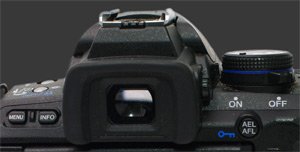
The back of the camera is where most of the buttons are. It also, as usual, has the viewfinder and LCD display. If you are considering the E-620 it is important to know that the viewfinder is tiny and dark, something which can be a deal breaker. This may depend on your vision but I found it very hard to verify focus through the viewfinder, so much that I kept thinking I must have bumped the diopter-correction dial. This is the only serious ergonomic issue found with this DSLR.
The LCD screen is hinged to make it movable. The hinge is solid enough that this does not seem affect the solidity of the camera. The position of the hinge is such that the LCD has to move sideways before tilting. This is rather a poor choice as far as movable LCDs go because seeing the screen from a high or low angle requires protruding the LCD completely to the left of the camera. It does work well for self-portraits though. The screen is dated in terms of brightness and sharpness but still quite usable. In live-view the LCD exposure-priority except in S and A mode. So one does not see under-exposure in these modes.
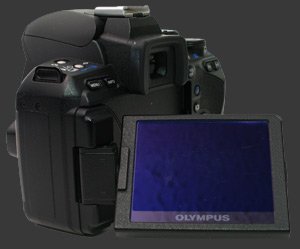
Above and to the left of the LCD there is a menu and info button. The info button toggles a status display on the rear LCD when using the viewfinder and goes through various display modes in live-view. The menu button does what is expected.
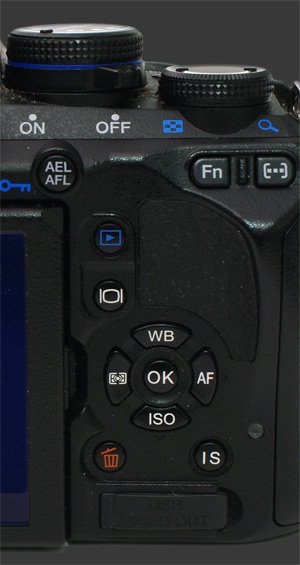 To the other side of the viewfinder, there is a customizable AE-L/AF-L button, a customizable Fn button and a focus-point selection button. The remaining buttons on the back are: playback, live-view, delete, stabilization and the 5-way controller which is made of 5 separate buttons. Each of these is assigned a function: up is white-balance, right is autofocus, down is ISO and left is metering. It would have been better if the ISO button was the highest, in place of the playback button and the metering mode button be just below it, in place of the live-view button. This would make operation more efficient as the most used functions while shooting would be accessible without shifting your grip. It would be an improvement but the current arrangement is pretty usable.
The Olympus E-620 has a choice of 5 metering patterns. The usual multi-segment, center-weighed and spot are there plus two modes unique to Olympus: highlight and shadow based spot metering. These extremely useful metering modes work like spot metering except that they meter for highlights or shadows, instead of mid-town. The reasons these are worth it is that it is easy to determine the brightest or darkest area where details are needed.
Further functions of the camera are setable via a tabbed menu system or an interactive status screen. The central OK button activates the status screen which is quite easy to use. The menu system is easy to navigate but it a mess in terms of organization. Luckily there are external buttons for most common operations. The most common deeply hidden function is WB fine-tuning.
The settings menu has a whopping 69 items. This camera is extremely customizable, from minor details such as dial rotation to important camera customization. The most useful options include: AE-L/AF-L options per focus-mode, choice of AE-L metering pattern, info screen choices, one-touch custom white-balance assignable to the Fn button, WB fine-tuning and control over noise-reduction. The first two letters of filenames can be changed but sadly not the numbering convention with is based on the date, day of month first. This causes files to sort out-of-order when a images cross a month boundary.
 |



 
|
 Next1 - Usability & Ergonomics2 - Image Quality & Performance
Please Support Neocamera
All information on Neocamera is provided free of charge yet running this website is a huge endeavor. Purchases made via affiliate links found throughout the site help keep it running and up-to-date. There is no additional cost to you, so please consider buying via these links to our affilates:




Thank you for your support!


Olympus E-620 Highlights


 SLR digital camera
Sensor-Size: 17 x 13mm

Actual size when viewed at 100 DPI
| 12 Megapixels DSLR | ISO 100-3200 |
| Four-Thirds Mount 2X FLM | Shutter 1/4000-60s |
| 2-Axis Built-in Stabilization, 4-Stop Improvement | Full manual controls, including Manual Focus |
| 95% Coverage Small Viewfinder | Custom white-balance with 2 axis fine-tuning |
| Built-in Dust Reduction | Spot-Metering |
| 4 FPS Drive, Unlimited Images | Hot-Shoe |
| 2.7" LCD 230K Pixels | Lithium-Ion Battery |
| Compact Flash, xD |
Camera Bag


Your camera bag is empty. To add a camera or lens click on the star next to its name.
Your camera bag is empty.
Add cameras or lenses by clicking on the star next to their name.
Updates
2026.09.08

The Wild Magic of Iceland Book Review
Review of The Wild Magic of Iceland by Norris Niman. A photographic journey through seasons.
2026.07.31

ZY Optics Pittura 30mm F/2.4 Medium-Format Lens Review
The ZY Optics Pittura 30mm F/2.4 is a manual lens designed exclusively for Medium-Format Digital Cameras. This fast prime lens captures a wide field-of-view, equivalent to a 24mm on Full-Frame. It is am affordable alternative to first-part GFX and XCD lenses.
2026.07.26

Fujifilm GFX100S II Review
Express review of the Fujifilm GFX100S II. This 102 MP Medium-Format Mirrorless Digital Camera packs an 5-Axis 8-Stop IBIS and a 5.8 MP 0.5" EVF showing 100% coverage at an extra-large 0.84X magnification. It is a more compact version of the flagship GFX100 II. This review covers exactly how these camera compare.
2026.07.14

Sony Alpha A7R VI Review
Extended In-Depth Review of the Sony Alpha A7R VI. This flagship Full-Frame Mirrorless Digital Camera combines ultra-high 67 MP resolution with very fast 30 FPS continuous shooting. It packs a 5-axis 8½-stop IBIS mechanism and an ultra-sensitive 759-Point Phase-Detect AF system. Its incredibly sharp 9.4 MP 0.64" EVF has a huge 0.9X magnification, 100% coverage, 10-bit HDR and 100% DCI-P3 color-space. Captures 8K video at 30 FPS or 4K video at 120 FPS.
2026.05.21

Laowa 4.5-10mm F/2.8 Fisheye Zoom Lens Review
In-depth review of the Venus Optics Laowa 4.5-10mm F/2.8 Fisheye Zoom Lens. This lens zooms from a circular to rectangular fisheye with an 180° viewing angle. This review analyses its optical quality, construction and handling.
2026.04.13

Laowa 17mm F/4 Zero-D Shift Review
In-Depth review of the Venus Optics Laowa 17mm F/4 Zero-D Shift Lens. This ultra-wide Shift lens is specifically designed for Mirrorless Digital Cameras and is available in 4 Full-Frame mounts plus 2 Medium-Format ones.
2025.11.13

Best Gifts for Photographers in 2025 by Budget
The annual Neocamera Photography Gift Guide updated to 2025. Find great gifts for photographers with any price budget.
2025.07.07

Stellar Photo Recovery Review
Review of Stellar Photo Recovery V12. This Windows and MacOS software can recover photos and videos in a huge number of formats from memory cards, USB drives, SSDs and HHDs.
2025.05.14

Huion Kamvas 13 Gen 3 Review
In-Depth review of the Huion Kamvas 13 Gen 3 Pen Display Tablet for photographers and graphic artists.
2025.01.18

Fujifilm GFX 2025 Lens Roundup
Lens Review roundup of Fujifilm GFX Medium-Format lenses. Quality, performance and handling of the GF20-35mm F/4R WR, GF30mm F/3.5 Tilt-Shift and the GF55mm F/1.7.
2024.11.18

Best 2024 Photography Gifts for Every Budget
Great gifts for photographers and photo enthusiasts selected for every budget among the best products of 2024.
2024.08.07

Eye Protection Tips for Professional Photographers
The four main considerations for professional photographers regarding eyewear.
2026.09.08
2026.07.31
2026.07.26
2026.07.14
2026.05.21
2026.04.13
2025.11.13
2025.07.07
2025.05.14
2025.01.18
2024.11.18
2024.08.07