



 Camera Basics
 Camera Choosing
 Camera Models
 Camera Buying
 DSLR Buying

Nikon D3 Summary
 12 Megapixels
 Single Lens Reflex
 High ISO: ISO 6400 or more is available at full-resolution.
 Level: Measures camera tilt and helps to keep the horizon level.
 Continuous Drive
 Manual Controls: Both fully-manual (M) and semi-automatic modes (T and V).
 Custom White-Balance: Specifies exactly what should be white to the camera.
 Action Photography: Shutter speeds of 1/1500 or more.
 Night Photography: Reaches shutter-speeds longer than 4 seconds.
 Hotshoe: Allows external flash units to be attached.
 Spot Metering
 Depth-Of-Field Preview: Improve perception of DOF before shooting.
 Weatherproof - Seals protect from dust, humidity and light splashing.
 Accepts Compact Flash memory.
 Neocamera hands-on review
 Discontinued: No longer produced by the manufacturer. May still be in stock or found used.
Nikon D3 Assessment
The D3 is Nikon's most advanced digital camera and is aimed at the highest end of photographers. This full-frame DSLR is characterized by the outstanding quality of its images and its ultra-high-ISO capability. Indeed, the D3 produces the cleanest ISO 6400 images to date and, while noisy, it reaches ISO 25600 too, allowing unprecedented images to be captured.
The Nikon D3 is also a fast performer, with continuous shooting at 9 FPS at full-resolution and a fast 51-point auto focus system. It has some special features like a built-in level, viewfinder curtain and flexible dual memory slots, both supporting UDMA Compact Flash. While it is quite heavy it is equally well-built with weather-sealing against moisture and dust.
The high-end of DSLR cameras is interesting because there are no direct competitors. The D3 and the D700, its smaller full-frame sibling, are unique in their ultra high-ISO capability, helped by their relatively moderate sensor resolution. The main functionality differences are that the D3 is considerably faster and has a 100% coverage (vs 95%) viewfinder. Strangely, the relatively lower-end and much cheaper D300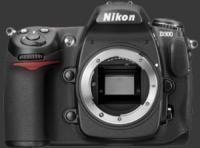
Nikon D300 has the 100% viewfinder but neither the ultra high-ISO not the faster drive.
On the Canon side, there is the 1Ds Mark III, 1D Mark III and the just announced 5D Mark II. The closest to the D3 is the 1D Mark III which shoots 10 megapixels images at 10 FPS. Unfortunately for the 1D, it does not reach the ultra high-ISO of the D3, plus its 1.3X FLM gives removes possibilities from the wide-end of lenses. Both the 5D and the 1Ds feature higher resolution 21 megapixels sensors which are superior for large prints, potentially at the expense of higher image noise. The Canon EOS 5D Mark II does have one ace up its sleeve, a 1080p HDTV movie mode with sound recording. On the downside, its viewfinder shows 98% coverage.
Finally, the wild-card is the Sony Alpha A900 which has a 25 megapixels sensor with built-in stabilization, a 100% coverage viewfinder, unlimited 5 FPS continuous drive and ISO up to 6400. Until production models show up, we cannot guess on image quality but, feature wise, the A900 seems more suited for large prints than the D3 but not as well for sports and action photography. Low light photography of static scenes can go either way because the A900 is capable of stabilizing fast prime lenses to compensate for its lower maximum ISO.
| PROS | CONS |
|---|---|
| Exceptional ISO range | Poor automatic white-balance in artificial light |
| Clean up to ISO 6400 | Viewfinder eye-point is very close |
| Excellent exposure | Small AE-L/AF-L button |
| Class leading continuous drive, up to 11 FPS crop | Small RAW burst depth compared to competition |
| Super fast & responsive | Fiddly metering dial |
| Fast 51-point auto focus | No built-in flash |
| Large 100% coverage viewfinder | Barely noticeable shutter halfway point |
| Superb LCD resolution | Quite heavy |
| Built-in digital level | |
| Viewfinder curtain | |
| Auto cropping with DX (1.5 FLM) lenses | |
| Durable quality | |
| Dual compact flash | |
 Excellent Excellent Excellent Excellent |
|
Recent Similar Cameras


Nikon D3 Nikon D3 Hands-On Review
Neocamera got to use a production Nikon D3 for a few days. Since this is not enough time to produce a full-review, this hands-on focuses on the experience of using the D3 relative to other modern DSLRs.
The first impression from the D3 comes from its size and weight. At around 1.5kg (3 lbs) with battery, this is one of the heaviest DSLR. Its integrated vertical grip and large pentaprism make this camera one of the biggest. It feels built-like-a-tank. This is not a subtle camera. Add a full-frame (FX) lens and the whole thing gets heavier. A cropped-sensor lens (DX) can be used but then you lose 7 megapixels. The optical viewfinder is quite large and shows 100% of the frame. This is much better than most DSLRs which show around 95%. The only lower cost DSLR cameras with 100% coverage are the Nikon D300, the Olympus E-3 and the Sony Alpha A900. This pro feature allows photographers to be certain of their final composition. The large viewfinder does have a short eye-point, meaning that to see the whole frame, you must press yourself right against it and feel the camera's hard case against your forehead since the D3 does skimp on rubber around the eye-piece. Speaking of the viewfinder, it has an integrated curtain to prevent light from coming into the camera during long exposures. Part of the D3's total weight comes from its hefty battery which provides excellent battery life.
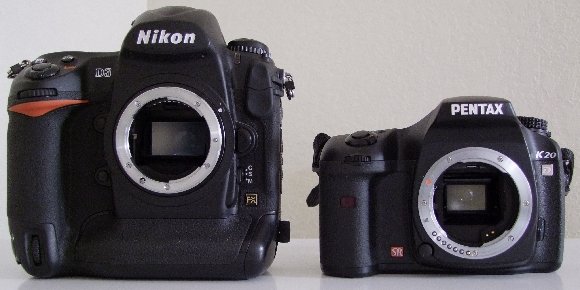
Ergonomics of the D3 are good, similar to the D300 which we fully-reviewed. The AE-L/AF-L button is quite small but still reachable without much effort. The dual control wheels of the D3 are easily accessed in standard landscape orientation but are slightly uncomfortable to reach in portrait mode. When holding the camera vertically, there are no dedicated EC and AF-On buttons. A metering dial with central locking is located on the viewfinder housing. It is somewhat fiddly to operate because the locking button is in the center. The drive-mode dial though has its locking button on the side which makes it much easier to use. Nevertheless, having locking buttons for dials is a pro feature to prevent accidental changes. Another pro feature is dual UDMA Compact Flash slots. These slots can be configured as overflow (fill one card then the other), backup (duplicate images) and RAW for one and JPEG for the other. Just imagine how long you can shoot 12 megapixels images with 2 CF cards of 100 GB each!
The D3 features extensive and fine-granularity customization. The EC display defaults to being positive on the left and negative one the right. If you regularly use non-Nikon DSLRs, this can be confusing and counter-intuitive. Luckily, the D3 lets you reverse the axis and even to rotation of dials. You can reassign the AE-L/AF-L, AF-On and Func buttons too. WB can be selected by the press of a button using the rear control wheel and fine-tuned along the Amber-Blue scale using the front one. It can further be tuned along the Magenta-Green scale using the menu system. Other settings except for ISO and Quality can be adjusted using either control wheel. The ultra-sensitive shutter-release may not please everyone due to its barely perceptible halfway point but its behavior is customizable too.
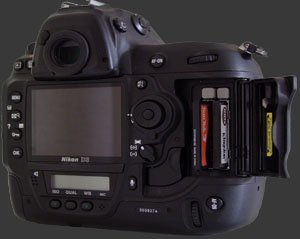 Now for the odds and ends. The D3 has a clever tilt-meter visible in the viewfinder when the Func button is help. This is a cool and extremely useful feature which can save a lot of images. Although images can be un-tilted by software, such tiny rotations are highly destructive on image quality for technical reasons too long to explain here. The D3 also features expanded EC range (-5..+5), 2 to 9 frame bracketing and multiple exposures up to 9 frames. There is also support of DX lenses which use 5 megapixels from the sensor and mask the viewfinder to show the captured area. Like other full-frame DSLRs, the D3 does not feature a built-in flash. HDMI output from this digital camera is limited 1080i rather than 1080p. We have no idea why this is so but seems quite silly considering that cameras only capture progressive images and 1080p displays are ubiquitous lately and clearly superior. Again, no camera is perfect for all types of photography, but the D3 with its combination of high-ISO, fast burst rate, advanced autofocus is as close as it gets for action photography. For other types of photography, it performs among the top as well.
Needless to say, we would not call the D3 stealthy. While testing it, someone approached and asked if he could look at it, just to say that he saw one! The Nikon D3 commands quite some attention, specially when paired with the excellent 14-24mm F2.8 ultra-wide angle zoom lens.
Nikon D3 Related Information
| Sister Models |
|---|
| Nikon D700 - 95% Coverage viewfinder, Not as big, 5 FPS, Single CF |
| Nikon D300 Nikon D300 - 1.5X Crop sensor, ISO 6400 Max, 6 FPS, Single CF |
| Reviews | |
|---|---|
| DP Review | Photography Blog |
| Photo.net | |
 |


|
Please Support Neocamera
All information on Neocamera is provided free of charge yet running this website is a huge endeavor. Purchases made via affiliate links found throughout the site help keep it running and up-to-date. There is no additional cost to you, so please consider buying via these links to our affilates:




Thank you for your support!


Nikon D3 Highlights


 SLR digital camera
Sensor-Size: 36 x 24mm

Actual size when viewed at 100 DPI
| 12 Megapixels DSLR | ISO 100-25600 |
| Nikon F Mount 1X FLM | Shutter 1/8000-30s |
| 100% Coverage Extra Large Viewfinder | Full manual controls, including Manual Focus |
| 1 Axis Digital Level | Custom white-balance with 2 axis fine-tuning |
| Weatherproof | Spot-Metering |
| 9 FPS Drive, 64 Images | Hot-Shoe & Sync-Port |
| 3" LCD 920K Pixels | Lithium-Ion Battery |
| Compact Flash x 2 |
Camera Bag


Your camera bag is empty. To add a camera or lens click on the star next to its name.
Your camera bag is empty.
Add cameras or lenses by clicking on the star next to their name.
Updates
2026.09.08

The Wild Magic of Iceland Book Review
Review of The Wild Magic of Iceland by Norris Niman. A photographic journey through seasons.
2026.07.31

ZY Optics Pittura 30mm F/2.4 Medium-Format Lens Review
The ZY Optics Pittura 30mm F/2.4 is a manual lens designed exclusively for Medium-Format Digital Cameras. This fast prime lens captures a wide field-of-view, equivalent to a 24mm on Full-Frame. It is am affordable alternative to first-part GFX and XCD lenses.
2026.07.26

Fujifilm GFX100S II Review
Express review of the Fujifilm GFX100S II. This 102 MP Medium-Format Mirrorless Digital Camera packs an 5-Axis 8-Stop IBIS and a 5.8 MP 0.5" EVF showing 100% coverage at an extra-large 0.84X magnification. It is a more compact version of the flagship GFX100 II. This review covers exactly how these camera compare.
2026.07.14

Sony Alpha A7R VI Review
Extended In-Depth Review of the Sony Alpha A7R VI. This flagship Full-Frame Mirrorless Digital Camera combines ultra-high 67 MP resolution with very fast 30 FPS continuous shooting. It packs a 5-axis 8½-stop IBIS mechanism and an ultra-sensitive 759-Point Phase-Detect AF system. Its incredibly sharp 9.4 MP 0.64" EVF has a huge 0.9X magnification, 100% coverage, 10-bit HDR and 100% DCI-P3 color-space. Captures 8K video at 30 FPS or 4K video at 120 FPS.
2026.05.21

Laowa 4.5-10mm F/2.8 Fisheye Zoom Lens Review
In-depth review of the Venus Optics Laowa 4.5-10mm F/2.8 Fisheye Zoom Lens. This lens zooms from a circular to rectangular fisheye with an 180° viewing angle. This review analyses its optical quality, construction and handling.
2026.04.13

Laowa 17mm F/4 Zero-D Shift Review
In-Depth review of the Venus Optics Laowa 17mm F/4 Zero-D Shift Lens. This ultra-wide Shift lens is specifically designed for Mirrorless Digital Cameras and is available in 4 Full-Frame mounts plus 2 Medium-Format ones.
2025.11.13

Best Gifts for Photographers in 2025 by Budget
The annual Neocamera Photography Gift Guide updated to 2025. Find great gifts for photographers with any price budget.
2025.07.07

Stellar Photo Recovery Review
Review of Stellar Photo Recovery V12. This Windows and MacOS software can recover photos and videos in a huge number of formats from memory cards, USB drives, SSDs and HHDs.
2025.05.14

Huion Kamvas 13 Gen 3 Review
In-Depth review of the Huion Kamvas 13 Gen 3 Pen Display Tablet for photographers and graphic artists.
2025.01.18

Fujifilm GFX 2025 Lens Roundup
Lens Review roundup of Fujifilm GFX Medium-Format lenses. Quality, performance and handling of the GF20-35mm F/4R WR, GF30mm F/3.5 Tilt-Shift and the GF55mm F/1.7.
2024.11.18

Best 2024 Photography Gifts for Every Budget
Great gifts for photographers and photo enthusiasts selected for every budget among the best products of 2024.
2024.08.07

Eye Protection Tips for Professional Photographers
The four main considerations for professional photographers regarding eyewear.

