Camera Basics
 Camera Choosing
 Camera Models
 Camera Buying
 DSLR Buying

Fujifilm Finepix F480 Review
 8 Megapixels
 Low-Quality Video: 320x240 resolution or less.
 Action Photography: Shutter speeds of 1/1500 or more.
 Accepts Secure Digital High Capacity (SDHC) and SD memory.
 Accepts xD memory.
 Neocamera detailed review
 Discontinued: No longer produced by the manufacturer. May still be in stock or found used.
Fujifilm Finepix F480 Introduction
More than most ultra-compact cameras, the Fuji F480 lacks in features and controls. The features that it does have are listed here:
- ISO sensitivity: Auto, 100, 200, 400 and 800.
- White balance: Auto, sunlight, cloudy, fluorescent (3 types) and incandescent.
- Exposure compensation: -2..+2 stops, 1/3 stop increments.
- Drive modes: Single-frame, continuous 3-frames at 0.6 FPS, self-timer (2s and 10s).
- Macro focus to 5cm at wide-angle or 30cm at telephoto.
- Flash mode: Off, on, on with redeye reduction, slow-sync and slow-sync with redeye reduction.
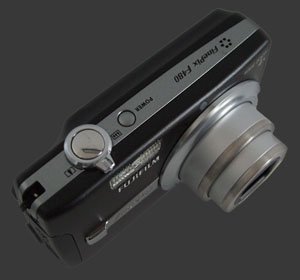
Fujifilm Finepix F480 Suitability - What is it good for?
The Fuji Finepix F480 is a very basic point-and-shoot digital camera with a wide-angle lens. Its 8 megapixels sensor and 4X optical zoom are just a bit more than the average ultra-compact, but it offers much less control than most cameras in its class. Even its low resolution movie-mode is quite dated.
As a purely point-and-shoot model, this is a snapshot-only camera. There are no controls over metering or any image parameters. Even setting the ISO sensitivity and using exposure-compensation requires the use of a particular scene mode.
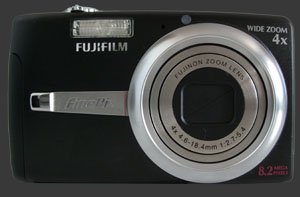
Its slim but sturdy camera body, measuring 0.9" thick, makes it easy to carry around safely. Plus,since its wide-angle lens28-112mm in 35mm-equivalent terms is well-suited for photography in tight places, this ultra-compact comfortably fits the bill as a social digital camera.
Fujifilm Finepix F480 Usability - How easy is it to use?
The Fuji Finepix F480 is equipped with a large 2.7" LCD display comprised of 230,000 pixels. The display can be brightened momentarily by pressing the up-arrow. Luckily, the visibility of the F480's display is rather good, because this ultra-compact, like most, does not have any other viewfinder.
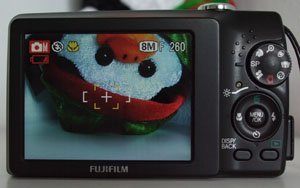
The shutter and zoom control wrapped around it are fairly standard. They are both very responsive and feel solid. The camera's body also feels sturdy but some buttons, like the OK button, just feel cheap and less responsive, sort-of sticky. Even the battery and memory door is better than average. However, the tiny latch that prevents the battery from falling out appears truly flimsy.
Body ergonomics are decent. Given its ultra-compact form-factor and relatively large LCD, the F480 is not so comfortable to hold. There is barely anything to hold on to one the cameras front and, at the rear, there is no place to put your thumb without overlapping the mode-dial or the LCD. We have seen worse, but we have also seen better, including the Fuji F470 and F10 models. Fuji provides a mid-quality wrist-strap for some security. The mode dial and 4-way controller are easy to reach, with the latter being prone to unintentional use.
The Fuji Finepix F480's 4-way controller activates some function while in shooting mode. Up brightens the LCD for a few seconds, Right cycles through flash-modes, Down activates the 2s or 10s self-timer and Left toggles macro mode. There are also dedicated push-buttons for entering playback mode and for changing the information displayed on the LCD. Using all these features is pretty straight forward.
The menu system has two levels. The first level, called Shooting Menu, is attractive and comprised of a variable number of items depending on the camera's mode. The second level, called Set-Up, is a very bland tabbed-menu which always shows the same options. Both are easy to navigate.
Unfortunately, for a camera that does so little, parts of the F480's interface are surprisingly convoluted. The main problem being the accessibility of features and how they interact with the mode dial. In Auto mode, the Shooting Menu presents 3 options: ISO, Quality and Continuous. There is also an always-present additional item for accessing the Set-Up menu. While in this mode the exposure-compensation and white-balance options are nowhere to be found, the ISO option is visible but displays no options other than Auto. In the Manual scene-mode, options for EC and WB make an appearance and the ISO option displays the camera's available ISO sensitivities, including Auto. It is a mystery why do some options disappear while others just provide one choice depending on the scene mode.
In Red Eye mode, not only are the flash modes limited to Red eye or Slow-sync redeye, but the Continuous option disappears from the menu system. In SP mode, the first level menu gets an additional option called Scene Position. The option displays the scene-mode selection screen. There is also a Digital Zoom mode that uses a fixed 3X digital zoom even if digital zoom is deactivated in the Set-Up menu. In this mode the zoom indicator bar colors become inverted with the normal zoom range painted blue and the digital zoom range painted transparent. As to not undo the Digital Zoom mode, the blue range becomes inaccessible. In Movie mode, the first level menu does not display any option.
All in all, using the Fuji Finepix F480 is not that hard because there are not that many features to use. The best is to keep the camera in SP mode using the Manual scene-mode. In this configuration, nearly all of the F480's features are readily accessible. Most importantly, this is the only way to control ISO, white-balance and exposure-compensation.
Fujifilm Finepix F480 Conclusion
The Fuji Finepix F480 is low-cost point-and-shoot camera with good image quality, mostly reasonable speed and a rare wide-angle lens. Its features are very limited and its interface somewhat convoluted, but it performs relatively well for an ultra-compact. Given its very low price, the F480 is a good value.
The point of the F480 is truly its affordable wide-angle lens. Buying this digital camera means giving up on photographic controls that most modern cameras have. For those who want to take snapshots by the push of a button, and never change any camera settings, the F480 is a probably good choice.
For more controls in an ultra-compact, we recommend looking at the Canon Powershot SD800 IS, also with a wide-angle lens, the Fuji Finepix F40fd or the higher resolution Fuji Finepix F50fd. Neither of these last two cameras feature a wide-angle lens though.
 |


|

Please Support Neocamera
All information on Neocamera is provided free of charge yet running this website is a huge endeavor. Purchases made via affiliate links found throughout the site help keep it running and up-to-date. There is no additional cost to you, so please consider buying via these links to our affilates:




Thank you for your support!


Fujifilm F480 Highlights


 Ultra-Compact digital camera
Sensor-Size: 6 x 4mm

Actual size when viewed at 100 DPI
| 8 Megapixels Ultra Compact | ISO 100-800 |
| 4X Wide Optical Zoom | Shutter 1/1500-4s |
| 0.6 FPS Drive, 3 Images | Lithium-Ion Battery |
| 320x240 @ 30 FPS Video Recording | Secure Digital High Capacity, xD Internal Memory |
| 2.7" LCD 230K Pixels |
Camera Bag


Your camera bag is empty. To add a camera or lens click on the star next to its name.
Your camera bag is empty.
Add cameras or lenses by clicking on the star next to their name.
Updates
2025.11.13

Best Gifts for Photographers in 2025 by Budget
The annual Neocamera Photography Gift Guide updated to 2025. Find great gifts for photographers with any price budget.
2025.07.07

Stellar Photo Recovery Review
Review of Stellar Photo Recovery V12. This Windows and MacOS software can recover photos and videos in a huge number of formats from memory cards, USB drives, SSDs and HHDs.
2025.05.14

Huion Kamvas 13 Gen 3 Review
In-Depth review of the Huion Kamvas 13 Gen 3 Pen Display Tablet for photographers and graphic artists.
2025.01.18

Fujifilm GFX 2025 Lens Roundup
Lens Review roundup of Fujifilm GFX Medium-Format lenses. Quality, performance and handling of the GF20-35mm F/4R WR, GF30mm F/3.5 Tilt-Shift and the GF55mm F/1.7.
2024.11.18

Best 2024 Photography Gifts for Every Budget
Great gifts for photographers and photo enthusiasts selected for every budget among the best products of 2024.
2024.08.07

Eye Protection Tips for Professional Photographers
The four main considerations for professional photographers regarding eyewear.
2024.07.14

Fujifilm X100VI Review
Flagship fixed-lens compact digital camera with a 40 MP sensor and Image-Stabilization, a first for the series. Retro design featuring dual control-dials, plus direct ISO, Shutter-Speed and EC dials. Its hybrid viewfinder can switch between EVF and OVF mode.
2024.05.09

Fujifilm GFX100 II Review
Flagship 102 Megapixels Medium-Format Mirrorless Digital Camera with 8-Stop 5-Axis IBIS, 8 FPS Drive, 8K Video and 400 MP Super-Resolution capture in a weatherproof and freezeproof body with dual control-dials and dual memory-card slots.
2024.04.03

Fujifilm X-T5 Review
Newest Fujifilm flagship boasting a 40 MP APS-C sensor, 5-axis IBIS with 7-stop efficiency, 15 FPS continuous drive, 6.2K Video capture, dual control-dials and dual SDXC UHS-II slots in a sturdy weatherproof and freezeproof body.
2023.11.20

Best Digital Cameras of 2023
Find out which are the Best Digital Cameras of 2023. All the new Mirrorless Digital Cameras from entry-level to high-end professional.
2023.07.10

Fujifilm X-H2 Review
40 Megapixels APS-C Hybrid Mirrorless Digital Camera with 7-stop IBIS. Fastest shutter ever and 8K video capture. Large builtin EVF with 0.8X magnification and 5.8 MP, plus an Eye-Start Sensor. Packed with features and large number of controls in a weatherproof and freezeproof body.
2023.05.07

Sony FE 20-70mm F/4G Review
Review of the unique Sony FE 20-70mm F/4G lens. The optical zoom of this lens spans ultra-wide-angle and medium focal-length coverage, making it one of the most versatile Full-Frame lenses on the market.
2025.11.13
2025.07.07
2025.05.14
2025.01.18
2024.11.18
2024.08.07
2024.07.14
2024.05.09
2024.04.03
2023.11.20
2023.07.10
2023.05.07