



 Camera Basics
 Camera Choosing
 Camera Models
 Camera Buying
 DSLR Buying

Fujifilm Finepix F30 Samples
 6 Megapixels
 Continuous Drive
 VGA Video: 640 x 480 or more but less than 1280 x 720.
 Custom White-Balance: Specifies exactly what should be white to the camera.
 Action Photography: Shutter speeds of 1/1500 or more.
 Night Photography: Reaches shutter-speeds longer than 4 seconds.
 Spot Metering
 Accepts xD memory.
 Neocamera detailed review
 Discontinued: No longer produced by the manufacturer. May still be in stock or found used.
 1 - Images2 - Indoor Crops3 - Outdoor Crops4 - Comparative Crops
Fujifilm Finepix F30 Comparative Crops
The Fuji Finepx F30 and the Canon EOS 20D are extremely different cameras. Yet we found one thing in common between them, an ISO range of 100-3200. Just for fun, and because we were curious, we unfairly compare them here. People who are looking at a DSLR for its image quality and not for its features or versatility may be seriously interested in this comparison which illustrates some striking differences between these 2 cameras.
Each image below is composed of half a 100% crop from an unmodified Fuji F30 image and half a 100% crop from an unmodified Canon 20D image using a Canon 28-105 F3.5-4.5 USM lens. The Fuji pictures were taken first and then the Canon 20D was set to the same exposure using full-manual mode, this was the easiest way to get consistent exposure. Other than that both cameras were on auto-focus and auto-white balance.
Look carefully at these images and then read our analysis below.
| Fuji Finepix F30 | Canon EOS 20D |
|---|---|
| ISO 100 | ISO 100 |
|
|
| ISO 400 | ISO 400 |
|
|
| ISO 1600 | ISO 1600 |
|
|
| ISO 3200 | ISO 3200 |
|
|




Unsurprisingly, these two cameras produce very different looking images. Here is a table analyzing the major differences.
| Noise | Noise levels are comparable but both cameras treat noise very differently. The 20D seems to have a noise-reduction system that softens details more and so its images appear less grainy at high-ISO. Nevertheless, there seems to be similar noise levels which is quite surprising between an ultra-compact and a DSLR. |
|---|---|
| Color | Colors are different due to different automatic white balances. As a result, colors from the 20D are much more accurate. Conversely, the Fuji Finepix F30 produces overly saturated colors. |
| Brightness | Even though the F-stop and shutter-speed of each image half are an exact match, crops from the Fuji appear brighter. This can be the result of two differences: ISO accuracy and dynamic-range. Canon and Fuji perhaps measure ISO differently, this would affect the overall brightness of images given the same exposure. The Canon 20D can also capture more dynamic range but since all JPEG images have the same 8-bit range, results from the 20D appear to have less contrast. Consequently, brightness will vary differently across the image. |
| Sharpness | Incredibly, images from the Fuji F30 appear much sharper. This is actually the most shocking observation since the 20D was equipped with a quality Canon lens. However, close inspection of images from the F30 show some sharpening artifacts, potentially explaining why the 20D images are visibly softer. This is actually our third batch of images since at first we thought the focus was incorrect. |
The fact that the F30 and the 20D are aimed at different market shows in this comparison Consumer-oriented cameras, like the F30, generally produce images with greater consumer appeal than SLR cameras. This means more saturated colors and sharper images. Such images make excellent prints without any image processing up to common print sizes. At this, the Fuji Finepix F30 seems to excel.
The Canon 20D, even when equipped with a quality lens, still produces softer images with less saturated colors. These images have less immediate punch but are usually preferred by sophisticated photographers who like realistic colors and do their own image processing. Over-sharpened images are more difficult to process because sharpening artifacts can be emphasized during processing.
In the end, the Fuji Finepix F30 is an extremely capable camera which produces very appealing images where the effect of image noise is similar to that of DSLR cameras, although both cameras treat it differently. Notice that the 20D softens its images as ISO increases to hide the effects of noise. If we were to sharpen and increase color saturation of images from the 20D, we could get very similar results from the 20D without any processing.
 |


|
 1 - Images2 - Indoor Crops3 - Outdoor Crops4 - Comparative Crops
Please Support Neocamera
All information on Neocamera is provided free of charge yet running this website is a huge endeavor. Purchases made via affiliate links found throughout the site help keep it running and up-to-date. There is no additional cost to you, so please consider buying via these links to our affilates:




Thank you for your support!


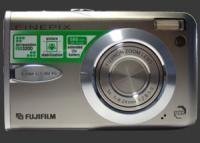
Fujifilm F30 Highlights


 Ultra-Compact digital camera
Sensor-Size: 8 x 6mm

Actual size when viewed at 100 DPI
| 6 Megapixels Ultra Compact | ISO 100-3200 |
| 3X Optical Zoom | Shutter 1/2000-15s |
| 2.2 FPS Drive, 3 Images | Custom white-balance |
| 640x480 @ 30 FPS Video Recording | Spot-Metering |
| 2.5" LCD 230K Pixels | Lithium-Ion Battery |
| xD, Internal Memory |
Camera Bag


Your camera bag is empty. To add a camera or lens click on the star next to its name.
Your camera bag is empty.
Add cameras or lenses by clicking on the star next to their name.
Updates
2026.09.08

The Wild Magic of Iceland Book Review
Review of The Wild Magic of Iceland by Norris Niman. A photographic journey through seasons.
2026.07.31

ZY Optics Pittura 30mm F/2.4 Medium-Format Lens Review
The ZY Optics Pittura 30mm F/2.4 is a manual lens designed exclusively for Medium-Format Digital Cameras. This fast prime lens captures a wide field-of-view, equivalent to a 24mm on Full-Frame. It is am affordable alternative to first-part GFX and XCD lenses.
2026.07.26

Fujifilm GFX100S II Review
Express review of the Fujifilm GFX100S II. This 102 MP Medium-Format Mirrorless Digital Camera packs an 5-Axis 8-Stop IBIS and a 5.8 MP 0.5" EVF showing 100% coverage at an extra-large 0.84X magnification. It is a more compact version of the flagship GFX100 II. This review covers exactly how these camera compare.
2026.07.14

Sony Alpha A7R VI Review
Extended In-Depth Review of the Sony Alpha A7R VI. This flagship Full-Frame Mirrorless Digital Camera combines ultra-high 67 MP resolution with very fast 30 FPS continuous shooting. It packs a 5-axis 8½-stop IBIS mechanism and an ultra-sensitive 759-Point Phase-Detect AF system. Its incredibly sharp 9.4 MP 0.64" EVF has a huge 0.9X magnification, 100% coverage, 10-bit HDR and 100% DCI-P3 color-space. Captures 8K video at 30 FPS or 4K video at 120 FPS.
2026.05.21

Laowa 4.5-10mm F/2.8 Fisheye Zoom Lens Review
In-depth review of the Venus Optics Laowa 4.5-10mm F/2.8 Fisheye Zoom Lens. This lens zooms from a circular to rectangular fisheye with an 180° viewing angle. This review analyses its optical quality, construction and handling.
2026.04.13

Laowa 17mm F/4 Zero-D Shift Review
In-Depth review of the Venus Optics Laowa 17mm F/4 Zero-D Shift Lens. This ultra-wide Shift lens is specifically designed for Mirrorless Digital Cameras and is available in 4 Full-Frame mounts plus 2 Medium-Format ones.
2025.11.13

Best Gifts for Photographers in 2025 by Budget
The annual Neocamera Photography Gift Guide updated to 2025. Find great gifts for photographers with any price budget.
2025.07.07

Stellar Photo Recovery Review
Review of Stellar Photo Recovery V12. This Windows and MacOS software can recover photos and videos in a huge number of formats from memory cards, USB drives, SSDs and HHDs.
2025.05.14

Huion Kamvas 13 Gen 3 Review
In-Depth review of the Huion Kamvas 13 Gen 3 Pen Display Tablet for photographers and graphic artists.
2025.01.18

Fujifilm GFX 2025 Lens Roundup
Lens Review roundup of Fujifilm GFX Medium-Format lenses. Quality, performance and handling of the GF20-35mm F/4R WR, GF30mm F/3.5 Tilt-Shift and the GF55mm F/1.7.
2024.11.18

Best 2024 Photography Gifts for Every Budget
Great gifts for photographers and photo enthusiasts selected for every budget among the best products of 2024.
2024.08.07

Eye Protection Tips for Professional Photographers
The four main considerations for professional photographers regarding eyewear.

