Camera Basics
 Camera Choosing
 Camera Models
 Camera Buying
 DSLR Buying

Fujifilm Finepix F10 Review
 6 Megapixels
 Continuous Drive
 VGA Video: 640 x 480 or more but less than 1280 x 720.
 Custom White-Balance: Specifies exactly what should be white to the camera.
 Action Photography: Shutter speeds of 1/1500 or more.
 Night Photography: Reaches shutter-speeds longer than 4 seconds.
 Spot Metering
 Accepts xD memory.
 Neocamera detailed review
 Discontinued: No longer produced by the manufacturer. May still be in stock or found used.
Fujifilm Finepix F10 Introduction
The Fuji Finepix F10 undeniably distinguishes itself from other ultra-compact cameras by its uncompromising 3X optical zoom lens, its superior 6 megapixel sensor and its spectacular battery life. This sturdy metallic ultra-compact digital camera may be bigger (1.1" thick) then most other ones in its class, but it can still be carried anywhere with ease. Additionally, its class-leading battery life of 500 shots per charge (CIPA standard) means not having to worry about its proprietary lithium-ion battery and its clunky charging system.
Fujifilm Finepix F10 Suitability - What is it good for?
Like most ultra-compact cameras, the Fuji F10 lacks in features and controls. It is a basic point-and-shoot camera with an almost typical feature set:
- ISO sensitivity selection: Auto, 80,100,200,400,800 and 1600.
- White balance: Auto, custom, sunlightlabeled Fine, cloudylabeled shade, fluorescent3 types and incandescent.
- Exposure compensation: -2..+2 stops, 1/3 stop increments.
- Metering control: Evaluative, center-weighed or spot.
- Drive modes: First 3-frames, last 3-frames, long continuous, self-timer.
- Focus modes: Center, multi-point, continuous.
- Focus distances: normal, high-speedsetup menu option, macro.
- Selection of shutter-speeds between 3 and 15 secondsin long-shutter mode.
- Unlimited 640x480 30 FPS Movie mode with sound.
Exposure is always automatic except when in night-scene mode with the long-shutter mode enabled via the setup menu. In this mode, the Fuji Finepix F10 locks its aperture at F5 but lets the user chose a shutter-speed between 3 and 15 seconds. Exposure compensation is provided to adjust the exposure but it does not work while the flash is in automatic mode.
The F10's most distinguished feature is its wide-selection of ISO sensitivities. With values from 80 all the way to 1600, the Fuji F10 goes much beyond the typical non-SLR digital camera, regardless of size. Even more outstanding than having a wide-selection of ISO sensitivities is having them all with very low noise at full resolution. Astonishingly, the Fuji F10 holds its own very well, even compared to some low-end DSLR cameras!
Other notable features of the F10 are its first-rate movie mode and several useful drive modes. Only a few other digital cameras offer 640x480 30 FPS movie mode with no time or file-size limits. As for drive modes, the last 3-frames mode is very valuable for taking action pictures. In this mode, the camera continuously takes pictures at 3 FPS until the shutter is released and then saves the last 3 pictures taken (the others are discarded). Fuji designed this mode thinking about photographers who want to anticipate action. The other 2 continuous drive modes are rather typical: either 3 images at 3 FPS or 40 images at less than 1 FPS.
Fujifilm Finepix F10 Usability - How easy is it to use?
The Fuji F10 is first of all a point-and-shoot digital camera. As such, it is easy to use and doesn't have enough features to distract users from taking pictures. Framing is done using a nice 2.5" LCD which can be brightened momentarily by pressing the up-arrow. This works well except in very bright light where the lack of an optical viewfinder makes framing a challenge. Otherwise, the LCD is very sharp and quite fluid. The shutter button also has a very nice feel with its large size and hard-to-miss halfway point.
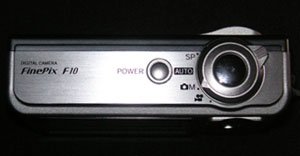
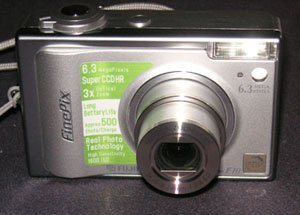
The metallic F10 feels solid and is fairly comfortable to hold thanks to a depression for the thumb on its rear, just below the zoom-controller, and a curved front element. Even the shutter-like lens cover is metallic which is more sturdy than most competing models. Fuji supplies a sturdy wrist-strap to keep it from falling. The strap also has a tightening element which can be used to securely attach the camera to your wrist. Due to the large LCD and the presence of a rear-mounted buttons, the F10 has neither room for an optical viewfinder nor room for your thumb anywhere other than directly below the zoom-controller. This makes its possible to accidentally press the 'F' button (see description below).
The Fuji Finepix F10 has a limited number of external controls. The only 3 functions which can be used without entering some kind of menu are macro on/off, flash-modes and the self-timer. Other functions are reached either by the 'F' button or the 'Menu' button (located in the center of the 4-way controller). The 'F' button is a Fuji classic, it serves to enter a small menu of commonly used settings. In this menu, the F10 provides 3 settings: image resolution, ISO and color mode. Notice that ISO is the only truly common setting in this menu? This is where the ergonomics of the F10 start lacking. In this menu most users would expect to see at least white-balance and exposure compensation (and ISO of course). There is clearly room for adding these 2 settings without removing the rarely used ones (image resolution and color-mode - who changes these more frequently than exposure compensation?).
The full menu of the Fuji F10 is called by the 'Menu' button. This menu is organized in numbered vertical tabs, each with between 1 and 6 items. Each item is only visible as an icon until it is highlighted. This means that if you don't remember what an icons looks like (try guessing the icon for 'Format Card'), you have to highlight each item in turn while watching the heading change near the top of the LCD screen. Once an item is selected, the right arrow enters the selection sub-menu which is also displayed as icons only until it is highlighted. The setup menu is entered using the last item of the first tab of the full menu. It is disorganized in the same manner as the full menu. The menu system is this cameras weakest point because it makes it tedious to change commonly used settings.
Several items in the menu system can appear greyed-out when they cannot be used. This is a normally expected behavior which serves to prevent users from changing inapplicable settings. For some reason Fuji did not do that for exposure compensation! Fine-print in manual says that exposure compensation is disabled if the flash is in automatic mode, in redeye reduction mode or in forced-flash mode when its too dark. When any of these situations occur, Fuji should disable the exposure compensation menu item. That would prevent people from concluding that the exposure compensation control does not work! Additionally, this is the first time we encountered these limitations and perhaps Fuji could remove them instead.
The zoom controller has a nice feel to it but provides too few zoom steps to be able to tightly frame a particular subject. There is also a button to enter playback mode. Playback mode is speedy and well implemented except for its menu which has the same shortcomings as the record-mode menu. It is easy to rapidly exit playback mode: Either press the playback button again or press the shutter-button halfway.
Recharging and connecting the Fuji F10 is rather clunky. The custom battery of the Fuji F10 is charged in the camera itself. Normally this would be quite simple, but to do so with the F10, one must connect the F10 to the terminal adapter, connect the terminal adapter to the AC/DC converter, connect the converter to the extension cord and then plug the cord into an outlet! Optionally, Fuji sells an appropriate external charger. The terminal adapter also serves to connect the camera to a computer (via USB) or to a television (via RCA jacks). The battery goes in using a plastic door that also covers the xD card slot. Unfortunately the battery compartment does not have a latch, so it can easily fall out while changing the xD card. Speaking of cards, xD cards are quite expensive which adds to the price of this camera.
Fujifilm Finepix F10 Conclusion
The Fuji Finepix F10 is an excellent ultra-compact. None of its weaknesses such as poor ergonomics, klunky charging system, expensive memory and limited feature set can detract from the fact that this camera takes fantastic pictures. The purpose of a camera is to take pictures and the F10 does this exceptionally well. Great color, edge-to-edge sharpness and low noise make pictures from the F10 outstanding. The F10 can also take more pictures on a single battery charge than most other digital cameras. This is also a very responsive camera. Among its class, the F10 is ultra-compact, takes better pictures, takes more pictures and takes them faster. That is what matters the most for a digital camera!
 |


|

Please Support Neocamera
All information on Neocamera is provided free of charge yet running this website is a huge endeavor. Purchases made via affiliate links found throughout the site help keep it running and up-to-date. There is no additional cost to you, so please consider buying via these links to our affilates:




Thank you for your support!


Fujifilm F10 Highlights
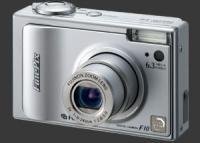


 Ultra-Compact digital camera
Sensor-Size: 8 x 6mm

Actual size when viewed at 100 DPI
| 6 Megapixels Ultra Compact | ISO 80-1600 |
| 3X Optical Zoom | Shutter 1/2000-15s |
| 2.2 FPS Drive, 3 Images | Custom white-balance |
| 640x480 @ 30 FPS Video Recording | Spot-Metering |
| 2.5" LCD 115K Pixels | Lithium-Ion Battery |
| xD |
Camera Bag


Your camera bag is empty. To add a camera or lens click on the star next to its name.
Your camera bag is empty.
Add cameras or lenses by clicking on the star next to their name.
Updates
2026.07.14

Sony Alpha A7R VI Review
Extended In-Depth Review of the Sony Alpha A7R VI. This flagship Full-Frame Mirrorless Digital Camera combines ultra-high 67 MP resolution with very fast 30 FPS continuous shooting. It packs a 5-axis 8½-stop IBIS mechanism and an ultra-sensitive 759-Point Phase-Detect AF system. Its incredibly sharp 9.4 MP 0.64" EVF has a huge 0.9X magnification, 100% coverage, 10-bit HDR and 100% DCI-P3 color-space. Captures 8K video at 30 FPS or 4K video at 120 FPS.
2026.05.21

Laowa 4.5-10mm F/2.8 Fisheye Zoom Lens Review
In-depth review of the Venus Optics Laowa 4.5-10mm F/2.8 Fisheye Zoom Lens. This lens zooms from a circular to rectangular fisheye with an 180° viewing angle. This review analyses its optical quality, construction and handling.
2026.04.13

Laowa 17mm F/4 Zero-D Shift Review
In-Depth review of the Venus Optics Laowa 17mm F/4 Zero-D Shift Lens. This ultra-wide Shift lens is specifically designed for Mirrorless Digital Cameras and is available in 4 Full-Frame mounts plus 2 Medium-Format ones.
2025.11.13

Best Gifts for Photographers in 2025 by Budget
The annual Neocamera Photography Gift Guide updated to 2025. Find great gifts for photographers with any price budget.
2025.07.07

Stellar Photo Recovery Review
Review of Stellar Photo Recovery V12. This Windows and MacOS software can recover photos and videos in a huge number of formats from memory cards, USB drives, SSDs and HHDs.
2025.05.14

Huion Kamvas 13 Gen 3 Review
In-Depth review of the Huion Kamvas 13 Gen 3 Pen Display Tablet for photographers and graphic artists.
2025.01.18

Fujifilm GFX 2025 Lens Roundup
Lens Review roundup of Fujifilm GFX Medium-Format lenses. Quality, performance and handling of the GF20-35mm F/4R WR, GF30mm F/3.5 Tilt-Shift and the GF55mm F/1.7.
2024.11.18

Best 2024 Photography Gifts for Every Budget
Great gifts for photographers and photo enthusiasts selected for every budget among the best products of 2024.
2024.08.07

Eye Protection Tips for Professional Photographers
The four main considerations for professional photographers regarding eyewear.
2024.07.14

Fujifilm X100VI Review
Flagship fixed-lens compact digital camera with a 40 MP sensor and Image-Stabilization, a first for the series. Retro design featuring dual control-dials, plus direct ISO, Shutter-Speed and EC dials. Its hybrid viewfinder can switch between EVF and OVF mode.
2024.05.09

Fujifilm GFX100 II Review
Flagship 102 Megapixels Medium-Format Mirrorless Digital Camera with 8-Stop 5-Axis IBIS, 8 FPS Drive, 8K Video and 400 MP Super-Resolution capture in a weatherproof and freezeproof body with dual control-dials and dual memory-card slots.
2024.04.03

Fujifilm X-T5 Review
Newest Fujifilm flagship boasting a 40 MP APS-C sensor, 5-axis IBIS with 7-stop efficiency, 15 FPS continuous drive, 6.2K Video capture, dual control-dials and dual SDXC UHS-II slots in a sturdy weatherproof and freezeproof body.
2026.07.14
2026.05.21
2026.04.13
2025.11.13
2025.07.07
2025.05.14
2025.01.18
2024.11.18
2024.08.07
2024.07.14
2024.05.09
2024.04.03