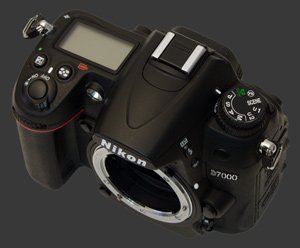
There are far fewer DSLR camera models than other types of digital cameras. However, models from a given manufacturer have many similarities and most DSLR cameras have a very similar feature set. While all DSLR cameras produce very high-quality images, most cameras from Panasonic and Olympus are slightly below the rest. This page is designed to help choosing the right DSLR camera.
Here is the line-up of current DSLR models in terms of how they compare to each other. Links to the review summaries are provided if available. |
Highest-End
Canon EOS 5D


With a 12 megapixel full-frame sensor, the Canon 5D is the undisputed resolution and image noise champion. |
Fuji Finepix S5 Pro


A DSLR with a unique sensor which delivers images of greater dynamic range than any other.
|
Nikon D200


With its 10 megapixel sensor and 5 FPS continuous drive, this camera undercuts the Canon 5D's price with an even better feature set.
|
Nikon D300


With a 12 megapixels sensor, 8 FPS continuous drive mode, builtin dust reduction, a 100% viewfinder and a highly customizable interface, the D300 is suitable for every type of professional photography.
|
|
|

Higher-End
Canon EOS 40D


A great 10 megapixels camera adapted to action photography with 6.5 FPS shooting and fast focusing. Produces high-quality images with a relatively low amount of sound. |
Canon EOS 30D


The replacement for the 20D still distinguishes itself by its 5 FPS continuous shooting, operating speed and image sharpness which makes it perfect for action photography. |
Canon EOS 20D


This camera distinguishes itself by its 5 FPS continuous shooting, operating speed and image sharpness which makes it perfect for action photography. |
Konica-Minolta Maxxum 7D


The 7D is one among two low-light photography champions thanks to its extremely low-noise and built-in Anti-Shake. Great ergonomics with plenty of external controls and build quality round off this camera as an excellent photographic tool.
|
Nikon D80


The D80 shares a similar 10 megapixel sensor with the D200 and uses the same viewfinder and focusing system. This camera mainly lacks its siblings 5 FPS drive and weather-proofed body.
|
Pentax K10D


The Pentax K10D is one of the most advanced cameras on the market with a 10 megapixel sensor, built-in shake-reduction, built-in dust-reduction, a weather-proofed body and the largest viewfinder of non-full-frame cameras. Outstanding ergonomics and several unique features complete this highly regarded DSLR.
|
Pentax K20D


The Pentax K20D is one of the most advanced cameras on the market with a 14.6 megapixel sensor supporting ISO up tp 6400, built-in shake-reduction, built-in dust-reduction, dust-detection, a weather-proofed body and the largest viewfinder of non-full-frame cameras.
|
Sony Alpha A700


This 12 megapixel features ISO sensitivities up to 6400, unlimited 5 FPS continuous drive, body-based stabilization, dust-reduction, great ergonomics and many advanced features. Image quality is excellent except at long shutter-speeds where it is still good but not top-notch. |
|

High-End
Canon Digital Rebel XTi


The Rebel XTi features a low-noise and high-detail 10 megapixel sensor plus built-in dust-reduction. Although it lacks spot-metering, the XTi has the performance of other high-end DSLR cameras.
|
Nikon D70s


The D70s distinguishes itself by its superior build quality and large body which makes it well suited for rough environments. Image quality is slightly nosier and softer than competitors.
|
Olympus E-500


This camera includes Olympus' unique sensor cleaning technology, sophisticated metering system, in-camera RAW conversions and unlimited continuous shooting. On the- downside, the E-500 is noisier and has the smallest viewfinder among its class.
|
Olympus E-510


This camera includes built-in stabilization, sensor cleaning technology, sophisticated metering system, in-camera RAW conversions and unlimited continuous shooting. On the- downside, the E-510 is has one of the smallest viewfinders.
|
Panasonic L1


The Panasonic L1 has the guts of an Olympus E330 and the design of a Leica rangefinder. On the plus side it features dust-reduction and an LCD-preview. On the negative side, the L1 produces noisier than average images and has the smallest and darkest viewfinder of any DSLR.
|
Pentax K100D


The K100D is the latest low-light photography champion thanks to its extremely low-noise and built-in Shake Reduction. It produces high quality images with outstanding simplicity. Its price, stabilization, use of AA batteries and lens compatibility give it superb value.
|
Pentax *ist DS2
Samsung GX1-S


This camera shows outstanding simplicity and ergonomics. It has the largest and clearest viewfinder in its class, uses standard AA batteries, uses SD cards for memory and the lightest DSLR in its class. |
Sony Alpha A100


This 10 megapixel camera features unlimited 3 FPS continuous drive, body-based stabilization, hardware dust-reduction, good ergonomics and many other great features. Its image quality is superb until you reach ISO 800 which is noisier than other modern DSLR cameras with the same sensor size. |
|

Entry Level
Canon Digital Rebel XT


The Rebel XT has currently the highest resolution and image quality of any entry-level DSLR. It also has very sophisticated control over white-balance.
|
Konica-Minolta Maxxum 5D


The 5D ties the Konica-Minolta Maxxum 7D as the low-light photography champion thanks to the same extremely low-noise levels and built-in Anti-Shake. It differs from the 7D in its simplified control layout but nevertheless is outstandingly ergonomic.
|
Nikon D40


One of the smallest DSLR cameras and the most limited feature-wise, the Nikon D40 still performs quickly and produces reasonable good images.
|
Nikon D40X


An upgraded Nikon D40 with 10 megapixels, the D40X is still one of the smallest DSLR cameras and the most limited feature-wise. The Nikon D40X shows good image quality and speed of operation.
|
Nikon D50


The Nikon D50 is the sturdiest camera in its class and features good continuous shooting up to 12 images at 2.5 FPS. Image quality is slightly nosier and softer than competitors. This camera uses SD cards and lacks a depth-of-field preview function.
|
Olympus E-300


Just like the E-500, this camera includes Olympus' sensor cleaning technology. On the downside, the E-300 features the lowest image quality of current DSLR cameras, particularly with respect to noise. It also has the second darkest and smallest viewfinder.
|
Olympus E-330


This is an updated version of the E-300 which the feature set of the E-500 and an LCD which can be used to frame images at odd angles compared to other DSLR cameras. The downsides of this camera include the lowest image quality in terms of noise and lack of details of any DSLR and the darkest viewfinder of them all.
|
Olympus E-410


The E-410 compromises on ergonomics and external controls to be the smallest DSLR to date, including a tiny viewfinder. Otherwise, it does a decent feature set with sophisticated metering, sensor cleaning and an unlimited 3 FPS continuous drive.
|
Pentax *ist DL


Another Pentax camera showing outstanding simplicity, very light weight and low cost is the Pentax *ist DL. This camera uses standard AA batteries for power and SD cards for storage. |
Pentax *ist DL2
Samsung GX1-L

Another Pentax camera showing outstanding simplicity, very light weight and low cost is the Pentax *ist DL2. This camera uses standard AA batteries for power and SD cards for storage. |
Pentax K110D

The Pentax K110D produces high quality images with outstanding simplicity. Its price, top-sensitivity of ISO 3200, use of AA batteries and lens compatibility make it a great starter DSLR. |
Sony Alpha A200


This 10 megapixel camera features unlimited 2.8 FPS continuous drive, body-based stabilization, hardware dust-reduction and excellent image quality and speed in a simple and easy to use design. |
 |