Camera Basics
 Camera Choosing
 Camera Models
 Camera Buying
 DSLR Buying

Pentax K10D Review
 10 Megapixels
 Single Lens Reflex
 Stabilization: Compensates for tiny involuntary movements of the camera.
 Continuous Drive
 Manual Controls: Both fully-manual (M) and semi-automatic modes (T and V).
 Custom White-Balance: Specifies exactly what should be white to the camera.
 Action Photography: Shutter speeds of 1/1500 or more.
 Night Photography: Reaches shutter-speeds longer than 4 seconds.
 Hotshoe: Allows external flash units to be attached.
 Spot Metering
 Depth-Of-Field Preview: Improve perception of DOF before shooting.
 Weatherproof - Seals protect from dust, humidity and light splashing.
 Accepts Secure Digital High Capacity (SDHC) and SD memory.
 Neocamera detailed review
 Discontinued: No longer produced by the manufacturer. May still be in stock or found used.
 1 - Capability2 - Usability3 - Performance
Pentax K10D Introduction
With the K10D, Pentax has the most feature-rich 10 megapixels DSLR currently available. This digital SLR camera boasts built-in stabilization, dust-reduction, weather-sealing, unlimited continuous shooting, the largest viewfinder among cropped-sensor cameras, and a wealth of unique photographic controls. Of course, image quality, performance and usability are just as important as features. As such, the K10D became the most anticipated camera of 2006. After all, with all those advanced features, photographers want this camera to excel at image quality.
This review takes a close look at the K10D's features, ergonomics, usability, image quality, performance and unique photographic controls. Similarly to most recent DSLR cameras, the K10D sports the following features:
- 10 Megapixels image sensor, 1.5X crop-factor.
- Automatic and selectable ISO from 100 to 1600.
- 1/4000s to 30s shutter-speeds, plus bulb mode
- Exposure compensation, -3..+3 EV, 1/5 EV inc or -2..+2, 1/3 EV
- Automatic, preset, kelvin and custom white-balance, all fine-tunable
- 11-point auto-focus system, with 9 cross-type points.
- Focus-point selection: automatic, manual or center.
- Focus modes: single-shot, continuous and manual.
- Metering modes: multi-segment, center-weighed and spot
- Full manual controls, including PASM modes.
- Exposure bracketing, 3 or 5 images, 0.3-2 EV inc.
- Contrast, saturation, sharpness and white-balance bracketing, 3 images.
- Self-timers: long and short with automatic mirror-lock-up
- Auto-Exposure-Lock, Auto-Focus-Lock and auto-focus override
- Customizable saturation, sharpness and contrast, 7 steps
- 2.5” LCD 210K Pixels, 140 degree viewing-angle
- 0.95X Magnification viewfinder, 95% coverage
- Image review with magnification and histogram, luminance and RBG
- Depth-of-field preview
- JPEG and RAW modes
- Built-in flash
- Lithium-ion battery
- Secure Digital High Capacity memory
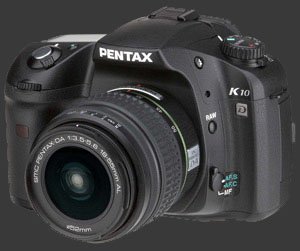
The Pentax K10D also stands-out by having all of the following advanced features, several of them being unique to this digital SLR camera:
- Shake-reduction, provides stabilization to all lenses at no additional cost
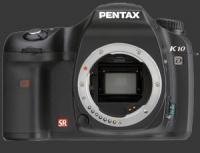
- Dust-reduction, diminishes the necessity of cleaning the image sensor
- Weather-seals, enables photography in adverse weather
- Unlimited 3 FPS continuous shooting
- Auto-ISO with selectable minimum and maximum
- Unique hyper-program, sensitivity-priority, hyper-manual and shutter-aperture-priority modes
- Direct ISO control in sensitivity-priority mode and optionally in aperture-priority and shutter-priority modes
- Dual-control wheels, for efficient parameter selection and navigation
- Multi-exposure photography mode
- In-camera RAW image conversions
- Selectable DNG or proprietary RAW file format
- Support for huge selection of legacy Pentax lenses.
- Illuminated top status panel
Pentax K10D Suitability - What is it good for?
Since DSLR cameras represent the high-end of digital cameras, they are generally suitable for most types of photography. The versatility of interchangeable lenses brings SLR cameras their greatest potential. The Pentax K10D is no exception, it is suitable for every type of photographic subject.
Feature-wise, a few DSLR cameras are better suited for action-photography. Even though the K10D can shoot at 3 FPS indefinitely, some cameras can shoot faster. Specifically, the 8 megapixels Canon EOS 30D and the 10 megapixels Nikon D200 both shoot continuously at up to 5 FPS.
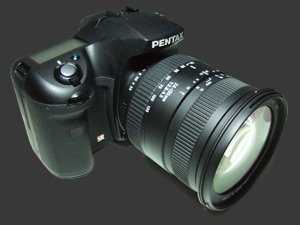
For specific photographic subjects, lens versatility is quite important. While the Pentax K10D supports an incredibly large collection of lenses, most of these lenses are no longer in production. In terms of modern lenses, Pentax offers a rather small lineup, certainly smaller than the lineups of Canon and Nikon. Alternate lenses with common focal-lengths are available from third-party manufacturers such as Sigma and Tokina.
The Pentax K10D is larger and weighs more than similarly priced DSLR cameras. This, plus its weather-sealed body, makes it more suitable for rougher environments. Conversely, its bulk is more noticeable and less discrete. This is somewhat a disadvantage for street and candid photography. Indeed, during testing this camera was noticed more than any other. While the smallest 10 megapixels DSLR, the Canon Digital Rebel XTi, weighs roughly 30% less, it is worth noting that the lens used can significantly contribute to a camera's bulk.
Pentax K10D Capability - What can it do?
As noted in the introduction, the Pentax K10D has everything expected from a DSLR plus an impressive amount of extra features. Headline features include built-in stabilization, called Shake Reduction by Pentax, a dust-reduction mechanism, a weatherproof body, unlimited continuous drive and selectable RAW image formats, either Pentax's PEF or Adobe's DNG. Built-in stabilization is not only a cost-saving feature, it also works with all lenses, even those without any stabilized counterparts such as prime, bright, tilt-shift and fish-eye lenses.
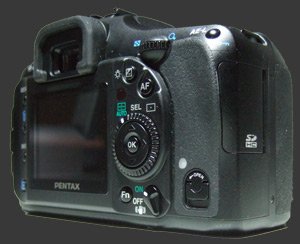
The Pentax K10D's power-switch has 3 positions: off, on and preview. The preview position is used for depth-of-field preview and digital preview. In all shooting modes, the behavior of the preview button is controlled by a setup option. Depth-of-field preview simply stops down the lens aperture to the one metered or set manually, this is the usual behavior. Digital preview takes a picture without storing it and displays it on the LCD. The digital preview is also used when setting white-balance. This is an innovative way to ensure that the proper white-balance is selected. While scrolling through white-balance options and fine-tuning white-balance, the preview image is updated accordingly.
The shutter-release on this DSLR is a standard 2-stage release with a distinct halfway point. By default, pressing the shutter-release halfway locks focus but not exposure. Exposure can be locked using a dedicated AEL-button or by pressing the shutter-release halfway when a custom option is set. Focus can also be locked by a separate AF-button which can be configured to disable auto-focus instead. When exposure is locked, whether using the AEL-button or half-pressing the shutter-release, an asterisk is displayed in the viewfinder. This is an important indication of which behavior is in effect.
 The mode dial of the Pentax K10D has 10 positions. Five of these modes are ubiquitous on modern DSLR cameras: automatic (called Green-mode), program (P), shutter-priority (Tv), aperture-priority (Av) and full manual (M) mode. Notably absent from the mode-dial are scene modes which frequently control the camera in mysterious ways. The remaining 5 modes are: sensitivity-priority (Sv), shutter-aperture-priority (TAv), bulb (B) and flash-sync (X). Sensitivity-priority is unique to the Pentax K10D, letting the user directly select the ISO sensitivity. Shutter-aperture-priority complements sensitivity-priority by letting the user select both shutter-speed and aperture, letting the camera select the ISO sensitivity. Bulb mode keeps the shutter open as long as the shutter-release is pressed, other DSLRs make it part of manual (M) mode. Finally, flash-sync mode keeps the shutter-speed at 1/180 which is the flash-sync speed. Surrounding the mode-dial is the metering selection switch. The 3 metering modes available are 16-segment metering, center-weighed metering and spot-metering.
The Pentax K10D has detailed control over white-balance including automatic white-balance, preset white-balance [daylight, shade, cloudy, tungsten, flash and 3-types of fluorescent], manual white-balance and color-temperature. All white-balance options can be fine-tuned in 15-steps from blue to amber and magenta to green. White-balance fine-tuning can be reset by simply pressing the green button from the preview screen.
Exposure compensation can be adjusted in 1/2 or 1/3 EV increments using the exposure compensation button combined with a control-wheel. When the increments are set to 1/2, the range is -3 to +3 EV. Otherwise, the range is -2 to +2 EV. The Pentax K10D can bracket exposure for 3 or 5 frames, with increments between 1/3 and 2 EV. It also supports extended bracketing which produces 3 images from one image capture. Images can vary in saturation, sharpness, contrast or white-balance. Flash compensation can be adjusted between -2 and +1 EV using the function menu.
This DSLR supports the standard drive modes [single, continuous, self-timer, remote-control] and multiple exposure. In continuous drive mode, the Pentax can shoot an unlimited number of JPEG images or up to 9 RAW images. Continuous shooting speed is always around 3 FPS. The self-timer can trigger after 2 or 12 seconds. With the 2-second self-timer, the mirror is automatically locked-up. Unfortunately, the 12-second self-timer does not reset after each use. This would avoid the common mistake of forgetting to reset the long self-timer. This is so simple that Pentax could correct this using a firmware update. Multiple-exposure can combine between 2 and 9 images with or without automatic exposure adjustment.
Every DSLR can produce both RAW and JPEG images but the Pentax K10D adds two extra features to its RAW support. The first feature is a choice of format, either Pentax's PEF or Adobe's DNG. The main difference is that PEF is more precisely suited to the K10D while DNG is more portable. The second feature is in-camera RAW development. This feature allows to use RAW images without spending time using conversion software. The difference between capturing JPEG images and processing RAW-images in-camera is that white-balance, image parameters and sensitivity can be adjusted after capture. To aid experimentation with RAW images, the K10D also has a dedicated button to take the next shot in RAW+JPEG mode.
 |


|
 Next1 - Capability2 - Usability3 - Performance
Please Support Neocamera
All information on Neocamera is provided free of charge yet running this website is a huge endeavor. Purchases made via affiliate links found throughout the site help keep it running and up-to-date. There is no additional cost to you, so please consider buying via these links to our affilates:




Thank you for your support!


Pentax K10D Highlights


 SLR digital camera
Sensor-Size: 24 x 16mm

Actual size when viewed at 100 DPI
| 10 Megapixels DSLR | ISO 100-1600 |
| Pentax K Mount 1.5X FLM | Shutter 1/4000-30s |
| 2-Axis Built-in Stabilization | Full manual controls, including Manual Focus |
| 95% Coverage Large Viewfinder | Custom white-balance with 2 axis fine-tuning |
| Weatherproof | Spot-Metering |
| Built-in Dust Reduction | Hot-Shoe & Sync-Port |
| 3 FPS Drive, Unlimited Images | Lithium-Ion Battery |
| 2.7" LCD 230K Pixels | Secure Digital High Capacity |
Camera Bag


Your camera bag is empty. To add a camera or lens click on the star next to its name.
Your camera bag is empty.
Add cameras or lenses by clicking on the star next to their name.
Updates
2026.09.08

The Wild Magic of Iceland Book Review
Review of The Wild Magic of Iceland by Norris Niman. A photographic journey through seasons.
2026.07.31

ZY Optics Pittura 30mm F/2.4 Medium-Format Lens Review
The ZY Optics Pittura 30mm F/2.4 is a manual lens designed exclusively for Medium-Format Digital Cameras. This fast prime lens captures a wide field-of-view, equivalent to a 24mm on Full-Frame. It is am affordable alternative to first-part GFX and XCD lenses.
2026.07.26

Fujifilm GFX100S II Review
Express review of the Fujifilm GFX100S II. This 102 MP Medium-Format Mirrorless Digital Camera packs an 5-Axis 8-Stop IBIS and a 5.8 MP 0.5" EVF showing 100% coverage at an extra-large 0.84X magnification. It is a more compact version of the flagship GFX100 II. This review covers exactly how these camera compare.
2026.07.14

Sony Alpha A7R VI Review
Extended In-Depth Review of the Sony Alpha A7R VI. This flagship Full-Frame Mirrorless Digital Camera combines ultra-high 67 MP resolution with very fast 30 FPS continuous shooting. It packs a 5-axis 8½-stop IBIS mechanism and an ultra-sensitive 759-Point Phase-Detect AF system. Its incredibly sharp 9.4 MP 0.64" EVF has a huge 0.9X magnification, 100% coverage, 10-bit HDR and 100% DCI-P3 color-space. Captures 8K video at 30 FPS or 4K video at 120 FPS.
2026.05.21

Laowa 4.5-10mm F/2.8 Fisheye Zoom Lens Review
In-depth review of the Venus Optics Laowa 4.5-10mm F/2.8 Fisheye Zoom Lens. This lens zooms from a circular to rectangular fisheye with an 180° viewing angle. This review analyses its optical quality, construction and handling.
2026.04.13

Laowa 17mm F/4 Zero-D Shift Review
In-Depth review of the Venus Optics Laowa 17mm F/4 Zero-D Shift Lens. This ultra-wide Shift lens is specifically designed for Mirrorless Digital Cameras and is available in 4 Full-Frame mounts plus 2 Medium-Format ones.
2025.11.13

Best Gifts for Photographers in 2025 by Budget
The annual Neocamera Photography Gift Guide updated to 2025. Find great gifts for photographers with any price budget.
2025.07.07

Stellar Photo Recovery Review
Review of Stellar Photo Recovery V12. This Windows and MacOS software can recover photos and videos in a huge number of formats from memory cards, USB drives, SSDs and HHDs.
2025.05.14

Huion Kamvas 13 Gen 3 Review
In-Depth review of the Huion Kamvas 13 Gen 3 Pen Display Tablet for photographers and graphic artists.
2025.01.18

Fujifilm GFX 2025 Lens Roundup
Lens Review roundup of Fujifilm GFX Medium-Format lenses. Quality, performance and handling of the GF20-35mm F/4R WR, GF30mm F/3.5 Tilt-Shift and the GF55mm F/1.7.
2024.11.18

Best 2024 Photography Gifts for Every Budget
Great gifts for photographers and photo enthusiasts selected for every budget among the best products of 2024.
2024.08.07

Eye Protection Tips for Professional Photographers
The four main considerations for professional photographers regarding eyewear.
2026.09.08
2026.07.31
2026.07.26
2026.07.14
2026.05.21
2026.04.13
2025.11.13
2025.07.07
2025.05.14
2025.01.18
2024.11.18
2024.08.07