



 Camera Basics
 Camera Choosing
 Camera Models
 Camera Buying
 DSLR Buying
Camera Bag Guide
Introduction
Finding the perfect camera bag is not as difficult as finding the right camera, but there are much more brands and shapes of camera bags than there are digital cameras. Since the equipment combinations that one must carry are nearly infinite, it is impossible to precisely recommend a specific camera bag model. Instead, we present common types of camera bags, discuss their advantages and disadvantages and present several models available in a variety of sizes. Because different types of camera bags suit different situations, it may be useful to own several types of models but beware that some camera bags can cost more than some cameras.
Holdster
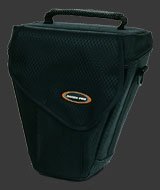 Camera holsters are designed to hold a single camera with a minimum number of small accessories. Typically, they have one or two pockets to keep extra batteries, extra memory and a camera cleaning cloth. Holsters are usually held with a wide shoulder strap. Some models also include a belt loop.
Holdsters can fit the largest fixed-lens camera or a non-pro DSLR with a single general purpose lens. This is the most common type of bag for ultra-zoom digital cameras. People who buy DSLR cameras and use them as fixed-lens cameras, either by buying only the kit lens or a single large zoom-factor lens, can easily manage with a holster.
When the size is right, these bags are very practical. They keep the camera in sight and accessible at all times. The only times when holsters are less than ideal is while doing activities which require a lot of mobility such as mountain climbing. Due to their small size, they are rarely very disruptive.
Nearly every camera bag manufacturer produces holsters for fixed-lens cameras. Several make holsters for a DSLR equipped with a relatively large lens. The larger models from Lowepro also feature all-weather covers to protect against heavy rain.
Advantages
- Very light weight.
- Camera remains easily accessible.
- Bag is visible while being worn.
- Counts as a personal item which can be brought in addition to one piece of carry-on on most flights.
Disadvantages
- Dangles unless equipped with belt-loops.



Belt Pack
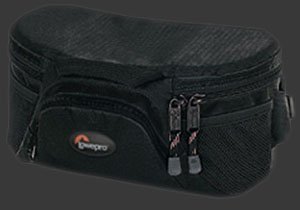
Belt packs are mid-sized camera bags which are worn at the waist. These bags typically have a large padded belt to secure them to the wearer's hips. Belt packs can be large enough to hold a DSLR, several lenses and other mid-size accessories like external flashes. This type of bag can feature several pockets and special hooks at attach secondary bags for extra lenses and accessories.
Since belt packs are wide but normally relatively shallow, most equipment remains easily accessible when opening the top lid. The best belt packs are designed to open away from the photographer so that the lid stays away while the bag's contents are accessed. Having the camera bag fixed to the wearer's waist creates a comfortable distribution of weight. Additionally, most belt packs keep camera gear reachable and visible at all times.
On the downside, belt packs can be a hindrance for some movements like crouching. Smaller ones can be temporarily pushed to the side, but not a larger fully-loaded one. Sitting down with a chunky belt pack can also be difficult. That means that stopping for a snack often means having to take off the belt pack and keeping an eye on it.
Advantages
- Comfortable distribution of weight.
- Equipment remains easily accessible.
- Bag is visible while being worn.
- Generally counts as a personal item which can be brought in addition to one piece of carry-on on most flights.
Disadvantages
- Sitting and crouching is difficult.
- All but the smallest belt packs have to be removed while sitting. This is a security risk in public areas.
Shoulder Bag
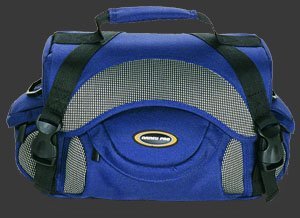
Shoulder bags, sometimes called messenger bags, are worn just like holsters but can be much larger. They greatly vary in size, from ones designed to hold a single camera plus a few accessories, to ones designed to hold two professional DSLR cameras, accessories, plenty of lenses and a laptop computer. Shoulder bags have much more compartments than holsters and their interior can be reorganized by moving padded dividers. They are designed to carry numerous pieces of equipment together but keep them from damaging each other.
Shoulder bags can carry large amounts of gear, including multiple cameras and lenses. Some of these can also attach a tripod to their exterior, usually underneath the main compartment. Just like holsters and belt packs, shoulder bags keep gear accessible and within sight at all times.
Shoulder bags can open in different ways. A large flap which covers the top and one side of the bag is the most common way. That flap normally includes pockets for small items. Other ways include a zipper along the outer-upper edge or in the middle of the bag's top-side. While the gear is always accessible, bags which open on the upper-outer edge with no flap on the zipper's side are ideal to work with gear (change lenses, install filters, swap batteries, etc).
The main disadvantages of shoulder bags are that they distribute weight unevenly and that they can hinder mobility. Since shoulder bags can get quite heavy and must be supported by a single shoulder strap, they can become quite tiring after a long day's use. Also, because they are bulky and dangle from only one shoulder, these bags become cumbersome for most activities other than walking. They are truly bothersome during climbing, even if only a ladder.
A personal favorite is the Lowepro Rezo series which come in several sizes, all with rain-protection covers. The Rezo bags are perfect to work with gear since they are designed to open away from the wearer. The largest such bag, the Rezo 190, can accommodate one DSLR and 4 extra medium-sized lenses. This model is still small enough to count as a personal item for boarding a plane with a carry-on too.
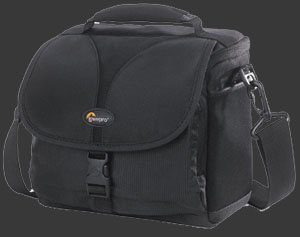
Lowepro Rezo 160 AW
For those interested, the largest shoulder bag found that still counts (barely) as a personal item is the Lowepro Nova 200. If worn backwards, working with gear is easy but the bag becomes awkward to open.
Advantages
- Can be loaded with lots of gear.
- Camera remains easily accessible.
- Bag is visible while being worn.
- May count as a personal item which can be brought in addition to one piece of carry-on on most flights.
Disadvantages
- A lot of weight on one shoulder.
- Dangles during moderate activity.
- Cumbersome when good mobility is required
- May be too large to count as a personal item.
Backpacks
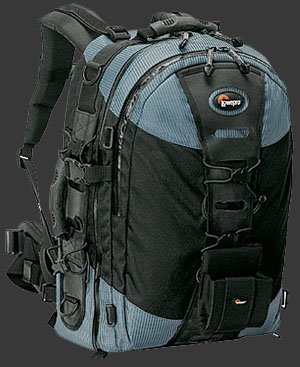 Backpacks are the largest and probably the most comfortable way to carry photographic equipment. Camera backpacks generally look like ordinary backpacks but are designed to securely hold photographic gear. These backpacks are fitted with foam dividers which can be rearranged to keep items in place and from knocking against each other. The exterior of some camera backpacks is designed to carry a tripod.
These bags come in a variety of sizes but even the smallest can carry a large camera and several lenses. The largest backpacks can hold several professional DSLR cameras, a dozen lenses, a tripod, a large laptop and numerous other items.
Obviously, the main advantage of a camera backpack is its size. Some gear will only fit in a photo backpack. It is also the most stable way to carry a tripod, except that the tripod is normally left exposed. Comfort of most backpacks is usually excellent. The distribution of weight is ideal since it is held symmetrically using both shoulders. Some large backpacks also have a belt for redistributing weight on the wearer's hips and to steady the backpack into position.
There are also a few models equipped with wheels and a handle. While this is practical for strolling the bag on flat ground, these bags are generally less comfortable when worn because their wheels and backs are hard. Normal camera backpacks have a soft padded back which is more comfortable.
Backpacks have an advantage over other types of camera bags for mobility. Most activities, including crouching and sitting, can be done with a backpack with little difficulty. Backpacks also keep your arms mobile.
On the other hand, all backpacks make gear least accessible by the photographer and most accessible to thieves. A small number of models have their opening against the wearer's back which makes it impossible to open while being worn with slashing.
To change lenses or cameras, a backpack must be removed. Working with gear is extra hard because backpacks rarely support themselves while not worn. They can be put down, but then the photographer has to crouch and the bag may get quite dirty. In some places like in a swamp, this is not practical. Plus, having your gear out of your sight in a crowded place makes it an easy target for thieves.
Advantages
- Largest possible capacity.
- Comfortable distribution of weight.
- Greatest mobility for activity, arms are free.
Disadvantages
- Must be removed to access gear.
- Working with gear is uncomfortable, usually requires bag to be put down.
- Gear is not in sight, higher risk of being robbed.
- Rarely counts as a personal item for flights.
Slings & More
There are plenty of variations to the camera bag theme, each trying to show advantages while minimizing the disadvantages.
One variation offered by several manufacturers is known as the sling. This basically a backpack which open sideways and a single strap which is worn diagonally. The goal of the sling is to wear it as a backpack but rotate it around your body to access gear without taking the bag off. The compartment that opens sideways when seen from the back actually opens upwards when the back is positioned in front of your body.
The result is a bag that is relatively comfortable to carry and keeps its wearer mobile while keeping gear quite accessible. While it does not distribute weight as well as a backpack, the sling is a great compromise. Although it is not designed to be worn in front, it may be carried for short periods in that position to keep your equipment visible. This position is much less comfortable because the strap holding the bag's weight in that position is thin and unpadded.
A currently unique and interesting design is Think Tank's Rotation 360. This is a backpack and belt pack combined. It is worn like a backpack with a built-in belt. The neat part is that the belt can be rotated with the backpack in place, so that a belt pack appears in sight. While in back, the belt-pack is contained within the backpack and so it cannot be opened by pick-pockets. The upper part of the backpack can be used for non-photographic items.
 Equipment Articles
Please Support Neocamera
All information on Neocamera is provided free of charge yet running this website is a huge endeavor. Purchases made via affiliate links found throughout the site help keep it running and up-to-date. There is no additional cost to you, so please consider buying via these links to our affilates:




Thank you for your support!


Camera Bag Makers
There are plenty of makers of camera bags. One of the most comprehensive is Lowepro. They produce all types of high-quality bags, most of them with all-weather protection covers and plenty of internal pockets. This is quite important since it is hard to predict when it will be needed. Lowepro produces some completely waterproof bags too. Their website is easy to navigate and very well organized.
Naneu Pro also has an extensive selection of camera bags. Many Naneu Pro bags have a rough military-style with multiple externally-accessible pockets. Their product are presented in a simple website. However, you have to add items to your cart to find out their price.
Think Tank Photo makes many simple looking bags which hide a lot of sophistication in them. They offer several unique designs including expandable holster bags and the Rotation 360 which has its own dedicated mini website.
Tamrac is another major maker of camera bags. Although they do not tend to design their bags as well as Lowepro, they are quite popular due to lower prices. Their website is not great but does have information on all their current products.
Several digital camera manufacturers also sell camera bags, although their selection is quite limited.

Updates
2026.09.08

The Wild Magic of Iceland Book Review
Review of The Wild Magic of Iceland by Norris Niman. A photographic journey through seasons.
2026.07.31

ZY Optics Pittura 30mm F/2.4 Medium-Format Lens Review
The ZY Optics Pittura 30mm F/2.4 is a manual lens designed exclusively for Medium-Format Digital Cameras. This fast prime lens captures a wide field-of-view, equivalent to a 24mm on Full-Frame. It is am affordable alternative to first-part GFX and XCD lenses.
2026.07.26

Fujifilm GFX100S II Review
Express review of the Fujifilm GFX100S II. This 102 MP Medium-Format Mirrorless Digital Camera packs an 5-Axis 8-Stop IBIS and a 5.8 MP 0.5" EVF showing 100% coverage at an extra-large 0.84X magnification. It is a more compact version of the flagship GFX100 II. This review covers exactly how these camera compare.
2026.07.14

Sony Alpha A7R VI Review
Extended In-Depth Review of the Sony Alpha A7R VI. This flagship Full-Frame Mirrorless Digital Camera combines ultra-high 67 MP resolution with very fast 30 FPS continuous shooting. It packs a 5-axis 8½-stop IBIS mechanism and an ultra-sensitive 759-Point Phase-Detect AF system. Its incredibly sharp 9.4 MP 0.64" EVF has a huge 0.9X magnification, 100% coverage, 10-bit HDR and 100% DCI-P3 color-space. Captures 8K video at 30 FPS or 4K video at 120 FPS.
2026.05.21

Laowa 4.5-10mm F/2.8 Fisheye Zoom Lens Review
In-depth review of the Venus Optics Laowa 4.5-10mm F/2.8 Fisheye Zoom Lens. This lens zooms from a circular to rectangular fisheye with an 180° viewing angle. This review analyses its optical quality, construction and handling.
2026.04.13

Laowa 17mm F/4 Zero-D Shift Review
In-Depth review of the Venus Optics Laowa 17mm F/4 Zero-D Shift Lens. This ultra-wide Shift lens is specifically designed for Mirrorless Digital Cameras and is available in 4 Full-Frame mounts plus 2 Medium-Format ones.
2025.11.13

Best Gifts for Photographers in 2025 by Budget
The annual Neocamera Photography Gift Guide updated to 2025. Find great gifts for photographers with any price budget.
2025.07.07

Stellar Photo Recovery Review
Review of Stellar Photo Recovery V12. This Windows and MacOS software can recover photos and videos in a huge number of formats from memory cards, USB drives, SSDs and HHDs.
2025.05.14

Huion Kamvas 13 Gen 3 Review
In-Depth review of the Huion Kamvas 13 Gen 3 Pen Display Tablet for photographers and graphic artists.
2025.01.18

Fujifilm GFX 2025 Lens Roundup
Lens Review roundup of Fujifilm GFX Medium-Format lenses. Quality, performance and handling of the GF20-35mm F/4R WR, GF30mm F/3.5 Tilt-Shift and the GF55mm F/1.7.
2024.11.18

Best 2024 Photography Gifts for Every Budget
Great gifts for photographers and photo enthusiasts selected for every budget among the best products of 2024.
2024.08.07

Eye Protection Tips for Professional Photographers
The four main considerations for professional photographers regarding eyewear.
2026.09.08
2026.07.31
2026.07.26
2026.07.14
2026.05.21
2026.04.13
2025.11.13
2025.07.07
2025.05.14
2025.01.18
2024.11.18
2024.08.07
Camera Bag


Your camera bag is empty. To add a camera or lens click on the star next to its name.
Your camera bag is empty.
Add cameras or lenses by clicking on the star next to their name.
NEWS
2026.09.16

Canon Increments R8 to Mark II
Digital Camera
2026.09.15

Sony Launches Super-Telephoto GMaster Lenses
Lens
2026.09.09
OM Systems Relaunches PEN
Digital Camera
2026.09.08
Sony Reveals First Fisheye Zoom Lens
Lens
2026.09.04
Fujifilm Launches New 400mm Prime Lens
Lens
2026.08.10

Peak Design Launches City Line Bags
Bag
2026.08.04
Sony Launches Light Super-Telephoto Full-Frame Zoom Lens
Lens
2026.07.31
Venus Optics Creates Two Parfocal Ultra-Macro Lens
Lens
2026.07.31
ZY Optics Pittura 30mm F/2.4 Medium-Format Lens Launch and Review
Lens ○ Review
2026.07.26
Fujifilm GFX100S II Review Published
Digital Camera ○ Review
2026.07.14
Sony Alpha A7R VI Review Published
Digital Camera
2026.07.09
Sony Unveils 5th Generation RX10
Digital Camera

