



 Camera Basics
 Camera Choosing
 Camera Models
 Camera Buying
 DSLR Buying
Best Digital Cameras of 2025
Introduction

These are strange times! While 2023 saw the digital camera market pick up after years of decline, 2024 also maintained the trend. During each of those years, a total of 25 new digital cameras were launched. There seems to be a renewed interest in photography and traffic at Neocamera is higher than it has been for years! However, only 19 digital camera were launched in 2025.
To their credit, camera makers have been trying out new formulas. Apparently, unsuccessfully though. Numerous new camera concepts failed to gain market traction and seem to alienate digital photography enthusiasts. These are a few camera pushed a hybrid photo-video models that compromise too much on the photography side.
2025 saw the launch of 13 mirrorless cameras and 6 models aimed at distinct markets. Since the latter do not compete with each other, it is impossible to select a Best among them. So, an overview of those models is given at the end of this article.
The Best New Mirrorless Digital Cameras of 2025
This year, there are only mirrorless cameras to compare. The wide price range these cameras sell for puts numerous models out of reach for some people. When awarding the Best Mirrorless Digital Camera title below, contenders are grouped by maximum retail price:
- Afforable: Digital Cameras up $1000 USD, excluding any lens.
- Prosumer: More advanced mirrorless cameras not exceeding $2000 USD max.
- Professional: Full professional-grade mirrorless digital cameras up to $3000 USD.
- Premium Professional: The very best mirrorless digital camera regardless of price.
Note that prices above are for the camera body only. Count on needing or more lenses to complement a camera. Good lenses generally cost as much as the camera itself. Also, each category is defined by the maximum price, so the best camera must be better than all cameras below its price to win each category.
Best Mirrorless Digital Cameras
Mirrorless Digital Cameras continue to dominate the market. This year, only 13 mirrorless digital cameras were launched. These new models span several categories across a huge range of prices and so very few of them compete with each other. Sony did not release any new cameras since the Alpha A1 II
Sony Alpha A1 II late last year.
Here is the complete list of 2025 Mirrorless Digital Cameras with their major specifications:
| Camera | Sensor Size | MP | IBIS | Price |
|---|---|---|---|---|
| Canon EOS R50 V | APS-C (1.6X) | 24 | None | $620 USD |
| Canon EOS R6 Mark III | Full-Frame | 32 | 8½-Stops | $2900 USD |
| Fujifilm X-E5 | APS-C (1.5X) | 40 | 7-Stops | $1700 USD |
| Fujifilm X-T30 III | APS-C (1.5X) | 26 | None | $1000 USD |
| Hasselblad X2D II 100C | 645D (0.8X) | 100 | 10-Stops | $7400 USD |
| Leica SL3-S | Full-Frame | 24 | 5-Stops | $5700 USD |
| Nikon Z5 II | Full-Frame | 24 | 7½-Stops | $1700 USD |
| Nikon ZR | Full-Frame | 24 | 7½-Stops | $2200 USD |
| OMS OM-3 | Four-Thirds | 20 | 6½-Stops | $1800 USD |
| OMS OM-5 Mark II | Four-Thirds | 20 | 6½-Stops | $1200 USD |
| Panasonic S1 II | Full-Frame | 24 | 7-Stops | $3200 USD |
| Panasonic S1 IIE | Full-Frame | 24 | 5½-Stops | $2200 USD |
| Panasonic S1R II | Full-Frame | 44 | 8-Stops | $3300 USD |
This price-range is enormous. The most expensive model on the list cost 12X more than the cheapest model! A budget of $1000 USD can only get two cameras and extra is required for a matching lens, unless upgrading from another camera using the same mount. More affordable cameras are normally built around smaller sensors but there is an odd inversion this year. Both Micro Four-Thirds mirrorless are more expensive than two out of three APS-C models. Neither camera below $1000 USD has builtin stabilization, a serious limitation.
The next price level includes both Micro Four-Thirds cameras, one APS-C mirrorless and one Full-Frame model, sold for exactly the same price as the APS-C camera! Sensor-size is not everything but it is a major contributor to image-quality. Larger sensors require larger lenses though, which is the main point to keep in mind when figuring out which camera is ideal for you.
The remaining two price classes have three or four competing cameras. Among the more expensive range, there is one Medium-Format Mirrorless Digital Camera. The rest are all Full-Frame models. The good news is that all these are really solid performers. There will be little incentive to change systems but, if you wish to choose a new platform, read on to found out which are the best cameras in their classes.
Best Affordable Mirrorless Camera 2025

Fujifilm X-T30 III
 26 Megapixels
 Electronic View Finder
 High ISO: ISO 6400 or more is available at full-resolution.
 Level: Measures camera tilt and helps to keep the horizon level.
 Continuous Drive
 Ultra HD (4K) video: 3840x2160 resolution or more.
 Manual Controls: Both fully-manual (M) and semi-automatic modes (T and V).
 Custom White-Balance: Specifies exactly what should be white to the camera.
 Action Photography: Shutter speeds of 1/1500 or more.
 Night Photography: Reaches shutter-speeds longer than 4 seconds.
 Hotshoe: Allows external flash units to be attached.
 Spot Metering
 Accepts Secure Digital Extended Capacity (SDXC), SDHC and SD memory.
The Fujifilm X-T30 III is a light and highly compact digital camera that delivers features and performance well above it price-point! This mirrorless is built around a 26 Megapixels X-Trans CMOS 4 sensor which captures images of exceptional quality at a truly blazing speed. Its hybrid shutter allows for shutter-speeds from 1/32,000s to 15 minutes. It can also shoot full-resolution images continuously at 20 FPS. Phase-Detection sites spread across the sensor power a sophisticated 425-Point AF system.
To make it so compact and affordable, Fujifilm decided to omit IBIS in this model. The similar X-S20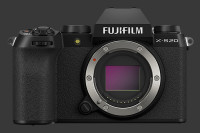
Fujifilm X-S20 fetches a 40% higher price by offering builtin image stabilization! Getting that camera instead requires a substantial jump in budget. The X-S20 is also 30% heavier for it.
This mirrorless offers a highly tactile interface with plenty of controls, including dual control-dials. The X-T30 III has a 2.4 Megapixels 0.39" EVF that shows 100% coverage at 0.62X magnification and comes with an essential Eye-Start Sensor. It delivers impressive video capabilities, including the second highest resolution among APS-C cameras. The Fujifilm X-T30 III can record 6K Video (6240x4160) at 30 FPS or Cinema 4K (4096x2160) at 60 FPS. External audio is also supported via a standard 3.5mm mini-jack.
The X-T30 III delivers one of the best values among Mirrorless Digital Camera. It can handle a wide variety of subjects and is easy to take along, thanks to its light 378g weight.





Best Prosumer Mirrorless 2025
Nikon Z5 II
 24 MegapixelsElectronic View FinderHigh ISO: ISO 6400 or more is available at full-resolution.
 Stabilization: Compensates for tiny involuntary movements of the camera.Level: Measures camera tilt and helps to keep the horizon level.Continuous DriveUltra HD (4K) video: 3840x2160 resolution or more.Manual Controls: Both fully-manual (M) and semi-automatic modes (T and V).Custom White-Balance: Specifies exactly what should be white to the camera.Action Photography: Shutter speeds of 1/1500 or more.Night Photography: Reaches shutter-speeds longer than 4 seconds.Hotshoe: Allows external flash units to be attached.Spot Metering
 Depth-Of-Field Preview: Improve perception of DOF before shooting.
 Weatherproof - Seals protect from dust, humidity and light splashing.Accepts Secure Digital Extended Capacity (SDXC), SDHC and SD memory.
The Nikon Z5 II is among the most balanced cameras on the market and it is comes in at a really competitive price! This Full-Frame Mirrorless Digital Camera sells the a lower price than several APS-C and Four-Thirds model. Its 24 Megapixels CMOS sensor outputs some of the best image-quality among similarly-priced cameras.
The 24 MP sensor in this mirrorless packs relatively large pixels which are great for low-light photography. They span a standard ISO 100-64000 sensitivity-range which is expandable to 50-204800. Additionally this Full-Frame sensor is mounted on a modern 5-axis image-stabilization system which compensates for up to 7½ stops of camera shake. This is also an incredibly fast camera that can capture full-resolution images at 30 FPS.
Nikon packed the Z5 II with professional features and controls, including dual control-dials and a weatherproof body with dual SDXC memory-card slots. There is a large 3.7 Megapixels 0.5" EVF with 0.8X magnification at 100% coverage and an essential Eye-Start Sensor. It has good video capabilities, include being able to capture 4K Ultra-HD video at 60 FPS, plus RAW video at 120 FPS.
All together this makes the Nikon Z5 II an incredible value, delivering image-quality, speed and a wide range of features unique to this price-point.
Best Professional Mirrorless 2025
Panasonic Lumix S1R II
 44 MegapixelsElectronic View FinderHigh ISO: ISO 6400 or more is available at full-resolution.Stabilization: Compensates for tiny involuntary movements of the camera.Continuous DriveUltra HD (4K) video: 3840x2160 resolution or more.Manual Controls: Both fully-manual (M) and semi-automatic modes (T and V).Custom White-Balance: Specifies exactly what should be white to the camera.Action Photography: Shutter speeds of 1/1500 or more.Night Photography: Reaches shutter-speeds longer than 4 seconds.Hotshoe: Allows external flash units to be attached.Spot MeteringWeatherproof - Seals protect from dust, humidity and light splashing.
 Accepts CF Express Type B memory.Accepts Secure Digital Extended Capacity (SDXC), SDHC and SD memory.
Panasonic released the most digital cameras this year, including their latest Full-Frame Mirrorless flagship, the Panasonic Lumix S1R II. The is a large and relatively heavy camera that packs almost every photo and video feature to date. This mirrorless has an Leica L-mount, which it shares with models from other companies to access a wide lens catalog from Panasonic, Leica, Sigma and other third-party manufacturers.
The Panasonic Lumix S1R II is built around a 44 Megapixels BSI-CMOS sensor mounted on a modern 5-axis image-stabilization system which provides 8 stops of efficiency. It is the second-highest resolution sensor among 2025 cameras and one of the few allow 8K video recording. This sensor has a broad sensitivity range and has an extremely high throughput. The S1R II can capture full-resolution images at 40 FPS.
As a professional camera, the Panasonic S1R II comes with a large number of direct controls, including rare triple control-dials. The body of this camera is weatherproof and freezeproof down to -10C. It also packs dual asymmetric memory-card slots: one CF Express Type B and one SDXC UHS-II. The is an ultra-high-resolution 5.8 Megapixels 0.5" EVF that shows 100% coverage at 0.78X magnification and comes with an essential Eye-Start Sensor. This model also incorporates a 779_point Phase-Detect AF system.
Outstanding video capabilities are built into the Panasonic S1R II. It can record 8K video at 30 FPS and Cinema 4K or standard Ultra HD at 120 FPS. Stereo analog audio is available directly on the camera. Using an optional XLR adapter, the S1R II can record 32-bit Float 4 Chanel audio. This is currently the fastest and only freezeproof camera with 8K capabilities.
Best Premium Professional 2025
Hasselblad X2D II 100C
 100 MegapixelsElectronic View FinderHigh ISO: ISO 6400 or more is available at full-resolution.Stabilization: Compensates for tiny involuntary movements of the camera.Continuous DriveManual Controls: Both fully-manual (M) and semi-automatic modes (T and V).Custom White-Balance: Specifies exactly what should be white to the camera.Action Photography: Shutter speeds of 1/1500 or more.Night Photography: Reaches shutter-speeds longer than 4 seconds.Hotshoe: Allows external flash units to be attached.Spot MeteringDepth-Of-Field Preview: Improve perception of DOF before shooting.Accepts CF Express Type B memory.
The Hasselblad X2D II 100C is a unique Medium-Format Mirrorless Digital Camera with multiple best-in-class capabilities. This model is part of the Hasselblad XCD system designed to build the smallest Medium-Format cameras possible. The first consequence of the this is that no XCD cameras have a mechanical shutter, instead the rely on leaf-shutters inside the lens, making it virtually impossible to adapter third-party lenses. The second is that the X2D 100C does not have any video capabilities.
This Medium-Format camera is built around a huge 100 Megapixels 44x33mm CMOS sensor with a 4:3 aspect-ratio that is typical of large-formats. With the X2D II, Hasselblad created the most effective image-stabilization mechanism ever! This new 5-axis image-stabilization system compensates for up to 10-stops of shake, making it possible to capture multi-second exposures without using a tripod! The camera supports exposures of 1/6000s to 68 minutes.
The enormous volume of data captured by each image, which reaches 100 Megapixels images in 16-bit RAW mode, restricts the speed of this mirrorless to a maximum of 3 FPS. This type of camera is mostly used for static and slow moving subjects. So, it not a general purpose camera yet it is certain to excel at landscape, architecture and night photography.
This professional camera incorporates an enormous 5.8 Megapixels 0.66" EVF with 1X magnification, 100% coverage and an essential Eye-Start Sensor. There is also an exceptionally large 2.4 Megapixels 3.6" LCD at the back. Hasselblad made this model weatherproof and freezeproof to -10C. The one major professional feature missing from the X1D II is dual memory-card slots. Instead, this Medium-Format Mirrorless Digital Camera includes a single CF Express Type B slot plus internal memory. Also, while the Hasselblad X1D II 100C offers dual control-dials, it has significantly fewer physical controls than virtually all professional cameras.
The Hasselblad X2D 100C is an incredible and highly specialized digital camera. It produces extremely high-quality images with an outstanding amount of details and high dynamic-range. At 840g, it is very light for a Medium-Format camera, even while packing a class-leading IBIS with 10-stops of efficiency!
New Fixed Lens Digital Cameras
Six fixed-lens cameras were released in 2025. Each manufacturer appears to have targetted a different market and so none of the new models compete, except perhaps two serving a certain audience. All but two of these new camera are built around a different size sensor and a different lens. This makes it impossible to rank one over the other.
The following cameras are new this year, ordered by sensor-size, starting with the smallest:
| Model | Category | Sensor Size | Megapixels | Price | |
|---|---|---|---|---|---|
| Canon Powershot ELPH 360 HS A | Ultra-Compact | 1/2.3" | 20 MP | 380 USD | |
| Nikon Coolpix P1100 | Ultra-Zoom | 1/2.3" | 16 MP | 1150 USD | |
| Canon Powershot V1 | Compact | 1.4" | 22 MP | 930 USD | |
| Ricoh GR IV | Premium Compact | APS-C | 26 MP | 1500 USD | |
| Sony RX1R III | Premium Large | Full-Frame | 61 MP | 5100 USD | |
| Fujifilm GFX100RF | Medium Format | 645D | 100 MP | 5600 USD |
The price of these cameras emphasizes how they target vastly different budges, except for the Sony RX1R III and Fujifilm GFX100RF. These two cameras share similarities yet the Fujifilm is a much larger and heavier digital camera. In fact, the GFX100RF is 50% heavier than the RX1R III. Without a double the Fujifilm GFX100RF delivers superior image-quality, it is however less portable, so selecting between them is about priorities.
 Next
Next Equipment Articles
Please Support Neocamera
All information on Neocamera is provided free of charge yet running this website is a huge endeavor. Purchases made via affiliate links found throughout the site help keep it running and up-to-date. There is no additional cost to you, so please consider buying via these links to our affilates:




Thank you for your support!


Updates
2025.11.13

Best Gifts for Photographers in 2025 by Budget
The annual Neocamera Photography Gift Guide updated to 2025. Find great gifts for photographers with any price budget.
2025.07.07

Stellar Photo Recovery Review
Review of Stellar Photo Recovery V12. This Windows and MacOS software can recover photos and videos in a huge number of formats from memory cards, USB drives, SSDs and HHDs.
2025.05.14

Huion Kamvas 13 Gen 3 Review
In-Depth review of the Huion Kamvas 13 Gen 3 Pen Display Tablet for photographers and graphic artists.
2025.01.18

Fujifilm GFX 2025 Lens Roundup
Lens Review roundup of Fujifilm GFX Medium-Format lenses. Quality, performance and handling of the GF20-35mm F/4R WR, GF30mm F/3.5 Tilt-Shift and the GF55mm F/1.7.
2024.11.18

Best 2024 Photography Gifts for Every Budget
Great gifts for photographers and photo enthusiasts selected for every budget among the best products of 2024.
2024.08.07

Eye Protection Tips for Professional Photographers
The four main considerations for professional photographers regarding eyewear.
2024.07.14

Fujifilm X100VI Review
Flagship fixed-lens compact digital camera with a 40 MP sensor and Image-Stabilization, a first for the series. Retro design featuring dual control-dials, plus direct ISO, Shutter-Speed and EC dials. Its hybrid viewfinder can switch between EVF and OVF mode.
2024.05.09

Fujifilm GFX100 II Review
Flagship 102 Megapixels Medium-Format Mirrorless Digital Camera with 8-Stop 5-Axis IBIS, 8 FPS Drive, 8K Video and 400 MP Super-Resolution capture in a weatherproof and freezeproof body with dual control-dials and dual memory-card slots.
2024.04.03

Fujifilm X-T5 Review
Newest Fujifilm flagship boasting a 40 MP APS-C sensor, 5-axis IBIS with 7-stop efficiency, 15 FPS continuous drive, 6.2K Video capture, dual control-dials and dual SDXC UHS-II slots in a sturdy weatherproof and freezeproof body.
2023.11.20

Best Digital Cameras of 2023
Find out which are the Best Digital Cameras of 2023. All the new Mirrorless Digital Cameras from entry-level to high-end professional.
2023.07.10

Fujifilm X-H2 Review
40 Megapixels APS-C Hybrid Mirrorless Digital Camera with 7-stop IBIS. Fastest shutter ever and 8K video capture. Large builtin EVF with 0.8X magnification and 5.8 MP, plus an Eye-Start Sensor. Packed with features and large number of controls in a weatherproof and freezeproof body.
2023.05.07

Sony FE 20-70mm F/4G Review
Review of the unique Sony FE 20-70mm F/4G lens. The optical zoom of this lens spans ultra-wide-angle and medium focal-length coverage, making it one of the most versatile Full-Frame lenses on the market.
2025.11.13
2025.07.07
2025.05.14
2025.01.18
2024.11.18
2024.08.07
2024.07.14
2024.05.09
2024.04.03
2023.11.20
2023.07.10
2023.05.07
Camera Bag


Your camera bag is empty. To add a camera or lens click on the star next to its name.
Your camera bag is empty.
Add cameras or lenses by clicking on the star next to their name.
NEWS
2025.12.02

Sony Upgrades Alpha 7 to 5th Generation
Digital Camera ○ Lens
2025.11.29

Venus Optics Releases New Zero-D Tilt-Shift Macro Lens
Lens
2025.11.23
Best Digital Cameras of 2025
Digital Camera
2025.11.14

Photography Gift Guide 2025 Edition
2025.11.06
Canon Announces Third-Generation R6 Mirrorless
Digital Camera ○ Lens
2025.10.23
Fujifilm Launches X-T30 III Plus New Wide Zoom
Digital Camera ○ Lens
2025.10.21
Peak Design Unveils Field Plate and Form Straps
2025.10.16
Nikon Unveils Z-Mount DX Lens Duo
Lens
2025.10.16
Venus Optics Unveils Fast Telephoto Prime Lens
Lens
2025.10.01

Think Tank Photo FocusPoint RollTop Backpacks
Bag
2025.09.30
Sony Produces Super Macro GMaster Lens
Lens
2025.09.17
Venus Optics Created First Telephoto Ultra-Macro Lens
Lens

