Camera Basics
 Camera Choosing
 Camera Models
 Camera Buying
 DSLR Buying

Canon EOS 7D Review
 18 Megapixels
 Single Lens Reflex
 High ISO: ISO 6400 or more is available at full-resolution.
 Level: Measures camera tilt and helps to keep the horizon level.
 Continuous Drive
 Full 1080p HD Video: 1920 x 1080 resolution or more but less than 4K.
 Manual Controls: Both fully-manual (M) and semi-automatic modes (T and V).
 Custom White-Balance: Specifies exactly what should be white to the camera.
 Action Photography: Shutter speeds of 1/1500 or more.
 Night Photography: Reaches shutter-speeds longer than 4 seconds.
 Hotshoe: Allows external flash units to be attached.
 Spot Metering
 Depth-Of-Field Preview: Improve perception of DOF before shooting.
 Live-View: Lets DSLR cameras use the rear LCD as an EVF.
 Weatherproof - Seals protect from dust, humidity and light splashing.
 Accepts Compact Flash memory.
 Neocamera detailed review
 Discontinued: No longer produced by the manufacturer. May still be in stock or found used.
 1 - Capability2 - Usability3 - Performance
Canon EOS 7D Introduction
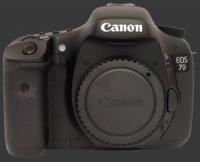
The Canon EOS 7D introduces a new series of Canon DSLR cameras. This is now their highest-end 1.6X crop-sensor DSLR, sitting between the 50D and the full-frame 5D Mark II in price while having more features than both of those digital cameras. The 7D adds a number features not presently seen on Canon cameras outside of 1D and 1Ds series: a 100% coverage viewfinder and a weather-sealed body. This is also the first Canon SLR to have a built-in level, this one showing tilt and pitch independently.
The 7D is based around an all-new 18 megapixels sensor, capable of ISO 100 to 12800, 8 FPS continuous shooting and full 1080p HDTV video-recording. The whole is packaged in a sturdy weather-sealed body with a 100% coverage pentaprism viewfinder offering 1X magnification and a wealth of external controls including two control-dials.
Evaluation unit provided by Photo Service.
This in-depth review takes a look at the Canon EOS 7D in terms of features, ergonomics, usability, performance and image quality. As their new flagship 1.6X-crop DSLR, the 7D sports the following features:
- 18 Megapixels image sensor, 1.6X crop-factor.
- Automatic and selectable ISO from 100 to 12800.
- 1/8000s to 30s shutter-speeds, plus bulb mode.
- Exposure compensation: -5..+5 EV, 1/2 EV increments or 1/3 EV increments.
- Exposure bracketing, 3 images, 0.3 or 0.5 to 3 EV, depending on exposure increments.
- Metering modes: evaluative linked to focus, partial (9%), spot (2.3%) and center-weighed average.
- Full manual controls: PASM and Bulb mode. Three custom configuration can use any exposure mode.
- Automatic, 6 preset, kelvin and custom white-balance, all fine-tunable.
- White-balance bracketing, 3 images.
- 19-point auto-focus system, all cross-type points.
- Focus-point selection: automatic among all, automatic among group, manual selection of single point.
- Focus modes: single-shot, continuous, automatic and manual.
- Image parameters: sharpness, saturation, contrast and tone, 8 steps each.
- Highlight tone priority mode, limits ISO to 200-6400.
- 8 FPS continuous shooting for up to 126 images.
- Self-timers: 10s and 2s, remote-triggerable.
- Manual mirror-lock-up (MLU) available as custom setting.
- JPEG, RAW (3 sizes) and JPEG+RAW modes.
- 1920x1080 @ 30/25/24 FPS (1080p) HD 16:9 movie-modes.
- 1280x720 @ 60 or 50 FPS (720p) HD 16:9 movie-mode.
- 640x480 @ 60 or 50 FPS (480p) 4:3 movie-mode.
- Mono sound with internal mic, stereo with external.
- Live-view shooting with Face-Detect, Contrast-Detect or Phase-Difference autofocus.
- In-camera correction of vignetting for supported lenses.
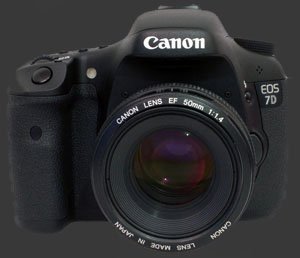
The refined EOS body of the 7D has the following as well:
- 100% coverage 1X magnification viewfinder.
- 3” LCD 921K Pixels, 160 degree viewing-angle.
- 2 Axis digital level, displayable in LCD or viewfinder.
- Image review with magnification and histograms, luminance and RGB.
- Depth-of-field preview.
- Dual-control dials, for efficient parameter selection.
- Auto-Exposure-Lock (AEL) Auto-Focus-Start (AF-On) buttons.
- Quick menu function to change parameters directly on the status display.
- Customizable multi-function button.
- Built-in popup flash, hot-shoe and sync-port for external lighting.
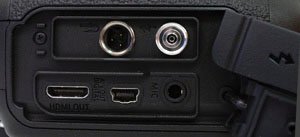
- HDMI output and stereo microphone connector.
- Manually illuminated top status panel.
- Dust-reduction, diminishes the necessity of cleaning the image sensor.
- Weather-sealed body against dust and moisture.
- Proprietary lithium ion-battery.
- Compact Flash memory.
Canon EOS 7D Suitability - What is it good for?
Since DSLR cameras represent the high-end of digital cameras, they are generally suitable for most types of photography. The versatility of interchangeable lenses brings SLR cameras their greatest potential. The Canon EOS 7D is no exception, it is suitable for every type of photographic subject.
The Canon 7D has acquired nearly all features of previous Canon DSLR cameras and even introduced several ones of its own. Everything expected from a DSLR is there with a very fast continuous drive and a high ISO limit which are extremely suitable for fast action, indoors and outdoors, at least with a sufficiently bright lens. The handful of models which can shoot in lower light either have larger sensors or built-in stabilization, which is not useful for action. Yet, given a maximum ISO of 12800, the 7D is pretty close.
Every other photo subject is very well covered with the 7D, particularly given Canon's extensive lens line up. Lenses compatible with the 7D cover 10-600mm, equivalent in 35mm terms to 16-960mm. There are tilt-shift specialty lenses for architecture and macro lenses with up to 5X magnification. Third-party makers add to this extensive collection. Studio and flash options are also extremely versatile with both a hot-shoe and a sync-port directly on the camera. All modern Canon flashes work with the 7D as well.
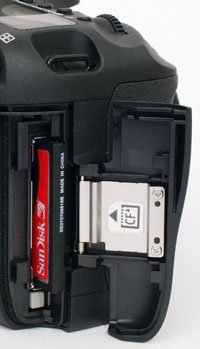
The Canon EOS 7D has a weather-sealed body resistant to 0C (32F) and 85% humidity. This provides a minimum of protection against the elements. This digital camera runs on the same proprietary lithium-ion battery as the 5D Mark II and uses Compact Flash memory cards. Compact Flash cards are presently the fastest cards available and come in the largest capacities.
Canon EOS 7D Capability - What can it do?
As noted in the review introduction, the Canon EOS 7D has everything expected from a modern DSLR nearly at the maximum limit:
- 18 megapixels is the highest resolution of any cropped-sensor camera.
- 1920x1080 is the highest HDTV resolution.
- The ISO range of 100-12800 is the widest of any cropped-sensor DSLR other than the 1D Mark IV.
- The top shutter-speed of 1/8000s matches the fastest DSLR cameras.
- 8 FPS is the fastest continuous drive among 1.6X or 1.5X crop DSLRs.
- 100% coverage viewfinder is as good as it gets.
- 3" LCD with 920k matches the highest resolution competitors.
- Canon has the largest line-up of lenses available of any manufacturer.
Remaining headline features include a weather-sealed body, a 2-axis digital level, a 19-point autofocus system, live-view and wireless flash control.
The level independently shows tilt and pitch. This allows the horizon to be kept horizontal while pointing upwards or downwards. An animated representation of the digital level can be shown on the LCD for use in Live-View mode or while using the camera on a tripod. When using the optical viewfinder, the autofocus point indicators cleverly show tilt and pitch. In a classic example of a company not wanting to guaranty much, the Canon 7D manual states that the error-margin of the digital level is ±1°. With such a wide margin, the level would be completely useless since most errors fall within that percentage. Larger errors are easily avoided. In practice, the review unit obtained was much more precise and provided about ¼° of accuracy.
The Canon 7D's power-switch has thankfully 2 positions: on and off. EOS x0D-series still use a 3-way switch which is a great source of confusion for beginners. Third option which is to lock the quick-dial, has moved to a dedicated button.
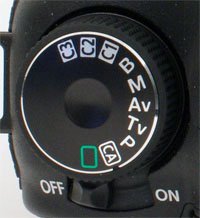
The mode dial of the Canon EOS 7D has 10 positions. A green mode and a CA mode provide automatic shooting with different levels of automation. Green mode provides no controls while CA mode allows for EC (brightness), program-shift (DOF) and tone. The usual PASM mode are available. Instead of bulb being part of M as the slowest shutter-speed, it gets its own position on the mode dial, just like on Pentax DSLRs. The remaining 3 positions are custom settings which can take on any mode the user chooses.
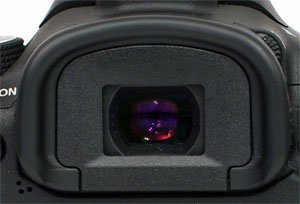
The Canon 7D is one of those cameras that help take better pictures by combining a 100% coverage viewfinder and built-in level. This way there is little reason to worry about crooked framing or unwanted elements with these features, leaving the photographer more mental energy to focus on composition and exposure. Small rotation are detrimental to image quality and therefore avoiding them helps produce higher quality images. Cropping is not damaging by itself but knowing what is going to be in the frame is a relief to the photographer wanting to maximize the resolution of resulting images.
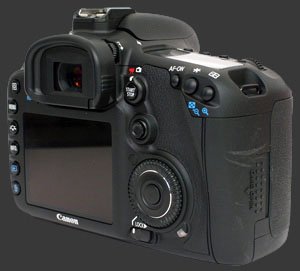
Live-view has come a long way since Fuji introduces its S2 Pro with 30s B&W view which you had to exit before taking the picture. The Canon XSi was the first camera to get close enough to deserve the Live-View icon next to its camera description. The Canon 7D keeps the same Live-View features and makes it faster and more consistent with normal camera operation. The 7D's live-view can autofocus and accurately previews coverage, exposure, color, white-balance and focus. To top this off, the 7D can also show a live histogram, the level and grid lines. Most buttons function the same way in live-view than normal, marking a significant improvement over the XSi. The only exceptions are the Info button and the Quick menu which are detailed further in the review.

Movie-mode and Live-View are entered using a shared button surrounded by a two-position dial. Live-view starts automatically when the dial is turned towards the movie icon. Then the START/STOP button begins recording or ends it. When the dial points to the Live-View icon, the START/STOP button enters and exits Live-View. In both modes, the shutter-releases take a picture. If a movie is being recorded, then a 1s gap appears in the movie each time a picture is taken. Notice that movie-mode, just like Live-View is independent of the exposure mode. The upside of this is that video can be recorded in any mode, including fully manual exposure. Canon did an excellent job here providing access to a good deal of functionality in movie-mode.
The Canon 7D has detailed control over white-balance including automatic white-balance, preset white-balanceDaylight, shade, cloudy, tungsten, fluorescent and flash., manual white-balance and color-temperature. All white-balance options can be fine-tuned in 19-steps from blue to amber and magenta to green. This DSLR can bracket white-balance fine-tuning in 1, 2 or 3 steps along the B-A or M-G axis for 3 frames.
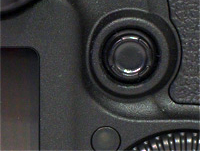
A new 19-point autofocus system was developed for this digital SLR. Every point has a cross-type sensor which is more sensitive to low-contrast detail. The point used can be chosen automatically among all points, automatically chosen among a cluster of nearby points or chosen by the photographer exactly. A small joystick, pictured above, moves the selection either as a group or individually. The camera lights up all points in focus when focus is locked.
This DSLR supports the standard drive modesSingle, continuous, self-timer, remote-control., with two speeds of continuous and self-timer shooting. The fast continuous drive runs at 8 FPS, the slow one at 3 FPS. A 2s or 10s self-timer can be chosen. The continuous drive is very impressive, not only is it extremely fast but it also shoots up to 126 frames without slowing down at high speed. At 3 FPS, the camera can shoot indefinitely. Mirror lockup function available as part of custom settings.
Exposure bracketing is separate from drive mode but is not completely independent. In single-shot mode, each frame must be captured with a full press-release cycle of the shutter. In continuous drive, all shots are taken as long as the shutter is kept down for enough time for the camera to record all three exposures. When the bracket is complete, continuous shooting stops.
Every DSLR can produce RAW, JPEG or both types of images but the Canon EOS 7D supports 3 sizes for both RAW and JPEG. RAW can be saved as an 18 megapixels image, a 10 megapixels one or a 4.5 megapixels image. It is not clear what processing the camera does to produce lower-resolution RAW images, although the 4.5 could be done by not doing Bayer-interpolation only averaging of green values because each pixel would come from one red, one blue and two green sub-pixels.
To aid experimentation with RAW images, this DSLR also has a dedicated button to take the next shot in a different file format. Quality of the RAW and JPEG activated by the dedicated button is chosen using the menu system. RAW files are saved in a proprietary Canon format.
The Canon EOS 7D features are large number of buttons, many of them customizable for shooting operation:
- Shutter: Start metering and focus, start metering or lock metering.
- AF-On: Start metering and focus, lock metering, disable autofocus, lock flash power or do nothing.
- AE-L: Lock exposure, start exposure and focus, disable autofocus, lock flash power or do nothing.
- DOF-Preview: DOF-Preview, disable autofocus, lock exposure, toggle between AF-S and AF-C.
- Lens button (if applicable): Disable autofocus, start metering and focus, lock exposure, toggle between AF-S and AF-C, activate IS or switch AF-function.
- M-Fn: Lock flash power, lock exposure, switch file-format for next shot, show level in viewfinder.
- Set: Do nothing, quality, picture-style, menu, replay last image, invoke quick menu.
- Front dial in M mode: Aperture or shutter-speed.
- Quick dial in M mode: Aperture, shutter-speed or AF-point.
- Joystick: Do nothing or AF-point selection.
Exposure is controllable in 1/3 or 1/2 EV steps while ISO is controllable in 1/3 or 1 EV steps. An extensive number of custom settings exist in the 11-page menu system, with several items leading t sub-menus and sometimes sub-sub-menus.
This digital camera also has a silent shooting mode and peripheral illumination correction which, due to the short time we had with this camera, remain untested. The 7D is relatively quiet for a DSLR even without silent shooting.
 |



 
|
 Next1 - Capability2 - Usability3 - Performance
Please Support Neocamera
All information on Neocamera is provided free of charge yet running this website is a huge endeavor. Purchases made via affiliate links found throughout the site help keep it running and up-to-date. There is no additional cost to you, so please consider buying via these links to our affilates:




Thank you for your support!


Canon 7D Highlights


 SLR digital camera
Sensor-Size: 22 x 15mm

Actual size when viewed at 100 DPI
| 18 Megapixels DSLR | ISO 100-12800 |
| Canon EF Mount 1.6X FLM | Shutter 1/8000-30s |
| 100% Coverage Large Viewfinder | Full manual controls, including Manual Focus |
| 2 Axis Digital Level | Custom white-balance with 2 axis fine-tuning |
| Weatherproof | Spot-Metering |
| Built-in Dust Reduction | Hot-Shoe & Sync-Port |
| 8 FPS Drive, 126 Images | Stereo audio input |
| 1920x1080 @ 30 FPS Video Recording | Lithium-Ion Battery |
| 3" LCD 920K Pixels | Compact Flash |
Camera Bag


Your camera bag is empty. To add a camera or lens click on the star next to its name.
Your camera bag is empty.
Add cameras or lenses by clicking on the star next to their name.
Updates
2026.09.08

The Wild Magic of Iceland Book Review
Review of The Wild Magic of Iceland by Norris Niman. A photographic journey through seasons.
2026.07.31

ZY Optics Pittura 30mm F/2.4 Medium-Format Lens Review
The ZY Optics Pittura 30mm F/2.4 is a manual lens designed exclusively for Medium-Format Digital Cameras. This fast prime lens captures a wide field-of-view, equivalent to a 24mm on Full-Frame. It is am affordable alternative to first-part GFX and XCD lenses.
2026.07.26

Fujifilm GFX100S II Review
Express review of the Fujifilm GFX100S II. This 102 MP Medium-Format Mirrorless Digital Camera packs an 5-Axis 8-Stop IBIS and a 5.8 MP 0.5" EVF showing 100% coverage at an extra-large 0.84X magnification. It is a more compact version of the flagship GFX100 II. This review covers exactly how these camera compare.
2026.07.14

Sony Alpha A7R VI Review
Extended In-Depth Review of the Sony Alpha A7R VI. This flagship Full-Frame Mirrorless Digital Camera combines ultra-high 67 MP resolution with very fast 30 FPS continuous shooting. It packs a 5-axis 8½-stop IBIS mechanism and an ultra-sensitive 759-Point Phase-Detect AF system. Its incredibly sharp 9.4 MP 0.64" EVF has a huge 0.9X magnification, 100% coverage, 10-bit HDR and 100% DCI-P3 color-space. Captures 8K video at 30 FPS or 4K video at 120 FPS.
2026.05.21

Laowa 4.5-10mm F/2.8 Fisheye Zoom Lens Review
In-depth review of the Venus Optics Laowa 4.5-10mm F/2.8 Fisheye Zoom Lens. This lens zooms from a circular to rectangular fisheye with an 180° viewing angle. This review analyses its optical quality, construction and handling.
2026.04.13

Laowa 17mm F/4 Zero-D Shift Review
In-Depth review of the Venus Optics Laowa 17mm F/4 Zero-D Shift Lens. This ultra-wide Shift lens is specifically designed for Mirrorless Digital Cameras and is available in 4 Full-Frame mounts plus 2 Medium-Format ones.
2025.11.13

Best Gifts for Photographers in 2025 by Budget
The annual Neocamera Photography Gift Guide updated to 2025. Find great gifts for photographers with any price budget.
2025.07.07

Stellar Photo Recovery Review
Review of Stellar Photo Recovery V12. This Windows and MacOS software can recover photos and videos in a huge number of formats from memory cards, USB drives, SSDs and HHDs.
2025.05.14

Huion Kamvas 13 Gen 3 Review
In-Depth review of the Huion Kamvas 13 Gen 3 Pen Display Tablet for photographers and graphic artists.
2025.01.18

Fujifilm GFX 2025 Lens Roundup
Lens Review roundup of Fujifilm GFX Medium-Format lenses. Quality, performance and handling of the GF20-35mm F/4R WR, GF30mm F/3.5 Tilt-Shift and the GF55mm F/1.7.
2024.11.18

Best 2024 Photography Gifts for Every Budget
Great gifts for photographers and photo enthusiasts selected for every budget among the best products of 2024.
2024.08.07

Eye Protection Tips for Professional Photographers
The four main considerations for professional photographers regarding eyewear.
2026.09.08
2026.07.31
2026.07.26
2026.07.14
2026.05.21
2026.04.13
2025.11.13
2025.07.07
2025.05.14
2025.01.18
2024.11.18
2024.08.07