



 Camera Basics
 Camera Choosing
 Camera Models
 Camera Buying
 DSLR Buying
National Geographic The Ultimate Field Guide To Landscape Photography
Express Summary
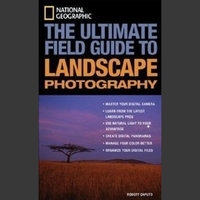
National Geographic's The Ultimate Field Guide To Landscape Photography is an intermediate photography book with emphasis on capturing the unique character of landscapes through photography. In this book, National Geographic photographer Robert Caputo teaches how to think about landscape photography in order to produce outstanding landscape photographs.
Building upon basics taught in general photography books, The Ultimate Field Guide To Landscape Photography extensively discusses aspects of composition and lighting as they relate to landscape photography. This field guide uses plenty of fantastic full-color photographs by award winning photographers to visually illustrate its teachings.
Photographers wishing to advance beyond the basics and improve their landscape photography have plenty to learn from of this well-written and well-illustrated book from National Geographic publications.
Book Review
Getting started with landscape photography is easy. In many ways, it is simple and not very technical. Bringing back images that invoke the feeling of being there takes much more effort and patience. That is what National Geographic's The Ultimate Field Guide To Landscape Photography is about.
There are many books on general photography that cover advice on every type of photography at once. However, there are far less that cover a single type of subject such as landscape photography. This particular book does so without going over all the basics again, yet it provides enough information not to require novice readers to keep referring to a book on basics.
The advice in this book is presented in comprehensible sections on various aspects of landscape photography. The text is written in a simple thought-provoking style. This is hallmark of more advanced photography books. While basic photography books must be informative to explain how photography works and how to use photographic tools, more advanced books which focus on the creative side must help their readers define the process by which they create each photograph. This is simply the case because there is no formula to define creativity, otherwise originality would not be possible.
After a brief introduction, the book starts with a chapter called The Landscape Photograph. This is where the author describes the thought process required to be successful at landscape photography. Several photography subjects are covered in this chapter to provide concrete examples of this thought process.
The second chapter, which is also the second-largest chapter in the book, is devoted entirely to composition. That is, to the art of choosing the elements that form a photograph and how to arrange them to convey the desired feelings. Several composition techniques and issues are discussed here with great images to illustrate the advice given.
The third chapter, which is called Using Light Effectively, is the books largest chapter. Without light, there cannot be photography so it is appropriate that more pages are devoted to light than any other subject. This chapter is not only about what light is ideal for landscape photography but also how to capture and use available light. Photographers do not always have the luxury of waiting for the perfect light and must therefore learn to often work with whatever light is there.
The book's two remaining chapters are rather small, which reflects the relative importance of their subjects. One of them, Cameras & Lenses, discusses the effect of equipment on landscape photography. The other, Digital Strategies, has very little to do with photography.
In Cameras & Lenses, the part on digital cameras is brief and somewhat over-simplified. Not without any bias, the first 2 steps of our digital camera buying guide explains the same things more accurately. On the other hand, the part on lenses has general advice on choosing lenses in the context of landscape photography.
The chapter called Digital Strategies seems to be the look-this-book-is-up-to-date-because-it-talks-about-digital-stuff chapter. It very briefly talks about working digitally. This chapter should be considered as a list of things to think about when working digitally rather than complete information. It is rather minimal and nothing regarding landscape photography would be missed if you skip those 14 pages.
Overall, this proved to be a great book which does exactly what it meant to do. It focuses on landscape photography while building on basics taught in introductory photography books. Beginners require a more basic book to learn photography such as the excellent National Geographic Photography Field Guide but anyone already familiar with the principles of photography will appreciate this book on landscape photography and the fact that it does not cover the basics yet again!

 Book Reviews
Please Support Neocamera
All information on Neocamera is provided free of charge yet running this website is a huge endeavor. Purchases made via affiliate links found throughout the site help keep it running and up-to-date. There is no additional cost to you, so please consider buying via these links to our affilates:




Thank you for your support!


Updates
2026.05.21

Laowa 4.5-10mm F/2.8 Fisheye Zoom Lens Review
In-depth review of the Venus Optics Laowa 4.5-10mm F/2.8 Fisheye Zoom Lens. This lens zooms from a circular to rectangular fisheye with an 180° viewing angle. This review analyses its optical quality, construction and handling.
2026.04.13

Laowa 17mm F/4 Zero-D Shift Review
In-Depth review of the Venus Optics Laowa 17mm F/4 Zero-D Shift Lens. This ultra-wide Shift lens is specifically designed for Mirrorless Digital Cameras and is available in 4 Full-Frame mounts plus 2 Medium-Format ones.
2025.11.13

Best Gifts for Photographers in 2025 by Budget
The annual Neocamera Photography Gift Guide updated to 2025. Find great gifts for photographers with any price budget.
2025.07.07

Stellar Photo Recovery Review
Review of Stellar Photo Recovery V12. This Windows and MacOS software can recover photos and videos in a huge number of formats from memory cards, USB drives, SSDs and HHDs.
2025.05.14

Huion Kamvas 13 Gen 3 Review
In-Depth review of the Huion Kamvas 13 Gen 3 Pen Display Tablet for photographers and graphic artists.
2025.01.18

Fujifilm GFX 2025 Lens Roundup
Lens Review roundup of Fujifilm GFX Medium-Format lenses. Quality, performance and handling of the GF20-35mm F/4R WR, GF30mm F/3.5 Tilt-Shift and the GF55mm F/1.7.
2024.11.18

Best 2024 Photography Gifts for Every Budget
Great gifts for photographers and photo enthusiasts selected for every budget among the best products of 2024.
2024.08.07

Eye Protection Tips for Professional Photographers
The four main considerations for professional photographers regarding eyewear.
2024.07.14

Fujifilm X100VI Review
Flagship fixed-lens compact digital camera with a 40 MP sensor and Image-Stabilization, a first for the series. Retro design featuring dual control-dials, plus direct ISO, Shutter-Speed and EC dials. Its hybrid viewfinder can switch between EVF and OVF mode.
2024.05.09

Fujifilm GFX100 II Review
Flagship 102 Megapixels Medium-Format Mirrorless Digital Camera with 8-Stop 5-Axis IBIS, 8 FPS Drive, 8K Video and 400 MP Super-Resolution capture in a weatherproof and freezeproof body with dual control-dials and dual memory-card slots.
2024.04.03

Fujifilm X-T5 Review
Newest Fujifilm flagship boasting a 40 MP APS-C sensor, 5-axis IBIS with 7-stop efficiency, 15 FPS continuous drive, 6.2K Video capture, dual control-dials and dual SDXC UHS-II slots in a sturdy weatherproof and freezeproof body.
2023.11.20

Best Digital Cameras of 2023
Find out which are the Best Digital Cameras of 2023. All the new Mirrorless Digital Cameras from entry-level to high-end professional.
2026.05.21
2026.04.13
2025.11.13
2025.07.07
2025.05.14
2025.01.18
2024.11.18
2024.08.07
2024.07.14
2024.05.09
2024.04.03
2023.11.20
Camera Bag


Your camera bag is empty. To add a camera or lens click on the star next to its name.
Your camera bag is empty.
Add cameras or lenses by clicking on the star next to their name.
NEWS
2026.05.13

Sony Levels Up 6th Generation Alpha A7R
Digital Camera
2026.05.13
Canon Launches First Full-Frame Video Mirrorless
Digital Camera
2026.05.12
Panasonic Finally Launches LX100 II Successor
Digital Camera
2026.03.24
Panasonic Launches ZS300 Compact Ultra-Zoom
Digital Camera
2026.03.10

Venus Optics Unveils Ultra Wide Perspective Control Lens Duo
Lens
2026.02.24
Nikon Release Lighter Bright Constant-Aperture Full-Frame Telephoto Zoom Lens
Lens
2026.02.05
Canon Introduces 2 Extreme Wide Full-Frame Lenses
Lens
2026.01.06
Nikon Introduces Lightweight Full-Frame Zoom Lens
Lens
2025.12.02
Sony Upgrades Alpha 7 to 5th Generation
Digital Camera ○ Lens
2025.11.29
Venus Optics Releases New Zero-D Tilt-Shift Macro Lens
Lens
2025.11.23
Best Digital Cameras of 2025
Digital Camera
2025.11.14

Photography Gift Guide 2025 Edition

