



 Camera Basics
 Camera Choosing
 Camera Models
 Camera Buying
 DSLR Buying
The Nikon D200 DBook
Express Summary
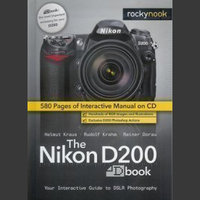
Rocky Nook's The Nikon D200 Dbook is an expanded user guide and reference for the Nikon D200 digital SLR. It goes beyond what any ordinary manual would cover using hundreds of colorful illustrations and many interactive pages.
The Nikon D200 Dbook is aimed at novice photographers with a thirst for knowledge about their camera and photo technology. Although the book's title only mentions the camera, this digital book also covers a range of related topics, including lenses, flashes, color science and image correction software.
Nikon D200 owners wanting to know how and when to use their camera's features will greatly appreciate this book's thoroughness and depth. Particularly, this book puts each feature in the context of photography with plenty of examples and illustrations describing situations when a particular feature should be used.
Book Review
The Nikon D200 Dbook covers a broad range of topics, all centered around the D200 but not necessarily exclusive to it. Topics include digital camera technology, color-science, lenses, flashes, image-manipulation software and more.
Although this is a digital book, its layout is quite similar to a printed book except with pages in landscape orientation. Each page has a sparse layout with colorful images and diagrams. Visually, this dbook is quite pleasing with bold colors and plenty of graphic elements. At the same time, this is a highly structured book. The entire book is divided into parts which are further divided into small sections. Each section is directly accessible through a built-in PDF bookmarks which makes navigation quick and efficient.
The first part, Digital Basics, is generic and applies to nearly any digital camera. Light and color are thoroughly discussed here, with a good introduction to color-science. Some readers may feel this is too much information, and indeed, it is possible to learn how to master the D200 without understanding all that. Nevertheless, those who are interested in the science behind photography will find the information there to be easily understandable and well-rounded. Pixels, Resolution and Image Size are covered in this part as well. There is also a great overview of monitor calibration with step-by-step instructions for using Adobe Gamma here.
The four parts that follow cover the main features of the D200: Focusing, Exposure & White-Balance and Flash. This is the core of the Nikon D200 Dbook. Starting with a very detailed tour of the camera, this part truly shows the depth and coverage that we expected from such a book. Unlike camera manuals which serve to list controls and menu options, this dbook clearly explains every one of the D200's setting and how it relates to taking pictures. These four parts (2 to 5), plus part 7 (Lenses) is where the Nikon D200 Dbook really shines. Together, these parts form the missing link between the camera and the photographer.
Since the D200 is so feature-rich, even among other DSLR cameras, it has an inherent complexity which is difficult to explain at times. Even so, this dbook provides some excellent explanations for depth-of-field, histograms and flash usage. There is even a section on camera profiling which rarely covered in photography books. Flash photography is complex and numerous books have been written on the topic alone, so finding a great introduction to it within the Nikon D200 Dbook is a real bonus. On the flip side, the interactions between continuous shooting and bracketing were less well explained.
The sixth part offers a very brief coverage of photography. Some technical considerations, which related to various photographic subjects like portrait, landscape, macro and action, are exposed here. While there is nothing wrong with this part, this type of overview is too shallow to be truly useful to the aspiring photographer. There are thousands of books entirely devoted to these topics, either as a whole or individually, so keep in mind that no topic so vast can be taught by such a short chapter.
As it was said earlier, the seventh part is among the best ones in this dbook. It starts with a superb explanation of the relation between angle-of-view and focal-length, while other sections here discuss various types of lenses, their use and the Nikon lens lineup. It is great to see a book which emphasizes the importance of lenses and discusses their properties with sufficient depth.
The last two parts focus on software. First, The Digital Life Style focuses on the Nikon Picture Project Software which is used to manage digital images. The information here is detailed but not that useful since most users tend to organize their images with something more sophisticated. Second, Digital Imaging covers manipulation software. This part includes a very comprehensive high-level view of imaging software. Although there is understandably more emphasis on Photoshop due to its popularity, the authors have to be commended for discussing other less popular imaging software too.
The Nikon D200 Dbook is a 580-page digital document packaged in a thin hard-cover booklet which serves as reference to the D200's buttons, displays and menus. The booklet's size and hard cover make it easy and safe to carry in a typical camera bag.
The Dbook itself is a Adobe PDF file with built-in navigation buttons and PDF-links between various pages. Upon loading, the Nikon D200 DBook tries to force Adobe Acrobat into full-screen mode and zooms to150% magnification. Thankfully, you can easily prevent the document from using all your precious screen real-estate and set it to a reasonable magnification. As pages of the Dbook are formatted for 4:3 screens, which are unfortunately becoming less common lately, full-screen viewing wastes space on most modern laptops and LCDs. Also, the default magnification makes you feel like you are reading a children's book. After toning it down you can have Acrobat remember the settings for each document, so that you do not have to do it each time you open the Dbook.
Overall, the Nikon D200 Dbook provides a satisfying addition to the Nikon D200 digital SLR. Most of the book is well-written with simple explanations and numerous images to illustrate important points. This digital book also covers plenty of related topics which normally get too little coverage like lenses, flashed, monitor calibration and camera profiling. Being critical of this dbook means also realizing that this book in its entirety is not for everyone. Some parts provide too much peripheral information, like the one on Color & Light, while some, like Taking Pictures, do not cover their topic enough to be genuinely useful. The final word is that most recent D200 owners will probably learn a great deal from this book and find it a worthy replacement for their camera's manual.
Note: Although we reviewed the Nikon D200 Dbook, Rocky Nook also publishes the Nikon D80 Dbook for those with a Nikon D80 rather than a D200.

 Book Reviews
Please Support Neocamera
All information on Neocamera is provided free of charge yet running this website is a huge endeavor. Purchases made via affiliate links found throughout the site help keep it running and up-to-date. There is no additional cost to you, so please consider buying via these links to our affilates:




Thank you for your support!


Updates
2026.05.21

Laowa 4.5-10mm F/2.8 Fisheye Zoom Lens Review
In-depth review of the Venus Optics Laowa 4.5-10mm F/2.8 Fisheye Zoom Lens. This lens zooms from a circular to rectangular fisheye with an 180° viewing angle. This review analyses its optical quality, construction and handling.
2026.04.13

Laowa 17mm F/4 Zero-D Shift Review
In-Depth review of the Venus Optics Laowa 17mm F/4 Zero-D Shift Lens. This ultra-wide Shift lens is specifically designed for Mirrorless Digital Cameras and is available in 4 Full-Frame mounts plus 2 Medium-Format ones.
2025.11.13

Best Gifts for Photographers in 2025 by Budget
The annual Neocamera Photography Gift Guide updated to 2025. Find great gifts for photographers with any price budget.
2025.07.07

Stellar Photo Recovery Review
Review of Stellar Photo Recovery V12. This Windows and MacOS software can recover photos and videos in a huge number of formats from memory cards, USB drives, SSDs and HHDs.
2025.05.14

Huion Kamvas 13 Gen 3 Review
In-Depth review of the Huion Kamvas 13 Gen 3 Pen Display Tablet for photographers and graphic artists.
2025.01.18

Fujifilm GFX 2025 Lens Roundup
Lens Review roundup of Fujifilm GFX Medium-Format lenses. Quality, performance and handling of the GF20-35mm F/4R WR, GF30mm F/3.5 Tilt-Shift and the GF55mm F/1.7.
2024.11.18

Best 2024 Photography Gifts for Every Budget
Great gifts for photographers and photo enthusiasts selected for every budget among the best products of 2024.
2024.08.07

Eye Protection Tips for Professional Photographers
The four main considerations for professional photographers regarding eyewear.
2024.07.14

Fujifilm X100VI Review
Flagship fixed-lens compact digital camera with a 40 MP sensor and Image-Stabilization, a first for the series. Retro design featuring dual control-dials, plus direct ISO, Shutter-Speed and EC dials. Its hybrid viewfinder can switch between EVF and OVF mode.
2024.05.09

Fujifilm GFX100 II Review
Flagship 102 Megapixels Medium-Format Mirrorless Digital Camera with 8-Stop 5-Axis IBIS, 8 FPS Drive, 8K Video and 400 MP Super-Resolution capture in a weatherproof and freezeproof body with dual control-dials and dual memory-card slots.
2024.04.03

Fujifilm X-T5 Review
Newest Fujifilm flagship boasting a 40 MP APS-C sensor, 5-axis IBIS with 7-stop efficiency, 15 FPS continuous drive, 6.2K Video capture, dual control-dials and dual SDXC UHS-II slots in a sturdy weatherproof and freezeproof body.
2023.11.20

Best Digital Cameras of 2023
Find out which are the Best Digital Cameras of 2023. All the new Mirrorless Digital Cameras from entry-level to high-end professional.
2026.05.21
2026.04.13
2025.11.13
2025.07.07
2025.05.14
2025.01.18
2024.11.18
2024.08.07
2024.07.14
2024.05.09
2024.04.03
2023.11.20
Camera Bag


Your camera bag is empty. To add a camera or lens click on the star next to its name.
Your camera bag is empty.
Add cameras or lenses by clicking on the star next to their name.
NEWS
2026.05.13

Sony Levels Up 6th Generation Alpha A7R
Digital Camera
2026.05.13
Canon Launches First Full-Frame Video Mirrorless
Digital Camera
2026.05.12
Panasonic Finally Launches LX100 II Successor
Digital Camera
2026.03.24
Panasonic Launches ZS300 Compact Ultra-Zoom
Digital Camera
2026.03.10

Venus Optics Unveils Ultra Wide Perspective Control Lens Duo
Lens
2026.02.24
Nikon Release Lighter Bright Constant-Aperture Full-Frame Telephoto Zoom Lens
Lens
2026.02.05
Canon Introduces 2 Extreme Wide Full-Frame Lenses
Lens
2026.01.06
Nikon Introduces Lightweight Full-Frame Zoom Lens
Lens
2025.12.02
Sony Upgrades Alpha 7 to 5th Generation
Digital Camera ○ Lens
2025.11.29
Venus Optics Releases New Zero-D Tilt-Shift Macro Lens
Lens
2025.11.23
Best Digital Cameras of 2025
Digital Camera
2025.11.14

Photography Gift Guide 2025 Edition

