Camera Basics
 Camera Choosing
 Camera Models
 Camera Buying
 DSLR Buying

Sony Alpha A100 Review
 10 Megapixels
 Single Lens Reflex
 Stabilization: Compensates for tiny involuntary movements of the camera.
 Continuous Drive
 Manual Controls: Both fully-manual (M) and semi-automatic modes (T and V).
 Custom White-Balance: Specifies exactly what should be white to the camera.
 Action Photography: Shutter speeds of 1/1500 or more.
 Night Photography: Reaches shutter-speeds longer than 4 seconds.
 Hotshoe: Allows external flash units to be attached.
 Spot Metering
 Depth-Of-Field Preview: Improve perception of DOF before shooting.
 Accepts Compact Flash memory.
 Neocamera detailed review
 Discontinued: No longer produced by the manufacturer. May still be in stock or found used.
 1 - Capability2 - Usability3 - Performance
Sony Alpha A100 Performance - How well does it take pictures?
Ultimately, it is the image quality that makes a camera worth buying. For an SLR, image quality greatly depends on the lens used. While color, noise, exposure and contrast are properties of the camera, distortion, vignetting and chromatic aberrations are properties of the lens. Sharpness depends on the weakest link. That is, the camera cannot capture more detail than the lens lets through. Conversely, it is possible for a lens to transmit more detail than the sensor can capture.
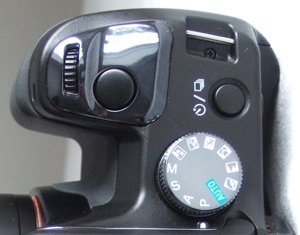
Multi-segment metering of the A100 is rather good. Overall, metering is conservative and avoids burning highlights. Occasionally, this may produce images which are darker than expected, but it keeps more highlight details than the average DSLR camera. The default metering is extremely consistent, probably due to the 40-segments used to calculate exposure. It is important to remember that the A100 has several unique settings which affect exposure. Particularly, the DRO, Lo80 and Hi200 settings. Using those settings, the Alpha A100 can capture a greater dynamic range while retaining more shadow or highlight details. The first set of scaled images below illustrates the differences between the normal and keyed ISO settings. The second set of scaled images shows the effect of the three possible DRO settings.
The Sony Alpha A100 produces very accurate colors in standard mode and slightly over-saturated colors in vivid mode. The colors in vivid mode are excellent for prints, with pleasing color saturation. The white-balance system is good, and substantially better than any other Sony cameras we have seen. Outdoor white-balance is neutral under most conditions. Even snow was rendered as white most of the time. Indoors, white-balance is not as accurate. Incandescent lighting leaves a noticeable yellow cast when using automatic white-balance. Preset white-balance is much better, requiring only a little fine-tuning under artificial light. Note that most DSLR cameras suffer from his problem. Compared to the competition, the Sony Alpha A100's automatic white-balance is about average. Custom white-balance, on the other hand, is excellent and adapts well to unusual lighting. The custom white-balance function can also be used as a color-meter since it reports the sampled color-temperature.
Images taken between ISO 80 and 200 show very low noise levels. The Lo80 particularly is extremely smooth. Noise at ISO 200 is negligible and would not be visible unless printing beyond the resolution of the camera. At ISO 400, noise starts becoming noticeable, particularly in shadow areas. For bright scenes, an ISO 400 can be printed at 18"x12" without concern for noise. With dark scenes, ISO 400 noise is much more visible and prints beyond 8"x10" will show some graininess. This is where the A100's performance drops below average compared to other DSLRs in its class. Noise levels further increase at ISO 800 and 1600. The ISO 800 setting is quite usable for most scenes when printed at 8"x12" or smaller. At ISO 1600, only 4"x6" prints are certain to look smooth.
While the most important factor for image sharpness with a DSLR is the lens, the camera's internal processing affects the result. In the case of the Sony Alpha A100, sharpness is controllable in 5-steps. Each step results in a noticeable jump in image sharpness. The default is good and acceptably sharp. A single-step increase in sharpness improves images for display purposes. The maximum two-step increase produces a very sharp image with a somewhat artificial feel. Particularly, increasing sharpness makes image noise more visible. Relative to sensitivity, sharpness slowly diminishes as ISO increases past 400.
The overall image quality of this DSLR is good. At low ISO settings, including Lo80 and Hi200, the Sony Alpha A100 produces superb images, thus matching its best competitors in terms of color, noise and exposure. Starting at ISO 400, noise levels start falling behind but do not become a problem until ISO 800. The recommendation is therefore that this camera's image quality be considered ideal for photography at low ISO sensitivities.
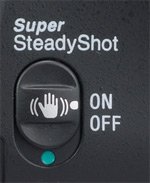 One of the Sony Alpha A100's most outstanding features is its built-in stabilization. This feature proved to be very effective. Sony claims up to 3.5 stops of improvement over normal hand-holding. In practice, we consistently got at least a 2-stop advantage. A 3-stop advantage was also frequently possible but occasionally left some slight image blur. This stabilization advantage somewhat compensates for the image noise at high-ISO, although not for moving subjects.
The A100 is fast and responsive. Shot-to-shot lag is very short, as long as focus can lock fast enough. That depends on the lens and lighting conditions, but the focusing system is extremely accurate. This is where the eye-start focus works to the Alpha A100's advantage. By pre-focusing before the shutter-button is half-pressed, focus lock time is greatly reduced. Image playback and zoom are very fast, even when switching between images while being zoomed. In terms of speed, the A100 never lets the photographer wait. The continuous shooting at 3 FPS can continue until the memory card gets full. No similarly priced 10 megapixels DSLR can do better.
| Normal vs. Keyed ISO | Dynamic Range Optimizer (DRO) |
|---|---|
 |
 |
| Lo80 - Lo key setting | DRO Off |
 |
 |
| ISO 100 - Standard setting | DRO Standard |
 |
 |
| Hi200 - Hi key setting | DRO Advanced |
Sony Alpha A100 Conclusion
The Sony Alpha A100 may have competitors from every other DSLR maker, but it stands up to them well. It has the second most advanced feature-set, just behind the Pentax K10D, but it also packs several unique features. With good image quality, great ergonomics, effective stabilization and superb speed, the Sony Alpha A100 is hard to beat.
The Alpha A100 clearly shows a well thought-out feature set and innovative features aimed to help the photographer. Particularly the low-key (Lo80) and high-key (Hi200) settings are very useful when dealing with high-contrast subjects without any post processing. The DRO system can often help with high-constast subjects too but since its result is less predictable, it is preferable to use this feature for shots which can be re-taken. For action shots, it is better not risk the DRO doing the wrong thing. This unpredictability would have been a non-issue if Sony had provided a virtual bracket for DRO as it did for white-balance.
Another superb aspect of this DSLR is its ergonomics. The camera is easy to hold with well-placed buttons to control important functions. The LCD, which serves as a status screen and is controlled by the eye-start sensor, greatly contributes to the overall ergonomics. Although there are a few things missing (such as a second control-wheel, to make this into pro-ergonomics), the A100's handling is among the best in its class.
The only disappointing aspect of the A100's performance is its high-ISO performance. ISO 800 and up should be avoided for photographs which may end-up printed big. For small prints, it is not a serious issue. In terms of low-light photography, the Sony Alpha A100 does quite well thanks to its built-in stabilization. It is low-light action that is the problem, particularly indoor sports where fast movement requires high ISO settings.
The bottom line is that the Sony Alpha A100 brings many unique features and produces high quality images under most conditions. Unless high-ISO is required for large prints, this is one of the best DSLRs to choose. Considering it has built-in stabilization and is priced relatively low, the A100 is an excellent value. Its closest competitor, the weatherproof Pentax K10D, is worth a look for its own unique features. Another interesting competitor is the Canon Digital Rebel XTi. It performs better at high-ISO but lacks stabilization and is not as ergonomic. For action photography, particularly indoors, the 8 megapixels Canon EOS 30D or the much more expensive Nikon D200 should be considered for their 5 FPS continuous drive and high-speed focusing.
 |


|

 1 - Capability2 - Usability3 - Performance
Please Support Neocamera
All information on Neocamera is provided free of charge yet running this website is a huge endeavor. Purchases made via affiliate links found throughout the site help keep it running and up-to-date. There is no additional cost to you, so please consider buying via these links to our affilates:




Thank you for your support!


Sony A100 Highlights
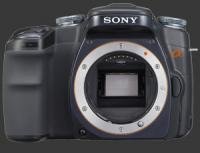


 SLR digital camera
Sensor-Size: 24 x 16mm

Actual size when viewed at 100 DPI
| 10 Megapixels DSLR | ISO 80-1600 |
| Sony A Mount 1.5X FLM | Shutter 1/4000-30s |
| 2-Axis Built-in Stabilization | Full manual controls, including Manual Focus |
| 95% Coverage Medium Viewfinder | Custom white-balance with 1 axis fine-tuning |
| Automatic Eye-Start sensor | Spot-Metering |
| Built-in Dust Reduction | Hot-Shoe |
| 3 FPS Drive, Unlimited Images | Lithium-Ion Battery |
| 2.5" LCD 230K Pixels | Compact Flash |
Wish-List
No camera is perfect, this one included. Then again, there is always the next model. At PMA 2007, Sony announced a new model scheduled to come out before the end of this year. Here we list our top enhancement wishes for the next Alpha model. Actually, the last 3 options could probably be implemented in a firmware update.
- Lower image noise at ISO 800 and above.
- Add a second control-wheel for faster changes in manual mode. Also, let it control ISO or exposure compensation in semiautomatic mode. It could also be used for zooming during playback.
- Add an ISO dial or dedicated ISO button. This would allow changing ISO without leaving the viewfinder. It would be nice if the ISO setting remained visible in the viewfinder at all times.
- Provide a usable ISO 3200 (or higher) option.
- Make the viewfinder have 100% coverage.
- Add a setup option to reset some settings on power-off. The most likely candidates are EC, WB, drive-mode, metering and ISO. They should be individually selectable.
- Make the simple vs. detailed status screen a setup option, that way the display button becomes an on/off switch. Since the detailed status screen is a superset of the other, users are expected to use one only.
- Add a DRO virtual bracket option. This would take one picture but save it 3 times, once with each DRO setting applied.
Lastly, adding support for a standard losslessly compressed high bit-depth image file format such as 16-bit per channel PNG would benefit all DSLR cameras including this one. However, the Sony Alpha A100's DRO would particularly benefit from the added precision.
Camera Bag


Your camera bag is empty. To add a camera or lens click on the star next to its name.
Your camera bag is empty.
Add cameras or lenses by clicking on the star next to their name.
Updates
2026.05.21

Laowa 4.5-10mm F/2.8 Fisheye Zoom Lens Review
In-depth review of the Venus Optics Laowa 4.5-10mm F/2.8 Fisheye Zoom Lens. This lens zooms from a circular to rectangular fisheye with an 180° viewing angle. This review analyses its optical quality, construction and handling.
2026.04.13

Laowa 17mm F/4 Zero-D Shift Review
In-Depth review of the Venus Optics Laowa 17mm F/4 Zero-D Shift Lens. This ultra-wide Shift lens is specifically designed for Mirrorless Digital Cameras and is available in 4 Full-Frame mounts plus 2 Medium-Format ones.
2025.11.13

Best Gifts for Photographers in 2025 by Budget
The annual Neocamera Photography Gift Guide updated to 2025. Find great gifts for photographers with any price budget.
2025.07.07

Stellar Photo Recovery Review
Review of Stellar Photo Recovery V12. This Windows and MacOS software can recover photos and videos in a huge number of formats from memory cards, USB drives, SSDs and HHDs.
2025.05.14

Huion Kamvas 13 Gen 3 Review
In-Depth review of the Huion Kamvas 13 Gen 3 Pen Display Tablet for photographers and graphic artists.
2025.01.18

Fujifilm GFX 2025 Lens Roundup
Lens Review roundup of Fujifilm GFX Medium-Format lenses. Quality, performance and handling of the GF20-35mm F/4R WR, GF30mm F/3.5 Tilt-Shift and the GF55mm F/1.7.
2024.11.18

Best 2024 Photography Gifts for Every Budget
Great gifts for photographers and photo enthusiasts selected for every budget among the best products of 2024.
2024.08.07

Eye Protection Tips for Professional Photographers
The four main considerations for professional photographers regarding eyewear.
2024.07.14

Fujifilm X100VI Review
Flagship fixed-lens compact digital camera with a 40 MP sensor and Image-Stabilization, a first for the series. Retro design featuring dual control-dials, plus direct ISO, Shutter-Speed and EC dials. Its hybrid viewfinder can switch between EVF and OVF mode.
2024.05.09

Fujifilm GFX100 II Review
Flagship 102 Megapixels Medium-Format Mirrorless Digital Camera with 8-Stop 5-Axis IBIS, 8 FPS Drive, 8K Video and 400 MP Super-Resolution capture in a weatherproof and freezeproof body with dual control-dials and dual memory-card slots.
2024.04.03

Fujifilm X-T5 Review
Newest Fujifilm flagship boasting a 40 MP APS-C sensor, 5-axis IBIS with 7-stop efficiency, 15 FPS continuous drive, 6.2K Video capture, dual control-dials and dual SDXC UHS-II slots in a sturdy weatherproof and freezeproof body.
2023.11.20

Best Digital Cameras of 2023
Find out which are the Best Digital Cameras of 2023. All the new Mirrorless Digital Cameras from entry-level to high-end professional.
2026.05.21
2026.04.13
2025.11.13
2025.07.07
2025.05.14
2025.01.18
2024.11.18
2024.08.07
2024.07.14
2024.05.09
2024.04.03
2023.11.20