Camera Basics
 Camera Choosing
 Camera Models
 Camera Buying
 DSLR Buying

Pentax K10D Review
 10 Megapixels
 Single Lens Reflex
 Stabilization: Compensates for tiny involuntary movements of the camera.
 Continuous Drive
 Manual Controls: Both fully-manual (M) and semi-automatic modes (T and V).
 Custom White-Balance: Specifies exactly what should be white to the camera.
 Action Photography: Shutter speeds of 1/1500 or more.
 Night Photography: Reaches shutter-speeds longer than 4 seconds.
 Hotshoe: Allows external flash units to be attached.
 Spot Metering
 Depth-Of-Field Preview: Improve perception of DOF before shooting.
 Weatherproof - Seals protect from dust, humidity and light splashing.
 Accepts Secure Digital High Capacity (SDHC) and SD memory.
 Neocamera detailed review
 Discontinued: No longer produced by the manufacturer. May still be in stock or found used.
 1 - Capability2 - Usability3 - Performance
Pentax K10D Performance - How well does it take pictures?
Ultimately, it is the image quality that makes a camera worth buying. For an SLR, image quality greatly depends on the lens used. While color, noise, exposure and contrast are properties of the camera, distortion, vignetting and chromatic aberrations are properties of the lens. Sharpness depends on the weakest link. That is, the camera cannot capture more details than the lens lets through. Conversely, it is possible for a lens to transmit more details than the sensor can capture.
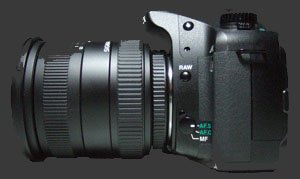
Exposure is generally good with the K10D, specially with subjects that fall within the camera's dynamic range. When a subject has more contrast then the K10D can capture, it consistently exposes conservatively. This means that highlights are rarely overexposed but images may appear darker than expected. Since this is not optimal for printing unmodified images, more positive exposure-compensation than usual is required for scenes with very bright highlights.
The Pentax K10D shows good color accuracy in its natural mode. The bright color mode gently increases color saturation but keeps colors looking natural. The white-balance system is very accurate when preset and manually set. Automatic white-balance is generally good except under artificial light where it leaves a noticeably warm color cast. This problem unfortunately occurs with most digital SLR cameras. However, since the K10D has a digital white-balance preview feature, it is very easy to select an accurate white-balance and fine-tune it until satisfied.
Noise levels are extremely low until ISO 400, very low but noticeable in shadow-areas at ISO 800 and low at ISO 1600. Compared to competing 10 megapixels DSLR cameras, the Pentax K10D is about average in terms of image noise. This is a great performance, although the Canon Digital Rebel XTi produces smoother images with just as much detail. The Nikon D80 also produces images with less noise but at the expense of fine detail. Still, the Sony Alpha A100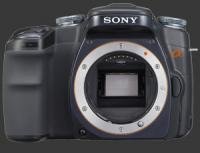
Sony Alpha A100 and Nikon D200 show more image noise at high sensitivities.
Image sharpness is controllable in 7 steps. At the default setting, images appear slightly soft, but this is easily corrected by increasing sharpness in-camera. It is common for high-end DSLR to produce slightly soft images by default since those images fair better during post-processing. Remember that final image sharpness is dependent on the lens, focal-length and aperture used. Overall, the Pentax K10D can produce high-quality images with plenty of details and no sharpening artifacts.
In operation, the Pentax K10D is speedy and responsive. There is rarely a moment where the photographer has to wait for the K10D. The focusing system is fast and accurate, with some variation depending on the lens used. Shutter-lag is always very short. Image playback and zoom is nearly instant as well. While Pentax claims the K10D shoots continuously indefinitely at 3 FPS, we found that shooting speed varied between 2.8 and 3.3 FPS for at least 24 shots. After that, the continuous drive became more erratic. While this is better than most DSLR cameras, the Sony Alpha A100 does better by sustaining 3 FPS until the memory card gets full.

Even though there are no formal ways of measuring the performance of image stabilization, weeks of testing suggest that Pentax's implementation is less efficient than Konica-Minolta's Anti-Shake. Although there is no doubt that the K10D's Shake Reduction works and makes a difference, result consistency was lower than expected. As for dust-reduction, it also makes a difference but the sensor may still requires occasional cleaning for stubborn dust.
Pentax K10D Conclusion
With so much excellent competition, the Pentax K10D distinguishes itself by an unequaled feature set. Even though image quality is on-par with its peers, the combination of stabilization, dust-reduction, weatherproofing and unique features is what makes this camera so appealing. In terms of handling, the Pentax K10D is exceptional. The two control-wheels and well placed buttons allow the camera to be controlled with unprecedented efficiently.
The only disappointing part of the K10D's performance was its built-in stabilization system which is not as efficient as advertised. Since there are no stabilized Pentax lenses, nothing can be done if it does not provide sufficient stabilization. Continuous drive was also somewhat erratic but still maintained a good average speed.
The bottom line is that the K10D cannot be beaten feature-wise. It brings some unique features and exposure modes into a very thoughtful and ergonomic design. In terms of image quality, the Canon Digital Rebel XTi and the 8 megapixels Canon EOS 30D still have the advantage, specially at high-ISO. Neither of these cameras have built-in stabilization or weatherproofing though. The XTi has an useful eye-start sensor but its ergonomics and capabilities are limited compared to the K10D. The 30D has the advantage of having a consistent 5 FPS continuous drive which is better suited for action photography.
Pentax K10D Samsung GX10
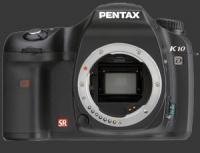
The Pentax K10D has a nearly identical twin, the Samsung GX-10. Unlike previous clones of Pentax DSLR cameras by Samsung, there are some cosmetics and interface differences between these two cameras. The only functionality differences between these two cameras is that the GX-10 only support Adobe's RAW format called DNG, while the Pentax K10D also supports Pentax's own compressed format, called PEF.
| Samsung GX-10 Reviews | |
|---|---|
| ePhotozine | |
 |


|
 1 - Capability2 - Usability3 - Performance
Please Support Neocamera
All information on Neocamera is provided free of charge yet running this website is a huge endeavor. Purchases made via affiliate links found throughout the site help keep it running and up-to-date. There is no additional cost to you, so please consider buying via these links to our affilates:




Thank you for your support!


Pentax K10D Highlights


 SLR digital camera
Sensor-Size: 24 x 16mm

Actual size when viewed at 100 DPI
| 10 Megapixels DSLR | ISO 100-1600 |
| Pentax K Mount 1.5X FLM | Shutter 1/4000-30s |
| 2-Axis Built-in Stabilization | Full manual controls, including Manual Focus |
| 95% Coverage Large Viewfinder | Custom white-balance with 2 axis fine-tuning |
| Weatherproof | Spot-Metering |
| Built-in Dust Reduction | Hot-Shoe & Sync-Port |
| 3 FPS Drive, Unlimited Images | Lithium-Ion Battery |
| 2.7" LCD 230K Pixels | Secure Digital High Capacity |
Wish List
Since no camera is perfect, here are our suggestions to Pentax for improving upon the K10D. Hopefully, we can see several of them in a firmware update rather than wait for the K10D's successor.
Update: Now that thePentax K20D was reviewed here
Pentax K20D, we can see that 4 of these 14 wishes were addressed. They are labeled K20D below.
- Revise the Shake-Reduction system to increase its efficiency and consistency. Providing a shake indication would be quite helpful as well.
- Add an option to disable the flashing Flash icon.
- Optionally allow the flashing icon in green mode only.
- Automatically reset the 12-second self-timer after each use.
- Allow reset values to be specified for parameters reset at power-off.
- Provide metering-line options to control the behavior of multi-segment metering (average, preserve-highlights, maximize-shadow-details).
- Improve consistency of continuous drive speed. K20D
- Improve image sharpening at edges. K20D
- Provide a usable ISO 3200 (or higher) option. K20D
- Improve automatic white-balance accuracy under artificial light. K20D
- Make a battery grip that supports AA batteries for the K10D and make its successor use AA batteries directly.
- Allow the camera to read the aperture from lenses when their aperture-ring is away from the A position.
- Add an eye-start sensor to automatically turn off the LCD when the viewfinder is in use.
- 100% coverage viewfinder.
Camera Bag


Your camera bag is empty. To add a camera or lens click on the star next to its name.
Your camera bag is empty.
Add cameras or lenses by clicking on the star next to their name.
Updates
2026.05.21

Laowa 4.5-10mm F/2.8 Fisheye Zoom Lens Review
In-depth review of the Venus Optics Laowa 4.5-10mm F/2.8 Fisheye Zoom Lens. This lens zooms from a circular to rectangular fisheye with an 180° viewing angle. This review analyses its optical quality, construction and handling.
2026.04.13

Laowa 17mm F/4 Zero-D Shift Review
In-Depth review of the Venus Optics Laowa 17mm F/4 Zero-D Shift Lens. This ultra-wide Shift lens is specifically designed for Mirrorless Digital Cameras and is available in 4 Full-Frame mounts plus 2 Medium-Format ones.
2025.11.13

Best Gifts for Photographers in 2025 by Budget
The annual Neocamera Photography Gift Guide updated to 2025. Find great gifts for photographers with any price budget.
2025.07.07

Stellar Photo Recovery Review
Review of Stellar Photo Recovery V12. This Windows and MacOS software can recover photos and videos in a huge number of formats from memory cards, USB drives, SSDs and HHDs.
2025.05.14

Huion Kamvas 13 Gen 3 Review
In-Depth review of the Huion Kamvas 13 Gen 3 Pen Display Tablet for photographers and graphic artists.
2025.01.18

Fujifilm GFX 2025 Lens Roundup
Lens Review roundup of Fujifilm GFX Medium-Format lenses. Quality, performance and handling of the GF20-35mm F/4R WR, GF30mm F/3.5 Tilt-Shift and the GF55mm F/1.7.
2024.11.18

Best 2024 Photography Gifts for Every Budget
Great gifts for photographers and photo enthusiasts selected for every budget among the best products of 2024.
2024.08.07

Eye Protection Tips for Professional Photographers
The four main considerations for professional photographers regarding eyewear.
2024.07.14

Fujifilm X100VI Review
Flagship fixed-lens compact digital camera with a 40 MP sensor and Image-Stabilization, a first for the series. Retro design featuring dual control-dials, plus direct ISO, Shutter-Speed and EC dials. Its hybrid viewfinder can switch between EVF and OVF mode.
2024.05.09

Fujifilm GFX100 II Review
Flagship 102 Megapixels Medium-Format Mirrorless Digital Camera with 8-Stop 5-Axis IBIS, 8 FPS Drive, 8K Video and 400 MP Super-Resolution capture in a weatherproof and freezeproof body with dual control-dials and dual memory-card slots.
2024.04.03

Fujifilm X-T5 Review
Newest Fujifilm flagship boasting a 40 MP APS-C sensor, 5-axis IBIS with 7-stop efficiency, 15 FPS continuous drive, 6.2K Video capture, dual control-dials and dual SDXC UHS-II slots in a sturdy weatherproof and freezeproof body.
2023.11.20

Best Digital Cameras of 2023
Find out which are the Best Digital Cameras of 2023. All the new Mirrorless Digital Cameras from entry-level to high-end professional.
2026.05.21
2026.04.13
2025.11.13
2025.07.07
2025.05.14
2025.01.18
2024.11.18
2024.08.07
2024.07.14
2024.05.09
2024.04.03
2023.11.20