



 Camera Basics
 Camera Choosing
 Camera Models
 Camera Buying
 DSLR Buying

Pentax K10D Summary
 10 Megapixels
 Single Lens Reflex
 Stabilization: Compensates for tiny involuntary movements of the camera.
 Continuous Drive
 Manual Controls: Both fully-manual (M) and semi-automatic modes (T and V).
 Custom White-Balance: Specifies exactly what should be white to the camera.
 Action Photography: Shutter speeds of 1/1500 or more.
 Night Photography: Reaches shutter-speeds longer than 4 seconds.
 Hotshoe: Allows external flash units to be attached.
 Spot Metering
 Depth-Of-Field Preview: Improve perception of DOF before shooting.
 Weatherproof - Seals protect from dust, humidity and light splashing.
 Accepts Secure Digital High Capacity (SDHC) and SD memory.
 Neocamera detailed review
 Discontinued: No longer produced by the manufacturer. May still be in stock or found used.
Pentax K10D Assessment
The Pentax K10D is amazingly fitted with nearly every feature possible for a DSLR camera: stabilization, dust-reduction, weatherproofing, advanced customization, digital white-balance and depth-of-field preview, unlimited continuous drive. It is only outpaced in terms of continuous shooting by some much more expensive digital SLRs, which can shoot at 5 FPS rather than 3 FPS. It also lacks an eye-start sensor which can automatically turn off the rear LCD like on the Sony Alpha A100 and the Canon Digital Rebel XTi. Priced below $1000, this feature set provides excellent value.
The Pentax K10D performs quite well, both in terms of image quality and speed. Among 10 megapixels DSLR cameras, its image quality is still behind the Canon Rebel XTi, the current leader. Color, exposure and focus are very accurate except for automatic white-balance under artificial lighting. Note that all current DLSR cameras have the same problem, although the K10D seems more afflicted. Noise levels are average for a DSLR, which is very good. Both the Canon XTi and the Nikon D80 show less noise, particularly at ISO 1600. The Sony Alpha A100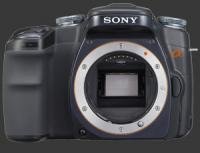
Sony Alpha A100 shows visibly more noise at ISO 800 and 1600. One great thing about the K10D is that its images keep plenty of details even at high-ISO. The weak point of the K10D's image quality is that it produces JPEG images with softer edges than normal. Even though image sharpness can be adjusted, DP Review reports that it has no effect on edge softness.
With several innovative features, the K10D distinguishes itself among its competitors. The full list of differences can be found in our 10 Megapixels DSLR Comparison feature. These unique features include: sensitivity priority mode, shutter-and-aperture priority mode (camera selects ISO), choice of program line for automatic mode, digital white-balance preview and in-camera RAW conversion. Digital white-balance preview is particularly interesting because it allows pre visualizing the effect of white-balance. Otherwise, one has to take test shots until the desired results are obtained.
Ergonomics are good with two control-wheels and a large rubberized grip. The weatherproofing means that doors are shut tighter and are slightly harder to open. This seems like a very acceptable compromise for this feature. Note that Pentax does not currently sell any weatherproof lenses and therefore this feature is not usable at this time. Weatherproof lenses are expected around March 2007 but pricing has not yet been announced. In the end, this may turn out to be a costly feature despite the low-cost of the camera.
The bottom line is that the Pentax K10D is a very desirable digital SLR. Although its feature set is unmatched, the Canon Digital Rebel XTi and Canon EOS 30D remain the image quality champions. The major feature missing from the K10D is a 5 FPS continuous drive which is present on the Canon EOS 30D and the Nikon D200. Since the 30D also shows better image quality, that camera would be better recommended for sport and action photography. The K10D also shows less image noise than the Sony Alpha A100 which is the only other stabilized high-resolution DSLR. If weatherproofing or built-in stabilization is required, the K10D is the camera to get. The Nikon D80 also competes well but does not bring any compelling features. For top image quality better go with Canon, either the XTi with built-in dust-reduction and an eye-start sensor or the 30D with its 5 FPS continuous drive and large viewfinder (still smaller than the K10D's viewfinder).
Neocamera detailed review Read the full Pentax K10D review here.
| PROS | CONS |
|---|---|
Natural image colors |
Slightly soft JPEG images |
| Excellent metering accuracy | Above average noise at ISO 1600 |
| Good focus speed and accuracy | Slightly less dynamic range than peers |
| Innovative exposure modes and choice of program line | Poor automatic white-balance under artificial light |
| Digital white balance and depth of field preview | Sealed body means doors are harder to open |
| Built-in stabilization for all lenses | |
| Durable weatherproof body | |
| Customizable auto ISO and ISO warning | |
| Flexible image parameters | |
| Built-in dust reduction | |
| Large viewfinder | |
| Good LCD visibility | |
| In-camera RAW conversion |
|
| Great price | |
 Excellent Excellent Excellent Excellent |
|
Recent Similar Cameras


Pentax K10D Related Information
Please Support Neocamera
All information on Neocamera is provided free of charge yet running this website is a huge endeavor. Purchases made via affiliate links found throughout the site help keep it running and up-to-date. There is no additional cost to you, so please consider buying via these links to our affilates:




If you found any information on this site valuable and did not purchase via our affiliate links, please considering donating via PayPal:
Any amount will be greatly appreaciated. Thank you for your support!


Pentax K10D Highlights
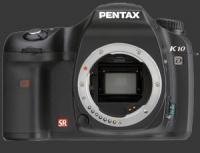


 SLR digital camera
Sensor-Size: 24 x 16mm

Actual size when viewed at 100 DPI
| 10 Megapixels DSLR | ISO 100-1600 |
| Pentax K Mount 1.5X FLM | Shutter 1/4000-30s |
| 2-Axis Built-in Stabilization | Full manual controls, including Manual Focus |
| 95% Coverage Large Viewfinder | Custom white-balance with 2 axis fine-tuning |
| Weatherproof | Spot-Metering |
| Built-in Dust Reduction | Hot-Shoe & Sync-Port |
| 3 FPS Drive, Unlimited Images | Lithium-Ion Battery |
| 2.7" LCD 230K Pixels | Secure Digital High Capacity |


Camera Bag


Your camera bag is empty. To add a camera or lens click on the star next to its name.
Your camera bag is empty.
Add cameras or lenses by clicking on the star next to their name.
Updates
2024.04.03

Fujifilm X-T5 Review
Newest Fujifilm flagship boasting a 40 MP APS-C sensor, 5-axis IBIS with 7-stop efficiency, 15 FPS continuous drive, 6.2K Video capture, dual control-dials and dual SDXC UHS-II slots in a sturdy weatherproof and freezeproof body.
2023.11.20

Best Digital Cameras of 2023
Find out which are the Best Digital Cameras of 2023. All the new Mirrorless Digital Cameras from entry-level to high-end professional.
2023.07.10

Fujifilm X-H2 Review
40 Megapixels APS-C Hybrid Mirrorless Digital Camera with 7-stop IBIS. Fastest shutter ever and 8K video capture. Large builtin EVF with 0.8X magnification and 5.8 MP, plus an Eye-Start Sensor. Packed with features and large number of controls in a weatherproof and freezeproof body.
2023.05.07

Sony FE 20-70mm F/4G Review
Review of the unique Sony FE 20-70mm F/4G lens. The optical zoom of this lens spans ultra-wide-angle and medium focal-length coverage, making it one of the most versatile Full-Frame lenses on the market.
2023.01.15

Huion Inspiroy Dial 2 Review
Review of the Huion Inspiroy Dial 2 tablet, a medium sized drawing surface with dual dials and customizable buttons. Connects via USB-C or Bluetooth 5.0 with Windows, Linux and Android support.
2022.12.08

How to Pack for a Photo Trip
Find out how to pack for a travel photography trip, carry your gear safely while meeting airline regulations.
2022.11.13

Best Digital Cameras of 2022
The best digital cameras of 2022. A short list of the most outstanding models in their respective categories. Choose one for yourself or as a gift.
2022.09.21

Pentax DA* 60-250mm F/4 SDM Review
Review of the Pentax DA* 60-250mm F/4 SDM, the constant-aperture telephoto zoom with the highest zoom-ratio on the market.
2022.09.20

Pentax DA* 50-135mm F/2.8 SDM Review
Review of the Pentax DA* 50-135mm F/2.8 SDM, the lightest professional telephoto zoom native to the K-mount.
2022.09.10

Pentax DA* 11-18mm F/2.8 DC AW Review
Review of the Pentax DA* 11-18mm F/2.8 DC AW, the widest professional ultra-wide zoom native to the K-mount.
2021.11.24

50 Gifts Under $50 For Photographers in 2021
50 Gifts photographers will love. All for under $50 USD. 2021 Edition.
2021.11.17

Best Digital Cameras for 2021
Neocamera shows which are the very best Digital Cameras for 2021 in every category: Mirrorless, DSLR, Premium Compact, Ultra-Zoom and Rugged.

