Camera Basics
 Camera Choosing
 Camera Models
 Camera Buying
 DSLR Buying

Nikon Coolpix P80 Review
 10 Megapixels
 Ultra-Zoom: At least 10X optical zoom.
 Electronic View Finder
 Stabilization: Compensates for tiny involuntary movements of the camera.
 VGA Video: 640 x 480 or more but less than 1280 x 720.
 Manual Controls: Both fully-manual (M) and semi-automatic modes (T and V).
 Custom White-Balance: Specifies exactly what should be white to the camera.
 Action Photography: Shutter speeds of 1/1500 or more.
 Night Photography: Reaches shutter-speeds longer than 4 seconds.
 Spot Metering
 Accepts Secure Digital High Capacity (SDHC) and SD memory.
 Neocamera detailed review
 Discontinued: No longer produced by the manufacturer. May still be in stock or found used.
 1 - Usability & Ergonomics2 - Image Quality & Performance
Nikon Coolpix P80 Performance - How well does it take pictures?
With such an extraordinary zoom range in a small body, there are compromises to be expected. It is easy to understand that the lens' short length for an 18X zoom implies that the sensor being it must be very small. This is how they get the FLM sufficiently large to reach 486mm. Despite this, technological advancements have improved lens designs to the point where the P80's lens is reasonably sharp and controls distortion quite well except at wide-angle. At wide-angle, the Nikon Coolpix P80 exhibits high barrel distortion.
The smaller an image sensor, the higher it tends to output noisy pixels. Higher image noise is normally dealt with using stronger noise reduction. The P80 shows a good deal of both as ISO is increased just passed the baseline. Images are clear and show little noise at ISO 64 and 100. 200 is notably noisier but without impacting image quality much. By ISO 400 though, noise reduction becomes destructive and visibly destroys image details. A side effect of the noise-reduction used in the Nikon Coolpix P80 is a color shift which gradually gets worst from ISO 400 onwards. As such, we would not recommend using the P80 any setting past ISO 400. Even ISO 400 should be only reserved for emergencies.
Ignoring the color distortion which appears at high ISO, the Nikon P80 produces reasonably accurate image colors with above average white-balance. The automatic white-balance system, in particular, is quite accurate although takes time to settle. The auto white-balance takes 1 to 2 seconds to get the color temperature right. This is directly visible on the LCD while framing. Within a few seconds of framing a subject, colors become quite neutral. All is not perfect though as dominant colors throw off the AWB system. Therefore, photographers should set white-balance manually when taking pictures with a colored background.
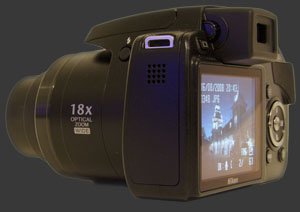
The Nikon Coolpix P80 features 4 metering modes: matrix, center-weighed, spot and spot-AF. The spot metering modes behave as expected with one of them using the frame-center and the other using the AF point to meter its mid-tone. The P80 is helpful here in that it shows the spot or center area being used. The default metering mode is Matrix metering which is expected to produce pleasing results under most circumstances. Unfortunately, the Nikon Coolpix P80 relies too much on the frame center for its Matrix metering thus making overexposure very common. Since we have seen this before from consumer-centric cameras, lets call this Consumer metering from now on. What this does it make sure a subject placed in the center of the frame is itself well exposed. When the background is brighter than the main subject, the background becomes over-exposed. Photographers know that this rarely works out to make a good picture as a bright background is distracting to viewers which weakens the subject. This digital camera captures less dynamic range than most which makes things worse when it cannot exposure properly.
Operating performance of the Nikon Coolpix P80 is a mixed bag. The camera is generally responsive except that button presses are often ignored while the camera is busy. Startup is slow at around 3s, shutdown is fast though. Focusing speeds vary considerably. In good light, near the wide-end of the zoom, the P80 focuses quickly. Near the telephoto end, focusing gets much slower, even worse in low light where it can take several seconds to lock. The zoom controller is fast but not fine-grained. Dials used to change parameters keep up well with the user.
Full-resolution continuous drive is slow and not very continuous: It shoots a maximum of 4 images at less than 1 FPS. This is faster than the shot-to-shot speed of the P80, which is around 3s. Both 2s and 10s self-timer resets themselves after each use. It is rather annoying for the 2s self-timer to do that. The self-timers are also reset when either the mode-dial is rotated or playback more is entered. After a customizable time-out, the P80 enters sleep mode which it wakes up very quickly from once the shutter-release is pressed.
Nikon Coolpix P80 Conclusion
It is fun to have a stabilized wide-angle 18X optical zoom lens. It is even more fun when it fits in a coat pocket or small pouch. This is truly what the Nikon Coolpix P80 is about. While it performs reasonably in some areas, and the lens is good for such a long range, this ultra-zoom has image quality problems which are hard to ignore given the competition.
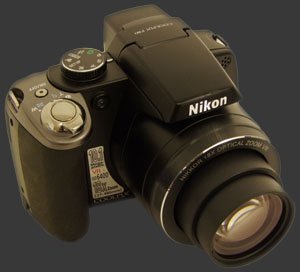
On the bright side, the P80's lens is an achievement in itself, it stays relatively sharp and shows few optical defects other than barrel distortion near its wide end. As long as ISO is kept low, this camera captures accurate colors and its automatic white-balance system is above average. Speed of operation has some good sides like short shutter-lag, quick LCD refresh and fast auto focus in good light towards the zoom's wide-end. Unfortunately shot-to-shot speeds are quite long and focusing can go to over 2 seconds at the telephoto end.
The most serious limitation is destructive image noise reduction performed by the camera which both destroys image details and causes colors to shift from ISO 400 onward. Other serious problems such as the tendency to over-exposure, nearly unusable EVF, poor viewfinder coverage and limited dynamic range really get in the way of taking great pictures with the Nikon Coolpix P80.
Competition includes the Panasonic Lumix DMC-FZ18 which also suffers from destructive noise reduction and limited dynamic range but performs quickly and is easier to operate. There is also the Fuji Finxpix S8000fd which has equally poor LCD and EVF coverage as the P80 but performs faster and produces higher quality images. So, while both Fuji and Panasonic had to compromise too for their 18X ultra-zoom digital cameras, the managed to produce better overall cameras.
 |


|

 1 - Usability & Ergonomics2 - Image Quality & Performance
Please Support Neocamera
All information on Neocamera is provided free of charge yet running this website is a huge endeavor. Purchases made via affiliate links found throughout the site help keep it running and up-to-date. There is no additional cost to you, so please consider buying via these links to our affilates:




Thank you for your support!


Nikon P80 Highlights


 Large digital camera
Sensor-Size: 6 x 5mm

Actual size when viewed at 100 DPI
| 10 Megapixels Ultra Zoom | ISO 64-2000 |
| 18X Wide Optical Zoom | Shutter 1/2000-8s |
| Built-in Stabilization | Full manual controls |
| 0.24" Built-in EVF 230K Pixels | Custom white-balance |
| 0.8 FPS Drive, 4 Images | Spot-Metering |
| 640x480 @ 30 FPS Video Recording | Lithium-Ion Battery |
| 2.7" LCD 230K Pixels | Secure Digital High Capacity |
Camera Bag


Your camera bag is empty. To add a camera or lens click on the star next to its name.
Your camera bag is empty.
Add cameras or lenses by clicking on the star next to their name.
Updates
2026.05.21

Laowa 4.5-10mm F/2.8 Fisheye Zoom Lens Review
In-depth review of the Venus Optics Laowa 4.5-10mm F/2.8 Fisheye Zoom Lens. This lens zooms from a circular to rectangular fisheye with an 180° viewing angle. This review analyses its optical quality, construction and handling.
2026.04.13

Laowa 17mm F/4 Zero-D Shift Review
In-Depth review of the Venus Optics Laowa 17mm F/4 Zero-D Shift Lens. This ultra-wide Shift lens is specifically designed for Mirrorless Digital Cameras and is available in 4 Full-Frame mounts plus 2 Medium-Format ones.
2025.11.13

Best Gifts for Photographers in 2025 by Budget
The annual Neocamera Photography Gift Guide updated to 2025. Find great gifts for photographers with any price budget.
2025.07.07

Stellar Photo Recovery Review
Review of Stellar Photo Recovery V12. This Windows and MacOS software can recover photos and videos in a huge number of formats from memory cards, USB drives, SSDs and HHDs.
2025.05.14

Huion Kamvas 13 Gen 3 Review
In-Depth review of the Huion Kamvas 13 Gen 3 Pen Display Tablet for photographers and graphic artists.
2025.01.18

Fujifilm GFX 2025 Lens Roundup
Lens Review roundup of Fujifilm GFX Medium-Format lenses. Quality, performance and handling of the GF20-35mm F/4R WR, GF30mm F/3.5 Tilt-Shift and the GF55mm F/1.7.
2024.11.18

Best 2024 Photography Gifts for Every Budget
Great gifts for photographers and photo enthusiasts selected for every budget among the best products of 2024.
2024.08.07

Eye Protection Tips for Professional Photographers
The four main considerations for professional photographers regarding eyewear.
2024.07.14

Fujifilm X100VI Review
Flagship fixed-lens compact digital camera with a 40 MP sensor and Image-Stabilization, a first for the series. Retro design featuring dual control-dials, plus direct ISO, Shutter-Speed and EC dials. Its hybrid viewfinder can switch between EVF and OVF mode.
2024.05.09

Fujifilm GFX100 II Review
Flagship 102 Megapixels Medium-Format Mirrorless Digital Camera with 8-Stop 5-Axis IBIS, 8 FPS Drive, 8K Video and 400 MP Super-Resolution capture in a weatherproof and freezeproof body with dual control-dials and dual memory-card slots.
2024.04.03

Fujifilm X-T5 Review
Newest Fujifilm flagship boasting a 40 MP APS-C sensor, 5-axis IBIS with 7-stop efficiency, 15 FPS continuous drive, 6.2K Video capture, dual control-dials and dual SDXC UHS-II slots in a sturdy weatherproof and freezeproof body.
2023.11.20

Best Digital Cameras of 2023
Find out which are the Best Digital Cameras of 2023. All the new Mirrorless Digital Cameras from entry-level to high-end professional.
2026.05.21
2026.04.13
2025.11.13
2025.07.07
2025.05.14
2025.01.18
2024.11.18
2024.08.07
2024.07.14
2024.05.09
2024.04.03
2023.11.20