Camera Basics
 Camera Choosing
 Camera Models
 Camera Buying
 DSLR Buying

Nikon D300 Review
 12 Megapixels
 Single Lens Reflex
 Continuous Drive
 Manual Controls: Both fully-manual (M) and semi-automatic modes (T and V).
 Custom White-Balance: Specifies exactly what should be white to the camera.
 Action Photography: Shutter speeds of 1/1500 or more.
 Night Photography: Reaches shutter-speeds longer than 4 seconds.
 Hotshoe: Allows external flash units to be attached.
 Spot Metering
 Depth-Of-Field Preview: Improve perception of DOF before shooting.
 Weatherproof - Seals protect from dust, humidity and light splashing.
 Accepts Compact Flash memory.
 Neocamera detailed review
 Discontinued: No longer produced by the manufacturer. May still be in stock or found used.
 1 - Capability2 - Usability3 - Performance
Nikon D300 Performance - How well does it take pictures?
Ultimately, it is the image quality that makes a camera worth buying. For an SLR, image quality greatly depends on the lens used. While color, noise, exposure and contrast are properties of the camera, distortion, vignetting and chromatic aberrations are properties of the lens. Sharpness depends on the weakest link. That is, the camera cannot capture more details than the lens lets through. Conversely, it is possible for a lens to transmit more details than the sensor can capture.
Exposure is generally excellent with the D300 with a conservative tendency. This means that highlights are rarely overexposed but images occasionally appear darker than expected. Based on matrix metering using a 1005-pixel RGB sensor, the D300 meters extremely consistently. This reduces worry about exposure accuracy as it means that small changes in viewpoint are unlikely to cause drastic changes in exposure. Since this is not optimal for printing unmodified images, more positive exposure-compensation than usual is required for scenes with bright highlights.
The Nikon D300 has punchy colors by default. Although such oversaturated colors are not realistic, they are appealing to certain photographers. The default color tone is also slightly warm. Luckily, the D300 caters to other photographers by offering several modes: Standard, Neutral and Vivid. There is also a Monochrome mode for black-and-white photography. Each Picture Control mode can be adjusted in terms of sharpening, contrast, brightness, saturation and hue. The adjustments are always relative to the mode but are quite fine grained. Using the Standard color mode and slightly reducing saturation can result in realistic colors.
The white-balance system is very accurate when preset or manually set. Automatic white-balance often leaves a noticeably warm color cast, though. This problem unfortunately occurs with most digital SLR cameras but the Nikon D300 seems to have it a bit worse than others we have seen lately.
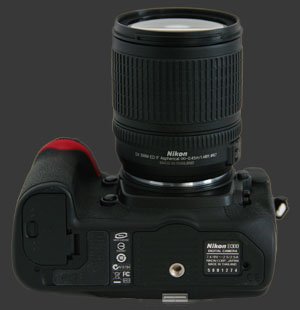
Noise levels are very low until ISO 400 and moderately low but noticeable at ISO 800. At ISO 1600, noise is evident but has a fine grain as to not appear disruptive. In response to higher noise, the D300 softens details with obvious noise-reduction. With this approach, this DSLR keeps noise generally lower than competing cameras. The ISO 3200 setting is quite noisy and soft, although a small print should be possible. At ISO 6400, noise levels are even higher and details get smeared even more. Even for a small print, ISO 6400 borders on useless.
Image sharpness is controllable in 10 steps. At the default setting, images appear slightly soft, but this is easily corrected by increasing sharpness in-camera. It is common for high-end DSLR to produce slightly soft images by default since those images fair better during post-processing. Sharpening steps are fine with the maximum level being rather sharp with some sharpening artifacts. At a setting of 6, up from a default of 2 within a range of 0 to 9, you get good sharpness without the over processed look or jaggies. Remember that final image sharpness depends on the lens, focal-length and aperture used.
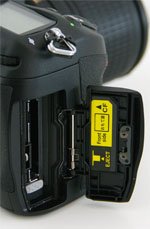 In operation, the Nikon D300 is extremely responsive. Most operations are nearly instant, including power-on and the all-important shutter-lag. The focusing system is fast but not the fastest we have ever seen, this honor goes to the Sony Alpha A700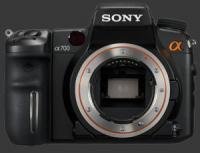
Sony Alpha A700. Since Nikon uses two different types of focus drive, one driven by a motor in the camera and one driven by a motor in the lens, focusing speeds can vary greatly between lenses. Image playback and zoom is nearly instant as well. The D300's continuous drive mode is top-notch, it shoots fast and clears the buffer fast.
The only sub par measurement we had with the D300 is below average battery-life (using the battery that Nikon ships with the D300). The D300 does support other battery types, so battery-life can vary more than usual. Speaking of the battery, the Nikon D300 has a sophisticated gauge system which measures battery-life in percentage, number of shots and life-expectancy. A nice touch is that the charger has a description of the status light printed right on it. No more doubting if yellow means still charging or done!
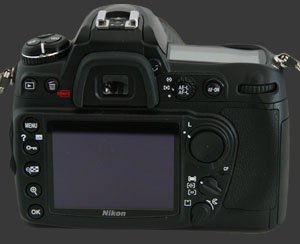
Live view is new to most DSLRs. Although the Nikon D300 has one of the most sophisticated live-views, it is still behind the experience of live-preview on fixed-lens digital cameras. Live-view here is treated as a drive-mode, very similarly to mirror lock-up. After selecting the live-view mode, the shutter-release must be pressed to enable the live-view display.
To obtain focus in live-view, one must use the AF-ON button, as the halfway point of the shutter-release is not used. There are two ways to focus in live-view, both of them really slow. We would not recommended any without camera support. One way is the DSLR-standard phase-detect which requires to flip the mirror but adds about one second of blanking to the preview. The other way uses the sensor to perform contrast-detect AF.
Live-view on the Nikon D300 shows focus and white-balance accurately but it does not preview exposure. For adjusting focus manually, the D300 allows live-view to be zoomed-in although this is mostly useful for the focus plane as DOF-preview is not available. Since the D300's viewfinder shows 100% coverage there is no need to use live-view for framing, only for precise manual focusing made easy by a 3" LCD and zooming feature.
Nikon D300 Conclusion
The Nikon D300 is certainly an excellent professional camera. Thanks to its 12 megapixels image sensor and high-speed continuous drive, this DSLR is great for every type of photography. Its professional status is well complemented by a durable weatherproof body and large viewfinder with 100% coverage. Another of the D300's most important features for professional photographers is the flexibility of its controls. The D300 is one of the most customizable cameras available.
The image quality of the D300 rivals the best DSLRs with an emphasis on smooth low-noise images at the expense of some details at high-ISO. While colors and white-balance are oversaturated and warm by default, picture controls and custom white-balance are flexible enough to produce more realistic-looking images. Exposure is accurate and highly consistent with a large number of metering options. This Nikon DSLR is extremely fast in use with near-instant performance for most functions. Focusing speed can be influenced by the lens but is generally fast. The 51-point focus system which includes 15 cross-type sensors provides very flexible focusing options including 3D subject tracking.
The bottom line is that the D300 impresses by its versatile feature set and solid performance. While there are some controls and user-interface which could be improved, it is hard to fault this digital camera.
 |


|

 1 - Capability2 - Usability3 - Performance
Please Support Neocamera
All information on Neocamera is provided free of charge yet running this website is a huge endeavor. Purchases made via affiliate links found throughout the site help keep it running and up-to-date. There is no additional cost to you, so please consider buying via these links to our affilates:




Thank you for your support!


Nikon D300 Highlights
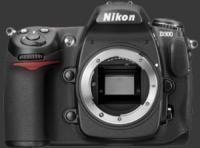


 SLR digital camera
Sensor-Size: 24 x 16mm

Actual size when viewed at 100 DPI
| 12 Megapixels DSLR | ISO 100-6400 |
| Nikon F Mount 1.5X FLM | Shutter 1/8000-30s |
| 100% Coverage Large Viewfinder | Full manual controls, including Manual Focus |
| Weatherproof | Custom white-balance with 2 axis fine-tuning |
| Built-in Dust Reduction | Spot-Metering |
| 6 FPS Drive, 100 Images | Hot-Shoe & Sync-Port |
| 3" LCD 920K Pixels | Lithium-Ion Battery |
| Compact Flash |
Wish List
Since no camera is perfect, here are our suggestions to Nikon for improving upon the D300.
- Build a better automatic white-balance system.
- Allow top-speed shooting without battery grip.
- Add Auto ISO option to the options when using the direct ISO button.
- Improve whether seals to keep out rain and snow.
- Reorganize the functions of some controls to make them more consistent. Reorganize the menu system too, it does not seem logically organized.
- Drive mode should be controlled by a modeless button plus control wheel.
- The only major feature missing is stabilization. Nikon sells VR lenses at a premium so it may not be in their current interests soon.
- Dare we ask for AA batteries directly in the body?
Camera Bag


Your camera bag is empty. To add a camera or lens click on the star next to its name.
Your camera bag is empty.
Add cameras or lenses by clicking on the star next to their name.
Updates
2026.05.21

Laowa 4.5-10mm F/2.8 Fisheye Zoom Lens Review
In-depth review of the Venus Optics Laowa 4.5-10mm F/2.8 Fisheye Zoom Lens. This lens zooms from a circular to rectangular fisheye with an 180° viewing angle. This review analyses its optical quality, construction and handling.
2026.04.13

Laowa 17mm F/4 Zero-D Shift Review
In-Depth review of the Venus Optics Laowa 17mm F/4 Zero-D Shift Lens. This ultra-wide Shift lens is specifically designed for Mirrorless Digital Cameras and is available in 4 Full-Frame mounts plus 2 Medium-Format ones.
2025.11.13

Best Gifts for Photographers in 2025 by Budget
The annual Neocamera Photography Gift Guide updated to 2025. Find great gifts for photographers with any price budget.
2025.07.07

Stellar Photo Recovery Review
Review of Stellar Photo Recovery V12. This Windows and MacOS software can recover photos and videos in a huge number of formats from memory cards, USB drives, SSDs and HHDs.
2025.05.14

Huion Kamvas 13 Gen 3 Review
In-Depth review of the Huion Kamvas 13 Gen 3 Pen Display Tablet for photographers and graphic artists.
2025.01.18

Fujifilm GFX 2025 Lens Roundup
Lens Review roundup of Fujifilm GFX Medium-Format lenses. Quality, performance and handling of the GF20-35mm F/4R WR, GF30mm F/3.5 Tilt-Shift and the GF55mm F/1.7.
2024.11.18

Best 2024 Photography Gifts for Every Budget
Great gifts for photographers and photo enthusiasts selected for every budget among the best products of 2024.
2024.08.07

Eye Protection Tips for Professional Photographers
The four main considerations for professional photographers regarding eyewear.
2024.07.14

Fujifilm X100VI Review
Flagship fixed-lens compact digital camera with a 40 MP sensor and Image-Stabilization, a first for the series. Retro design featuring dual control-dials, plus direct ISO, Shutter-Speed and EC dials. Its hybrid viewfinder can switch between EVF and OVF mode.
2024.05.09

Fujifilm GFX100 II Review
Flagship 102 Megapixels Medium-Format Mirrorless Digital Camera with 8-Stop 5-Axis IBIS, 8 FPS Drive, 8K Video and 400 MP Super-Resolution capture in a weatherproof and freezeproof body with dual control-dials and dual memory-card slots.
2024.04.03

Fujifilm X-T5 Review
Newest Fujifilm flagship boasting a 40 MP APS-C sensor, 5-axis IBIS with 7-stop efficiency, 15 FPS continuous drive, 6.2K Video capture, dual control-dials and dual SDXC UHS-II slots in a sturdy weatherproof and freezeproof body.
2023.11.20

Best Digital Cameras of 2023
Find out which are the Best Digital Cameras of 2023. All the new Mirrorless Digital Cameras from entry-level to high-end professional.
2026.05.21
2026.04.13
2025.11.13
2025.07.07
2025.05.14
2025.01.18
2024.11.18
2024.08.07
2024.07.14
2024.05.09
2024.04.03
2023.11.20