Camera Basics
 Camera Choosing
 Camera Models
 Camera Buying
 DSLR Buying

Nikon D3000 Review
 10 Megapixels
 Single Lens Reflex
 Continuous Drive
 Manual Controls: Both fully-manual (M) and semi-automatic modes (T and V).
 Custom White-Balance: Specifies exactly what should be white to the camera.
 Action Photography: Shutter speeds of 1/1500 or more.
 Night Photography: Reaches shutter-speeds longer than 4 seconds.
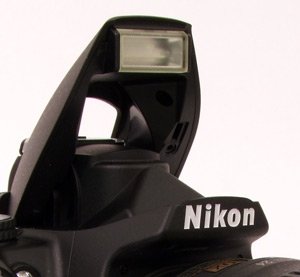
 Hotshoe: Allows external flash units to be attached.
 Spot Metering
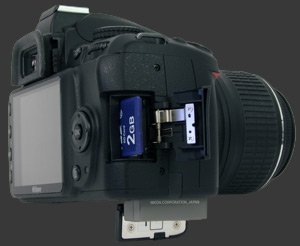
 Accepts Secure Digital High Capacity (SDHC) and SD memory.
 Neocamera detailed review
 Discontinued: No longer produced by the manufacturer. May still be in stock or found used.
 1 - Capability2 - Usability3 - Performance
Nikon D3000 Performance - How well does it take pictures?
Ultimately, it is the image quality that makes a camera worth buying. For an SLR, image quality greatly depends on the lens used. While color, noise, exposure and contrast are properties of the camera, distortion, vignetting and chromatic aberrations are properties of the lens. Sharpness depends on the weakest link. That is, the camera cannot capture more details than the lens lets through. Conversely, it is possible for a lens to transmit more details than the sensor can capture.
Note that the Nikon D3000 is only sold with a kit-lens in some markets. This specific lens is the 18-55mm F3.5-5.6 VR. As this lens is of rather poor quality, better get a higher-quality lens to avoid disappointments.
The D3000 has a reliable and generally quite accurate exposure system, which is a huge improvement over the D60. On most scenes, exposure compensation is not required and burnt highlights are kept relatively low.
The Nikon D3000 shows excellent color accuracy. The Standard setting provides the most realistic rendition of colors. There are 6 Picture Control styles, each can be modified in terms of sharpness, contrast, saturation and hue. The Neutral mode provides slightly a softer and less contrasty look, while both Landscape and Vivid modes show over-the-top-colors not suitable to represent reality.
The white-balance system performs better than most DSLR cameras. Preset and custom white-balance are very accurate. Automatic white-balance is spot-on most times. Even artificial light is handled quite well, with a noticeably warm but gentle color-cast.
Noise levels are very low until ISO 400 and moderately low but noticeable at ISO 800. At ISO 1600, noise is evident but has a fine grain which means that even medium-sized prints are possible. ISO 3200 is still usable for small prints as it is noisier without being too destructive on details. All in all, the D3000's handling of image noise is great, balancing increased noise and loss of details progressively as ISO increases.
Image sharpness is controllable in 10 steps. Images appear slightly soft be default, but this is corrected by increasing sharpness in-camera. It is quite common for high-end DSLR to produce slightly soft images by default since those images fare better during post-processing. Boosting sharpening to +2 provides much more pleasing results without surrounding details with halos commonly seen in over-sharpened images.
In operation, the Nikon D3000 is extremely responsive. Most operations are nearly instant, including the critical shutter-lag. Power on is fast and the camera is ready to shoot in an instant, although the animation showing sensor-cleaning makes it look like it takes longer. The important thing to note here is that sensor-cleaning is interruptible by a slight-press of the shutter-release.
Focusing speed depends on the lens used. With the kit lens, it is reasonable under bright conditions but a little slow, for a DSLR, in low-light. One thing that the kit-lens did well is focusing at close distances, giving it a magnification ratio of 1:3.2.
The continuous drive is also very good and the buffer never seems to fill up. This means you can shoot at 3 FPS until the memory card is full. Battery-life seems improved over the D60, as the D3000 is now on par with entry-level models using lithium-ion batteries.
Nikon D3000 Conclusion
The Nikon D3000 is an excellent option for new DSLR owners. It is a well-built camera with very good image quality and excellent speed of operation. Most people upgrading from a fixed-lens camera are looking for speed and image quality. At the same time, the D3000 gives users access to the second largest lens lineup of the industry.
Images from the D3000 are characterized by low image noise, plenty of details and accurate colors. Exposure is also very good, something that lets the D3000 get reach an Excellent rating compared to its predecessor.
The feature set and ergonomics of the Nikon D3000 are very reasonable for an entry-level DSLR. Pros will feel very limited but novices will not find this camera daunting. Its numerous features like spot-metering and white-balance fine-tuning make nearly any desired result achievable.
In the end, the D3000 is great because it delivers what novice DSLR users expect from a DSLR: image quality and speed above all. A simple and durable body round off its place as an excellent choice among entry-level DSLR cameras.
 |



 
|

 1 - Capability2 - Usability3 - Performance
Please Support Neocamera
All information on Neocamera is provided free of charge yet running this website is a huge endeavor. Purchases made via affiliate links found throughout the site help keep it running and up-to-date. There is no additional cost to you, so please consider buying via these links to our affilates:




Thank you for your support!


Nikon D3000 Highlights
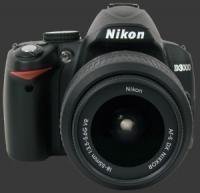


 SLR digital camera
Sensor-Size: 24 x 16mm

Actual size when viewed at 100 DPI
| 10 Megapixels DSLR | ISO 100-3200 |
| Nikon F Mount 1.5X FLM | Shutter 1/4000-30s |
| 95% Coverage Medium Viewfinder | Full manual controls, including Manual Focus |
| Built-in Dust Reduction | Custom white-balance with 2 axis fine-tuning |
| 3 FPS Drive, Unlimited Images | Spot-Metering |
| 3" LCD 230K Pixels | Hot-Shoe |
| Lithium-Ion Battery | |
| Secure Digital High Capacity |
Camera Bag


Your camera bag is empty. To add a camera or lens click on the star next to its name.
Your camera bag is empty.
Add cameras or lenses by clicking on the star next to their name.
Updates
2026.05.21

Laowa 4.5-10mm F/2.8 Fisheye Zoom Lens Review
In-depth review of the Venus Optics Laowa 4.5-10mm F/2.8 Fisheye Zoom Lens. This lens zooms from a circular to rectangular fisheye with an 180° viewing angle. This review analyses its optical quality, construction and handling.
2026.04.13

Laowa 17mm F/4 Zero-D Shift Review
In-Depth review of the Venus Optics Laowa 17mm F/4 Zero-D Shift Lens. This ultra-wide Shift lens is specifically designed for Mirrorless Digital Cameras and is available in 4 Full-Frame mounts plus 2 Medium-Format ones.
2025.11.13

Best Gifts for Photographers in 2025 by Budget
The annual Neocamera Photography Gift Guide updated to 2025. Find great gifts for photographers with any price budget.
2025.07.07

Stellar Photo Recovery Review
Review of Stellar Photo Recovery V12. This Windows and MacOS software can recover photos and videos in a huge number of formats from memory cards, USB drives, SSDs and HHDs.
2025.05.14

Huion Kamvas 13 Gen 3 Review
In-Depth review of the Huion Kamvas 13 Gen 3 Pen Display Tablet for photographers and graphic artists.
2025.01.18

Fujifilm GFX 2025 Lens Roundup
Lens Review roundup of Fujifilm GFX Medium-Format lenses. Quality, performance and handling of the GF20-35mm F/4R WR, GF30mm F/3.5 Tilt-Shift and the GF55mm F/1.7.
2024.11.18

Best 2024 Photography Gifts for Every Budget
Great gifts for photographers and photo enthusiasts selected for every budget among the best products of 2024.
2024.08.07

Eye Protection Tips for Professional Photographers
The four main considerations for professional photographers regarding eyewear.
2024.07.14

Fujifilm X100VI Review
Flagship fixed-lens compact digital camera with a 40 MP sensor and Image-Stabilization, a first for the series. Retro design featuring dual control-dials, plus direct ISO, Shutter-Speed and EC dials. Its hybrid viewfinder can switch between EVF and OVF mode.
2024.05.09

Fujifilm GFX100 II Review
Flagship 102 Megapixels Medium-Format Mirrorless Digital Camera with 8-Stop 5-Axis IBIS, 8 FPS Drive, 8K Video and 400 MP Super-Resolution capture in a weatherproof and freezeproof body with dual control-dials and dual memory-card slots.
2024.04.03

Fujifilm X-T5 Review
Newest Fujifilm flagship boasting a 40 MP APS-C sensor, 5-axis IBIS with 7-stop efficiency, 15 FPS continuous drive, 6.2K Video capture, dual control-dials and dual SDXC UHS-II slots in a sturdy weatherproof and freezeproof body.
2023.11.20

Best Digital Cameras of 2023
Find out which are the Best Digital Cameras of 2023. All the new Mirrorless Digital Cameras from entry-level to high-end professional.
2026.05.21
2026.04.13
2025.11.13
2025.07.07
2025.05.14
2025.01.18
2024.11.18
2024.08.07
2024.07.14
2024.05.09
2024.04.03
2023.11.20