Camera Basics
 Camera Choosing
 Camera Models
 Camera Buying
 DSLR Buying

HP Photosmart R967 Review
 10 Megapixels
 VGA Video: 640 x 480 or more but less than 1280 x 720.
 Manual Controls: Both fully-manual (M) and semi-automatic modes (T and V).
 Custom White-Balance: Specifies exactly what should be white to the camera.
 Action Photography: Shutter speeds of 1/1500 or more.
 Night Photography: Reaches shutter-speeds longer than 4 seconds.
 Spot Metering
 Accepts Secure Digital (SD) memory.
 Neocamera detailed review
 Discontinued: No longer produced by the manufacturer. May still be in stock or found used.
 1 - Capability2 - Usability3 - Performance
HP Photosmart R967 Performance - How well does it take pictures?
There are two main parts to performance: image quality and speed of operation. Image quality is defined in terms of exposure, color, sharpness, focus, noise, distortions, aberrations, contrast and dynamic range. The HP Photosmart R967 exposes its image conservatively, reducing the chances of blown highlights. Photographically speaking, this produces more vibrant and dramatic pictures. The flip side is that a main subject may appear darker than expected without using exposure compensation. This digital camera has an exposure compensation range from -3 to +3 EV, controllable in 1/3 EV steps. HP seems to have listened to its reviewers here which have criticized the older 8 megapixels R927 to produce slightly overexposed images.
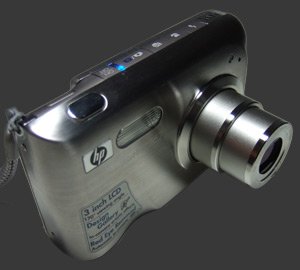
Color saturation is adjustable in three steps. The default setting produces nicely saturated colors which have consumer appeal without appearing artificial. The other two settings produce either more naturally saturated colors or overly saturates ones. The colors themselves appear quite accurate in all types of lighting. This camera appears to have an extremely accurate white-balance which performs better under artificial lighting than anything we have seen so far. White-balance is equally accurate outdoors, even at sunset and nighttime.
The camera's lens seems to resolve details acceptably well but its 10 megapixels sensor can capture more detail than the lens transmits. Resulting images have plenty of details but show some softness when seen at 100%. Remember that a 10 megapixels sensor can normally produce highly-detailed 13" x 19" prints. With a little softness, good resolution 12" x 16" prints are still possible. This camera's focus system seems above average in speed and accuracy and it is intelligent enough to let you know when macro-focus is needed or when the subject is too close.
Noise levels are clearly this camera's greatest weakness. The bad news is that a fine noise pattern is clearly visible at all ISO sensitivities. The good news is that noise increases slower than normal with increased sensitivities. Overall, ISO 100 is substantially noisier than average, ISO 200 is moderately noisier and ISO 400 is a bit noisier. Under bright conditions, the pattern of noise is rather fine and mostly composed of luminance-noise until ISO 200. At ISO 400, chroma-noise becomes visible. Thanks to its high-resolution sensor, this fine noise is not visible on medium-sized prints up to 12" x 9". Under low-light, noise levels increase substantially. ISO 100 and 200 noise is slightly visible on 8" x 10" prints, while ISO 400 noise is visible on 5" x 7" prints.
Optical quality is reasonably good with the HP Photosmart R967. There is a slightly noticeable amount of barrel distortion near the wide-angle side of the lens. There is absolutely no vignetting to be seen. Slight chromatic aberrations can be seen throughout the R967's images near areas of overexposure. Luckily, this camera's metering system rarely overexposes highlights, making chromatic aberrations an occasional occurrence.
Dynamic range and contrast are both handled well in this camera. Its metering does favor highlight detail rather than shadow detail which helps reduce the visibility of noise. Contrast is adjustable in three steps, which brings in more or less dynamic range into the photograph.
Speed of operation is good and an intelligent buffering system lets the camera remain usable during most operations. The shutter-lag is very short when prefocused. Focus speeds are about average except in macro, when it slows down the closer the subject. It appears that the camera performs some adaptive processing since shot-to-shot delays increase with slower shutter-speeds. Under bright conditions, shot-to-shot speeds are excellent, with several shots possible per second. Under low-light, shot-to-shot delays can increase to just above one second, which is about average. It takes about one second for the LCD view to reappear after a shot is taken. However, the camera's buffering system allows shots to be fired before that. When three shots have been taken but not yet written, another shot cannot be taken but menus remain usable. The zoom control also moves the lens at above average speeds.
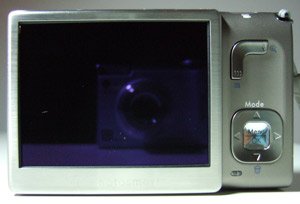
Even though the built-in flash is quite powerful, it recharges very fast. Several bursts can be fired without delay. After that, it takes 1-2 seconds to recharge. Recharging times may increase when battery levels are low. The menu system and buttons respond instantly. Image review and menus appear fast and can be dismissed rapidly with a press of the shutter. In playback mode, you can move between images at a good speed which is accompanied by a sliding animation which gives the illusion of rapid movement. Zooming into an image causes an initial delay while the full-resolution image is loaded. After that, zooming and scrolling is very fast.

HP Photosmart R967 Conclusion
The HP Photosmart R967 is an intriguing camera to recommend. Image quality is good except for noise levels which are mostly noticeable in large prints or low-light photography. White-balance is superb with automatic white-balance handling most types of lights, including mixed indoor lighting. Colors and exposure are well calibrated for consumer appeal and avoiding overexposure. This ultra-compact camera is well built and packed with advanced features including full-manual controls. This, together with its speedy performance, awards it a good rating.
It is this camera's target audience which is not so clear. On one hand, there is a complete built-in help system aimed at beginners. On the other, the are advanced controls using a simple but inefficient interface. Users of advanced functions normally demand an efficient interface and persistent camera controls. However, the R967 tends to forget most settings like its exposure-mode, ISO setting and flash-setting. It also requires a significant number of button-presses to change common settings like ISO and exposure compensation.
Overall, this camera is usable for general photography but specific conditions will challenge it. Particularly, low-light hand-held photography requires high-ISO capabilities and action photography requires either an optical viewfinder or that the LCD stays on during continuous shooting. In sum, the HP Photosmart R967 is recommended for beginners who rarely use advanced features for general outdoor and family photography.
 |


|

 1 - Capability2 - Usability3 - Performance
Please Support Neocamera
All information on Neocamera is provided free of charge yet running this website is a huge endeavor. Purchases made via affiliate links found throughout the site help keep it running and up-to-date. There is no additional cost to you, so please consider buying via these links to our affilates:




Thank you for your support!


HP R967 Highlights
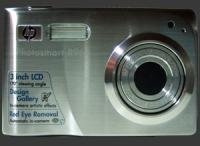


 Ultra-Compact digital camera
Sensor-Size: 8 x 6mm

Actual size when viewed at 100 DPI
| 10 Megapixels Ultra Compact | ISO 100-400 |
| 3X Optical Zoom | Shutter 1/2000-16s |
| 640x480 @ 24 FPS Video Recording | Full manual controls, including Manual Focus |
| 3" LCD 230K Pixels | Custom white-balance |
| Spot-Metering | |
| Lithium-Ion Battery | |
| Secure Digital |
Camera Bag


Your camera bag is empty. To add a camera or lens click on the star next to its name.
Your camera bag is empty.
Add cameras or lenses by clicking on the star next to their name.
Updates
2026.05.21

Laowa 4.5-10mm F/2.8 Fisheye Zoom Lens Review
In-depth review of the Venus Optics Laowa 4.5-10mm F/2.8 Fisheye Zoom Lens. This lens zooms from a circular to rectangular fisheye with an 180° viewing angle. This review analyses its optical quality, construction and handling.
2026.04.13

Laowa 17mm F/4 Zero-D Shift Review
In-Depth review of the Venus Optics Laowa 17mm F/4 Zero-D Shift Lens. This ultra-wide Shift lens is specifically designed for Mirrorless Digital Cameras and is available in 4 Full-Frame mounts plus 2 Medium-Format ones.
2025.11.13

Best Gifts for Photographers in 2025 by Budget
The annual Neocamera Photography Gift Guide updated to 2025. Find great gifts for photographers with any price budget.
2025.07.07

Stellar Photo Recovery Review
Review of Stellar Photo Recovery V12. This Windows and MacOS software can recover photos and videos in a huge number of formats from memory cards, USB drives, SSDs and HHDs.
2025.05.14

Huion Kamvas 13 Gen 3 Review
In-Depth review of the Huion Kamvas 13 Gen 3 Pen Display Tablet for photographers and graphic artists.
2025.01.18

Fujifilm GFX 2025 Lens Roundup
Lens Review roundup of Fujifilm GFX Medium-Format lenses. Quality, performance and handling of the GF20-35mm F/4R WR, GF30mm F/3.5 Tilt-Shift and the GF55mm F/1.7.
2024.11.18

Best 2024 Photography Gifts for Every Budget
Great gifts for photographers and photo enthusiasts selected for every budget among the best products of 2024.
2024.08.07

Eye Protection Tips for Professional Photographers
The four main considerations for professional photographers regarding eyewear.
2024.07.14

Fujifilm X100VI Review
Flagship fixed-lens compact digital camera with a 40 MP sensor and Image-Stabilization, a first for the series. Retro design featuring dual control-dials, plus direct ISO, Shutter-Speed and EC dials. Its hybrid viewfinder can switch between EVF and OVF mode.
2024.05.09

Fujifilm GFX100 II Review
Flagship 102 Megapixels Medium-Format Mirrorless Digital Camera with 8-Stop 5-Axis IBIS, 8 FPS Drive, 8K Video and 400 MP Super-Resolution capture in a weatherproof and freezeproof body with dual control-dials and dual memory-card slots.
2024.04.03

Fujifilm X-T5 Review
Newest Fujifilm flagship boasting a 40 MP APS-C sensor, 5-axis IBIS with 7-stop efficiency, 15 FPS continuous drive, 6.2K Video capture, dual control-dials and dual SDXC UHS-II slots in a sturdy weatherproof and freezeproof body.
2023.11.20

Best Digital Cameras of 2023
Find out which are the Best Digital Cameras of 2023. All the new Mirrorless Digital Cameras from entry-level to high-end professional.
2026.05.21
2026.04.13
2025.11.13
2025.07.07
2025.05.14
2025.01.18
2024.11.18
2024.08.07
2024.07.14
2024.05.09
2024.04.03
2023.11.20