



 Camera Basics
 Camera Choosing
 Camera Models
 Camera Buying
 DSLR Buying

Fujifilm Finepix F480 Samples
 8 Megapixels
 Low-Quality Video: 320x240 resolution or less.
 Action Photography: Shutter speeds of 1/1500 or more.
 Accepts Secure Digital High Capacity (SDHC) and SD memory.
 Accepts xD memory.
 Neocamera detailed review
 Discontinued: No longer produced by the manufacturer. May still be in stock or found used.
 1 - Sample Images2 - Indoor Crops
Fujifilm Finepix F480 Indoor Crops
Here are sample crops from an artificially-lit scene at each of the Fuji F480's ISO settings. Next to each of these crops, there is a crop from the Canon Powershot A720 IS at the same ISO setting. Although these are both digital cameras with 8 megapixels sensors, they are not direct competitors because the A720 is not an ultra-compact and has a much larger feature-set.
Images below are all unmodified 100% crops from their respective cameras. The ISO sensitivity was set on the camera but white-balance and exposure were fully-automatic, not that there is a choice on the Fuji F480. The A720 was left to its default settings.
These crops help determine which ISO settings can be acceptably used on these cameras. As noise increases, most cameras compensate with noise reduction which introduces softness. The result is that, while you can partly reduce noise at the expense of details, the maximum acceptable print size gets smaller as ISO is increased. The point at which a print become unacceptably noisy is a matter of personal taste.
Take a look at these images and then scroll down to our conclusion which is based on hundreds of images taken with the Fuji Finepix F480, including the ones from which these crops were taken.
| Fuji Finepix F480 | Canon Powershot A720 IS |
|---|---|
 ISO 100 - 1/4s F4.4 |
 ISO 100 - 1/4s F4.5 |
 ISO 200 - 1/8s F4.4 |
 ISO 200 - 1/8s F4.5 |
 ISO 400 - 1/17s F4.4 |
 ISO 400 - 1/15s F4.5 |
 ISO 800 - 1/34s F4.4 |
 ISO 800 - 1/30s F4.5 |
 ISO 1600 - 1/60s F4.5 |
These images show many differences between the two cameras. Colors are obviously different, with the Canon A720 showing colors which are closer to reality. The F480, being more consumer-oriented, exaggerates the red channel to produce a more vivid but less realistic image. Exposure is very similar, with both cameras choosing the same shutter-speed and a nearly identical apertures (F4.4 vs F4.5). Although exposures are similar, the F480 produces a brighter image, which suggests that the F480 is more sensitive to light. In other words. In other words, these two cameras have different interpretation of ISO sensitivities.
With regards to ISO performance, we can clearly see that both the Fuji and the Canon have to balance noise and detail at each ISO setting. As expected, both cameras produced sharp an clean ISO 100 images. At ISO 200, noise is still very subtle but the images became a tad softer, showing that noise-reduction is already kicking in. As we get to ISO 400, images from both cameras become noticeably more noisy and softer. This trend continues into ISO 800, and into ISO 1600 for the A720. The main difference here is that Fuji appears to be applying stronger noise-reduction which produces less noisy but softer images. We would say that until ISO 400, both cameras can pull-off a good mid-size print (12"x9"). ISO 800 is noisy enough that noise is visible on all but small print sizes, say 4"x5 1/3".
 |


|
 1 - Sample Images2 - Indoor Crops
Please Support Neocamera
All information on Neocamera is provided free of charge yet running this website is a huge endeavor. Purchases made via affiliate links found throughout the site help keep it running and up-to-date. There is no additional cost to you, so please consider buying via these links to our affilates:




Thank you for your support!


Fujifilm F480 Highlights


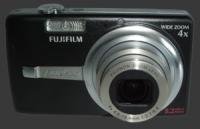
 Ultra-Compact digital camera
Sensor-Size: 6 x 4mm

Actual size when viewed at 100 DPI
| 8 Megapixels Ultra Compact | ISO 100-800 |
| 4X Wide Optical Zoom | Shutter 1/1500-4s |
| 0.6 FPS Drive, 3 Images | Lithium-Ion Battery |
| 320x240 @ 30 FPS Video Recording | Secure Digital High Capacity, xD Internal Memory |
| 2.7" LCD 230K Pixels |
Camera Bag


Your camera bag is empty. To add a camera or lens click on the star next to its name.
Your camera bag is empty.
Add cameras or lenses by clicking on the star next to their name.
Updates
2026.05.21

Laowa 4.5-10mm F/2.8 Fisheye Zoom Lens Review
In-depth review of the Venus Optics Laowa 4.5-10mm F/2.8 Fisheye Zoom Lens. This lens zooms from a circular to rectangular fisheye with an 180° viewing angle. This review analyses its optical quality, construction and handling.
2026.04.13

Laowa 17mm F/4 Zero-D Shift Review
In-Depth review of the Venus Optics Laowa 17mm F/4 Zero-D Shift Lens. This ultra-wide Shift lens is specifically designed for Mirrorless Digital Cameras and is available in 4 Full-Frame mounts plus 2 Medium-Format ones.
2025.11.13

Best Gifts for Photographers in 2025 by Budget
The annual Neocamera Photography Gift Guide updated to 2025. Find great gifts for photographers with any price budget.
2025.07.07

Stellar Photo Recovery Review
Review of Stellar Photo Recovery V12. This Windows and MacOS software can recover photos and videos in a huge number of formats from memory cards, USB drives, SSDs and HHDs.
2025.05.14

Huion Kamvas 13 Gen 3 Review
In-Depth review of the Huion Kamvas 13 Gen 3 Pen Display Tablet for photographers and graphic artists.
2025.01.18

Fujifilm GFX 2025 Lens Roundup
Lens Review roundup of Fujifilm GFX Medium-Format lenses. Quality, performance and handling of the GF20-35mm F/4R WR, GF30mm F/3.5 Tilt-Shift and the GF55mm F/1.7.
2024.11.18

Best 2024 Photography Gifts for Every Budget
Great gifts for photographers and photo enthusiasts selected for every budget among the best products of 2024.
2024.08.07

Eye Protection Tips for Professional Photographers
The four main considerations for professional photographers regarding eyewear.
2024.07.14

Fujifilm X100VI Review
Flagship fixed-lens compact digital camera with a 40 MP sensor and Image-Stabilization, a first for the series. Retro design featuring dual control-dials, plus direct ISO, Shutter-Speed and EC dials. Its hybrid viewfinder can switch between EVF and OVF mode.
2024.05.09

Fujifilm GFX100 II Review
Flagship 102 Megapixels Medium-Format Mirrorless Digital Camera with 8-Stop 5-Axis IBIS, 8 FPS Drive, 8K Video and 400 MP Super-Resolution capture in a weatherproof and freezeproof body with dual control-dials and dual memory-card slots.
2024.04.03

Fujifilm X-T5 Review
Newest Fujifilm flagship boasting a 40 MP APS-C sensor, 5-axis IBIS with 7-stop efficiency, 15 FPS continuous drive, 6.2K Video capture, dual control-dials and dual SDXC UHS-II slots in a sturdy weatherproof and freezeproof body.
2023.11.20

Best Digital Cameras of 2023
Find out which are the Best Digital Cameras of 2023. All the new Mirrorless Digital Cameras from entry-level to high-end professional.

