Camera Basics
 Camera Choosing
 Camera Models
 Camera Buying
 DSLR Buying

Fujifilm Finepix F40fd Review
 8 Megapixels
 VGA Video: 640 x 480 or more but less than 1280 x 720.
 Custom White-Balance: Specifies exactly what should be white to the camera.
 Action Photography: Shutter speeds of 1/1500 or more.
 Spot Metering
 Accepts Secure Digital (SD) memory.
 Accepts xD memory.
 Neocamera detailed review
 Discontinued: No longer produced by the manufacturer. May still be in stock or found used.
 1 - Usability & Ergonomics2 - Image Quality & Performance
Fujifilm Finepix F40fd Performance - How well does it take pictures?
The Fuji Finepix F40fd's image quality is among the top of its class. There are only a few ultra-compact digital cameras that produce nicer images. Those include the 6 megapixels Fuji F-series cameras like the F31fd, F30 and F20.
With the F40, Fuji compromised between noise and details differently than most digital cameras, including its F-series siblings. While the Fuji F40 keeps noise quite low, it does not suppress it completely. The result are images with very good detail that show some traces of noise at all ISO settings. Under ISO 400, it is very minimal and suitable for common print sizes. Images up to ISO 400 appear very sharp and have plenty of details. Even ISO 800 is quite usable, although with some loss of details. At 4"x6", ISO 1600 and 2000 images are very recognizable but still have visible amounts of noise. The indoor crop page illustrate this well.
The 3X optical zoom lens is sharp from corner to corner, just as with the F30 which we previously reviewed. Even macro shots remain sharp and without significant distortion. Colors are vibrant and quite accurate in terms of hue. There is a Chrome color mode which boosts color saturation to produce images with even more consumer appeal. We are glad to see that Fuji still does not provided an exaggerated default color rendition. White-balance settings are quite accurate, even on Auto which only leaves a slight warm tint under incandescent light. Custom white-balance was spot on.
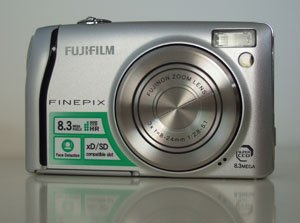
The weakest point of the F40's image quality is its higher than average purple fringing. Although it is not as bad as what we saw with the Sony Cybershot DSC-H9. High purple fringing is a common occurrence with Fuji digital cameras. As usual, purple fringing mostly occurs near areas of overexposure, so it should rarely be intrusive in properly exposed images.
Like its predecessors, the Fuji Finepix F40fd is quite fast for an ultra-compact. It starts fast, zooms fast, focuses fast and has very little shutter-lag once pre-focused. Focusing speed and accuracy was very impressive, easily beating competing models. The camera's lens moves very fast, even during power up. Given this performance, Fuji once again showed that it is able to produce one of the fastest cameras on the market. On the slower side, shot-to-shot speeds are a not great and playback speed is just average.
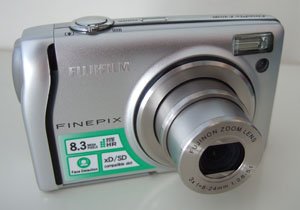
Continuous shooting speed is disappointing. There are a lot of slower ultra-compact cameras out there, but several Canon's SD-series cameras can shoot continuously at 2 FPS. Comparatively, the F40fd's long-period continuous drive is very slow. The other continuous drive options do not count since they only shoot 2 pictures continuously.
Battery life of the Fuji Finepix F40fd is good compared to most cameras. Although, one again, its F-series siblings do even better. According to CIPA standard, the F40 can take 380 photos per charge. Comparatively, the F10, F30 and F31fd could all take at least 500 per charge.

Fujifilm Finepix F40fd Conclusion
The Fuji Finepix F40 is an excellent ultra-compact. Despite not being the best, the F40 produces low-noise images with plenty of details. Add to that its good speed of operation, good battery-life and you have a great ultra-compact digital camera.
As a point-and-shoot model with a limited shutter-speed range it is not useful for all types of photography. However, for quick snapshots, it is among the top of its class. Its shortcomings include above average purple fringing, ridiculous continuous drive modes and a poorly placed tripod mount.
 |


|

 1 - Usability & Ergonomics2 - Image Quality & Performance
Please Support Neocamera
All information on Neocamera is provided free of charge yet running this website is a huge endeavor. Purchases made via affiliate links found throughout the site help keep it running and up-to-date. There is no additional cost to you, so please consider buying via these links to our affilates:




Thank you for your support!


Fujifilm F40fd Highlights


 Ultra-Compact digital camera
Sensor-Size: 8 x 6mm

Actual size when viewed at 100 DPI
| 8 Megapixels Ultra Compact | ISO 100-2000 |
| 3X Optical Zoom | Shutter 1/2000-3s |
| 1.3 FPS Drive, 2 Images | Custom white-balance |
| 640x480 @ 30 FPS Video Recording | Spot-Metering |
| 2.5" LCD 230K Pixels | Lithium-Ion Battery |
| Secure Digital, xD Internal Memory |
Camera Bag


Your camera bag is empty. To add a camera or lens click on the star next to its name.
Your camera bag is empty.
Add cameras or lenses by clicking on the star next to their name.
Updates
2026.05.21

Laowa 4.5-10mm F/2.8 Fisheye Zoom Lens Review
In-depth review of the Venus Optics Laowa 4.5-10mm F/2.8 Fisheye Zoom Lens. This lens zooms from a circular to rectangular fisheye with an 180° viewing angle. This review analyses its optical quality, construction and handling.
2026.04.13

Laowa 17mm F/4 Zero-D Shift Review
In-Depth review of the Venus Optics Laowa 17mm F/4 Zero-D Shift Lens. This ultra-wide Shift lens is specifically designed for Mirrorless Digital Cameras and is available in 4 Full-Frame mounts plus 2 Medium-Format ones.
2025.11.13

Best Gifts for Photographers in 2025 by Budget
The annual Neocamera Photography Gift Guide updated to 2025. Find great gifts for photographers with any price budget.
2025.07.07

Stellar Photo Recovery Review
Review of Stellar Photo Recovery V12. This Windows and MacOS software can recover photos and videos in a huge number of formats from memory cards, USB drives, SSDs and HHDs.
2025.05.14

Huion Kamvas 13 Gen 3 Review
In-Depth review of the Huion Kamvas 13 Gen 3 Pen Display Tablet for photographers and graphic artists.
2025.01.18

Fujifilm GFX 2025 Lens Roundup
Lens Review roundup of Fujifilm GFX Medium-Format lenses. Quality, performance and handling of the GF20-35mm F/4R WR, GF30mm F/3.5 Tilt-Shift and the GF55mm F/1.7.
2024.11.18

Best 2024 Photography Gifts for Every Budget
Great gifts for photographers and photo enthusiasts selected for every budget among the best products of 2024.
2024.08.07

Eye Protection Tips for Professional Photographers
The four main considerations for professional photographers regarding eyewear.
2024.07.14

Fujifilm X100VI Review
Flagship fixed-lens compact digital camera with a 40 MP sensor and Image-Stabilization, a first for the series. Retro design featuring dual control-dials, plus direct ISO, Shutter-Speed and EC dials. Its hybrid viewfinder can switch between EVF and OVF mode.
2024.05.09

Fujifilm GFX100 II Review
Flagship 102 Megapixels Medium-Format Mirrorless Digital Camera with 8-Stop 5-Axis IBIS, 8 FPS Drive, 8K Video and 400 MP Super-Resolution capture in a weatherproof and freezeproof body with dual control-dials and dual memory-card slots.
2024.04.03

Fujifilm X-T5 Review
Newest Fujifilm flagship boasting a 40 MP APS-C sensor, 5-axis IBIS with 7-stop efficiency, 15 FPS continuous drive, 6.2K Video capture, dual control-dials and dual SDXC UHS-II slots in a sturdy weatherproof and freezeproof body.
2023.11.20

Best Digital Cameras of 2023
Find out which are the Best Digital Cameras of 2023. All the new Mirrorless Digital Cameras from entry-level to high-end professional.
2026.05.21
2026.04.13
2025.11.13
2025.07.07
2025.05.14
2025.01.18
2024.11.18
2024.08.07
2024.07.14
2024.05.09
2024.04.03
2023.11.20