



 Camera Basics
 Camera Choosing
 Camera Models
 Camera Buying
 DSLR Buying
Travel Tips
Power
The biggest weakness of digital cameras while traveling compared to film cameras is their power source. Once every few years, a film camera would cease to work for no apparent reason, that's when we remembered that film cameras had batteries! With a digital camera, batteries run out day after day. As far as battery life goes, digital SLR cameras have a big advantage over regular digital cameras since they use their LCD much less often. Even among similar looking digital cameras, battery life can vary greatly. Some ultra-compacts last less than 200 shots, some over 1000!
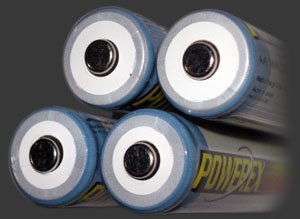
When traveling with a digital camera it is important to have enough power to last through a day of shooting. Of course, this depends on the amount of shooting you expect to do. For many medium to large cameras a single battery (or set of batteries) is enough. If one battery is not enough, a second and possibly a third battery may be necessary. The price advantage of AA batteries shows the most here. At the end of each day, remember to recharge used batteries. That way, each morning a full-day of shooting power is available.
When traveling abroad, the voltage and power plugs may differ from the ones which came with your battery charger. It is important to get informed regarding this before traveling. Most lithium-ion battery chargers are voltage-switching which means that they only need a simple plug adapterTypically costing a few dollars each. Not all AA battery chargers are voltage-switching but those can be obtained cheaply. The 100V-240V range will work almost anywhere on the planet.
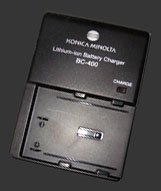
When common utility power is not within reach, there are alternatives which strongly favor AA batteries. One is to use a car's 12V lighter. Many AA battery chargers support this as a lightweight option. Certain Lithium-Ion chargers support this too. If the charger that came with your camera doesn't, look for a compatible one from a third-party vendor. If neither is available, don't despair, you can obtain an inverter that will produce normal voltage. Unfortunately, inverters are usually large and bulky.
The final power option is to use solar-power. There are relatively cheap solar AA battery chargers which will recharge 4 AA batteriesSee http://www.siliconsolar.com/aa,_aaa,_c,_d_solar_battery_charger.htm or http://store.sundancesolar.com/batcharbatpa.html in roughly 5 hours. For this, you must have double the number of batteries because they can only be recharged during the day. When all else fails you can always buy a large box of disposable AA batteries. Just don't tell green peace!

Weight
The weight of a digital camera is important while traveling. After all, you will be carrying it around on most days. Get a camera which you will not get tired of carrying after a long day of walking.
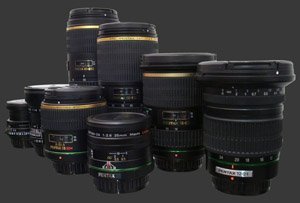
If your photographic needs require an SLR, consider the lenses you really need. Zoom lenses offer a lot of flexibility and sometimes a single zoom lens can be used. Even most photojournalists travel with about 3 lenses Wide-angle, normal and telephoto. Of course, you should consider your subject. Architecture photography is commonly done with wide angle lenses. Wildlife photography is more common with a telephoto lens.
Small cameras are not only light to carry, they are easy to conceal too. This is important when visiting poorer parts of the world where having a camera can make you an obvious target for thieves. Traveling in a group provides more protection against opportunistic thieves which more often pick isolated targets. On day trips to very poor places, it is advisable to leave the digital camera in a hotel safe. Those moments can be memorized using a disposable film camera which is of practically no valueIf they cannot afford one they cannot afford developing pictures from one either!. Be the judge of what you carry where, but remember that the more people are traveling with you, the safer you are.
Some cameras have built-in charging circuitry, this means that you don't have to travel with a charger unless the circuitry is not voltage switching. It won't change the weight you carry day to day, but it is less travel weight. On the down side, you can't charge an extra battery at the hotel while you are taking pictures outside. At the opposite end of the spectrum, some cameras can only be charged using a camera dock which is bulkier to carry than a charger.
Memory
Digital cameras store captured images and videos on flash memory cardsInternal memory is available on some cameras but for travel purposes there is rarely enough of it.. Those are currently available in capacities over 100 GB and can hold thousands of photographs. Although capacity and cost vary among formats, SD-derivatesSD, SDHC & SDXC now dominate the market and have the lowest cost-per-capacity.
The total size required depends on the average picture size and the number of pictures taken. A typical 12 MP camera produces 4 MB pictures, so 2 GB is good for 512 photos and 16 GB is good for 4096. High-end cameras can take larger images though. Remember that you get to delete poor and uninteresting pictures along the way, so you need capacity based on the number of photos you bring back.
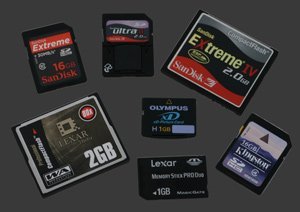
The ideal is to carry a single memory card large enough to accommodate all the pictures you could take during a trip. This way, you can't lose the card without losing the camera, since you don't need to take it out from the camera. This strategy may not be feasible for one of the following reasons:
- Sufficiently large cards are too expensive.
- The format used by your camera does not come in a sufficiently large size.
- Sufficiently large cards do not exit yet.
Flash memory cards are very tough and durable but there is a one-off chance that a card stops working. This is the only risk in carrying a single memory-card. To diminish this risk select brand name cardsLexar, Sandisk (Black or Red) & Kingston are known for durability and often back their cards with a lifetime warranty.
Another possibility is to carry multiple cards in order to have sufficient capacity to last a whole trip. The only problem is that small memory cards can get lost, so try to carry the least number of cards possible. If you do carry plenty of cards, get a card-holder big enough for all your cards.
The third possibility is to keep a single card, or a few, large enough for at least single day of shooting and transfer pictures out of it daily. This strategy requires an additional device to copy the contents of a memory card into another medium. Possibilities include:
- Laptop or similar portable computer: If you have a laptop and plan to travel with it, then it gives you access to its internal storage or an external drive. In either case, capacity is cheap and transferring is fast. The downside is that laptops and hard-drives are fragile and tempting to thieves.
- Hard-drive-based portable storage: This can be a device with a built-in card reader, a media-player, an iPod. This is often lighter and cheaper a laptop. The main downsides are the same. An additional downside is that most small hard-drives found in those devices cannot operate at altitudes above 10,000' (3300m).
- Flash-based USB storage: This is very robust and its small size makes it easier to hide. The main issue is that another device, such as a laptop, is needed to transfer images.
- Optical-disk burner: A stand-alone burner is ideal to avoid lugging a laptop but otherwise any burner will do. Since blank DVDs are very cheap, a burner has virtually unlimited capacity. Most importantly, the media and the device are separate. It is easy to make duplicates for added safety, keep them in separate places such as a suitcase and carry-on luggage and even mail them from abroad.
- Internet cafe: Depending where you go, counting on this can be risky to say the least. This can be a good light-weight option though. The real key is to bring your own secondary storage that connects via USB. For reliability, flash-based devices are the best. This can be more memory cards, USB keys or SSD drives. In the case of memory cards, bring a flash-reader too. It will save battery power, time and money, if you are billed by the minute.
- Photo store: Many photo stores around the world charge a small fee to copy a memory card into an optical disk for you. It can be risky to count on it for certain destinations. When available though, this is the lightest option and gives you flexibility of an optical burner without bulk.
Whichever device is used to transfer pictures should be verified before leaving on any trip. Disadvantages of traveling with a laptop include bulk, weight, power-consumption and visibility. Smaller laptops are more suitable for traveling due to diminished size, weight and power-consumption. There are rugged laptops made to withstand rough handling which may occur while traveling.
Know Your Camera
Sometimes people buy a new digital camera just before going on a trip - or worst during the trip itself. This can result in many unsatisfactory pictures. The more different the new digital camera from the old one, the worst it gets.
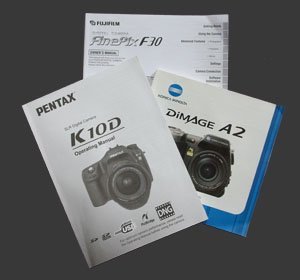
Modern digital cameras are complex devices whose behavior can vary a lot between models, particularly between models of different brands. For example, some cameras have exposure-priority displays which reflect the final exposure on the LCD preview, others do not. Knowing this difference is crucial for obtaining properly exposed images.
It is important to know the camera that you will travel with. If getting a new camera before a trip, better get it a few weeks in advance. With less than a week, get a camera which is an upgrade model to the one who previously had.
When you get your new camera, make a few tests and try it on a variety of subjects. It is important you view your test shots in the same way as you would your vacation photos. Photographs look very different in print compared to a computer-screen. Until you know how reliable your camera's LCD screen is, do not use it to judge color or exposure. Frequently, a brightness adjustment is even required to make Playback mode accurate.
Even if you have had your digital camera for a while, it is possible you have not used it for a while. A good idea is to check the batteries and quickly go over the manual. All Lithium-Ion batteries are vulnerable to age and simply stop keeping their charge after a while, regardless of how much use they had. On the other hand, NiMh batteries last for some number of recharge cycles, typically a few hundreds. After that, they do not recharge completely. Also, when buying new NiMh batteries, they need to cycled several times before optimally keeping their charge.
Photo Gear
The right gear for a trip depends on various factors including potential subjects, landscape, weather and transportation.
Subject matter depends on both preference and location, meaning you may not want to photograph everything you see. Bring only the lenses appropriate for the subject matter which interests you. For indoor shots and architecture, wide-angle zooms are ideal. There are several suitable digital SLR lenses which start around 18mmEquivalent to 27mm in 35mm terms.. If you like shooting in low light, bright lenses offer an advantage although are often heavier and have shorter zoom ranges. Telephoto lenses are usefully for wildlife photography. For birds, 450mm+ equivalentObtained by a 300mm lens in the case of a 1.5X crop DSLR. lenses are ideal. With such long lenses, stabilization is important to photograph animals at rest since they normally prefer shade.
The weather can influence or even ruin opportunities for photography. Rain and high-humidity are serious issues for most digital cameras. When expecting rain or snow, either use a resistant camera or bring some protection for it. The best protection is unsurprisingly an under-water housing. Since those are bulky and expensive, you can settle for a zip-lock bag. Place the camera inside but do not cover its lens, that would ruin the pictures. Instead, leave the lens peaking out and tighten the bag around the lens barrel using an elastic. There are also rain hoods available for purchase from professional photo stores.
Note that water alone will not damage a lens, but salt-water can. Therefore, it is recommended to bring a protective UV filter when shooting near the ocean. The same is true for flying sand. Under most other circumstances use a lend hood for protection and take off the UV filter to avoid a drop in image quality.

Considering transportation comes down to thinking about weight and space. Transport to remote areas, even by plane, can be very cramped. On trips with lots of hiking, less weight is better. There are also cases, like shooting in crowds, where space is tight right at the shooting location. For those occasions, smaller cameras can be more practical, even at the expense of some image quality and versatility.
When selecting photo gear for a trip, consider the whole trip as well as the individual sites. If you add up the ideal gear for each spot, you may end up with more gear than is practical to carry.
On a photography tour or other trip for the purpsose of photography, it is recommend bringing a second digital camera, in case the first one gets damaged or stolen. Both cameras could be identical so that they can share lenses, memory and batteries. When this is not affordable, any camera, even a point-and-shoot model, will do. Sometimes, having more than one type of camera can be advantageous.
 Photography Articles
Please Support Neocamera
All information on Neocamera is provided free of charge yet running this website is a huge endeavor. Purchases made via affiliate links found throughout the site help keep it running and up-to-date. There is no additional cost to you, so please consider buying via these links to our affilates:




Thank you for your support!


Updates
2026.05.21

Laowa 4.5-10mm F/2.8 Fisheye Zoom Lens Review
In-depth review of the Venus Optics Laowa 4.5-10mm F/2.8 Fisheye Zoom Lens. This lens zooms from a circular to rectangular fisheye with an 180° viewing angle. This review analyses its optical quality, construction and handling.
2026.04.13

Laowa 17mm F/4 Zero-D Shift Review
In-Depth review of the Venus Optics Laowa 17mm F/4 Zero-D Shift Lens. This ultra-wide Shift lens is specifically designed for Mirrorless Digital Cameras and is available in 4 Full-Frame mounts plus 2 Medium-Format ones.
2025.11.13

Best Gifts for Photographers in 2025 by Budget
The annual Neocamera Photography Gift Guide updated to 2025. Find great gifts for photographers with any price budget.
2025.07.07

Stellar Photo Recovery Review
Review of Stellar Photo Recovery V12. This Windows and MacOS software can recover photos and videos in a huge number of formats from memory cards, USB drives, SSDs and HHDs.
2025.05.14

Huion Kamvas 13 Gen 3 Review
In-Depth review of the Huion Kamvas 13 Gen 3 Pen Display Tablet for photographers and graphic artists.
2025.01.18

Fujifilm GFX 2025 Lens Roundup
Lens Review roundup of Fujifilm GFX Medium-Format lenses. Quality, performance and handling of the GF20-35mm F/4R WR, GF30mm F/3.5 Tilt-Shift and the GF55mm F/1.7.
2024.11.18

Best 2024 Photography Gifts for Every Budget
Great gifts for photographers and photo enthusiasts selected for every budget among the best products of 2024.
2024.08.07

Eye Protection Tips for Professional Photographers
The four main considerations for professional photographers regarding eyewear.
2024.07.14

Fujifilm X100VI Review
Flagship fixed-lens compact digital camera with a 40 MP sensor and Image-Stabilization, a first for the series. Retro design featuring dual control-dials, plus direct ISO, Shutter-Speed and EC dials. Its hybrid viewfinder can switch between EVF and OVF mode.
2024.05.09

Fujifilm GFX100 II Review
Flagship 102 Megapixels Medium-Format Mirrorless Digital Camera with 8-Stop 5-Axis IBIS, 8 FPS Drive, 8K Video and 400 MP Super-Resolution capture in a weatherproof and freezeproof body with dual control-dials and dual memory-card slots.
2024.04.03

Fujifilm X-T5 Review
Newest Fujifilm flagship boasting a 40 MP APS-C sensor, 5-axis IBIS with 7-stop efficiency, 15 FPS continuous drive, 6.2K Video capture, dual control-dials and dual SDXC UHS-II slots in a sturdy weatherproof and freezeproof body.
2023.11.20

Best Digital Cameras of 2023
Find out which are the Best Digital Cameras of 2023. All the new Mirrorless Digital Cameras from entry-level to high-end professional.
2026.05.21
2026.04.13
2025.11.13
2025.07.07
2025.05.14
2025.01.18
2024.11.18
2024.08.07
2024.07.14
2024.05.09
2024.04.03
2023.11.20
Camera Bag


Your camera bag is empty. To add a camera or lens click on the star next to its name.
Your camera bag is empty.
Add cameras or lenses by clicking on the star next to their name.
NEWS
2026.05.13

Sony Levels Up 6th Generation Alpha A7R
Digital Camera
2026.05.13
Canon Launches First Full-Frame Video Mirrorless
Digital Camera
2026.05.12
Panasonic Finally Launches LX100 II Successor
Digital Camera
2026.03.24
Panasonic Launches ZS300 Compact Ultra-Zoom
Digital Camera
2026.03.10

Venus Optics Unveils Ultra Wide Perspective Control Lens Duo
Lens
2026.02.24
Nikon Release Lighter Bright Constant-Aperture Full-Frame Telephoto Zoom Lens
Lens
2026.02.05
Canon Introduces 2 Extreme Wide Full-Frame Lenses
Lens
2026.01.06
Nikon Introduces Lightweight Full-Frame Zoom Lens
Lens
2025.12.02
Sony Upgrades Alpha 7 to 5th Generation
Digital Camera ○ Lens
2025.11.29
Venus Optics Releases New Zero-D Tilt-Shift Macro Lens
Lens
2025.11.23
Best Digital Cameras of 2025
Digital Camera
2025.11.14

Photography Gift Guide 2025 Edition

