



 Camera Basics
 Camera Choosing
 Camera Models
 Camera Buying
 DSLR Buying
Camera Bag


10 Megapixels DSLR Cameras Comparison
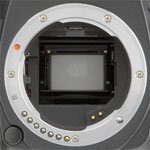 The most significant difference between these 10 megapixels DSLR cameras is the lens mount. The lens mount determines the usable selection of lenses available. Each camera manufacturer makes several lenses uniquely available for their lens mount. Third party manufacturers, considered to be of lower cost and generally lower quality, make lenses which are available in various mounts. Anyone with a collection of existing lenses must consider the cost of replacing the lenses they use the most. See other lens resources for details.
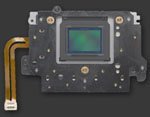 Another major difference is built-in image stabilization. The Sony Alpha A100 and the Pentax K10D are the only 10 megapixels DSLR cameras with it. It is primarily a cost saving feature. Stabilized lenses can cost up to 30% more than their equivalent non-stabilized counter-parts. With built-in stabilization, the cost of stabilization is saved for all lenses. Next, built-in stabilization applies to all lenses. Some lenses such as fisheye lenses, tilt-shift lenses and ultra-wide lenses have no stabilized counter parts. Therefore the only way to get such lens stabilized is using built-in stabilization.
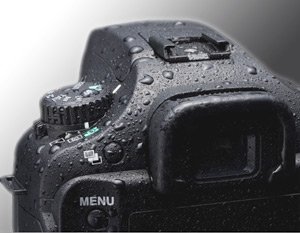
Until the announcement of the Pentax K10D, weather-proofing was considered a high-end-only feature. The only other 10 megapixels DSLR with weather-proofing is the more expensive Nikon D200. Remember, these models are not water-proof. Submerging a camera under-water requires a special housing. Neither Nikon nor Pentax provides a standard weather-proofing measurement for their DSLR, so it is difficult to say if these are equivalent. Pentax says the camera works in dusty and rainy environments. Nikon says the D200 offers resistance to casual moisture and dust. Solely based on these statements, it seems Pentax trusts their weather-seals more. If needed, this feature is hard to substitute as add-on weather-proofing is cumbersome.
Dust-reduction is a time-saving feature available on all but the Nikon DSLR cameras. Even if a camera does not have dust-reduction, its sensor can be cleaned either by an authorized dealer or using a sensor cleaning solution, like those from Visible Dust. Conversely, even cameras with dust-reduction may need to be occasionally cleaned since the dust-reduction systems are not perfect. The usefulness of this feature depends on the probability of getting sufficiently disruptive dust. People who work in studios or other clean indoor places and those who mostly use a single lens rarely report dust to be a problem.
Metering modes are taken for granted with DSLR cameras. The only camera which disappoints here is the Canon Rebel XTi which does not have spot-metering. This is a very important feature which greatly reduces the need for a separate light meter. Instead, the XTi has a partial meteringLike a large spot using 9% of the frame rather than 1-3%.. All these cameras have center-weighed and evaluative metering. Each camera implements evaluative metering differently and its accuracy is algorithm dependent, rather than depending on the number of metering segments.
The Nikon D200 leads the pack in terms of continuous drive. It sustains up to 5 FPS for at least 37 JPEG images. It can also shoot between 1 and 4 FPS. All other cameras in this roundup have a 3 FPS continuous drive. Most can buffer more than 20 JPEG images, but the Sony Alpha A100 and the Pentax K10D can sustain an unlimited number.
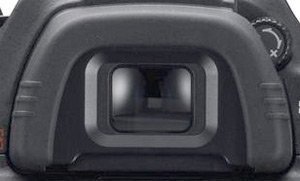
The last major characteristic is the viewfinder size and coverage. It can greatly affect the experience of composing photographs. While all the 10 megapixels cameras have 95% coverage viewfinders, their size does vary. At 0.95X, the Pentax K10D has the largest viewfinder. A hair behind, at 0.94X, are the Nikon D80 and D200. The A100 features a small 0.83X viewfinder, while the XTi has it even smaller at 0.8X for a 1.6X cropVersus 1.5X for all others..
| Table 3 - Major Differences | |||||
|---|---|---|---|---|---|
| Camera | Canon Rebel XTi | Pentax K10D | Nikon D80 | Nikon D200 | Sony Alpha A100 |
| Lens Mount | Canon EF/EF-S AF-Contacts |
Pentax KAF2 AF-Coupling AF-Contact |
Nikon F AF-Coupling AF-Contact |
Minolta A AF-Coupling |
|
| Stabilization | None | 2.5-4 Stops X/Y/Rotation |
None | 2-3.5 Stops X/Y |
|
| Weather Proofing | None | Dust/Splash Battery Grip |
None | Dust/Humidity | None |
| Dust-Reduction | Vibration Coating S/W Removal |
Shake Coating |
None | Shake Coating |
|
| Spot Metering | No | Yes | Yes | Yes | |
| Continuous Drive JPEG Limit RAW Limit |
3 FPS 27 10 |
3 FPS Unlimited 9 |
3 FPS 23 6 |
5 FPS 37 22 |
3 FPS Unlimited 6 |
| Viewfinder Magnification Grid Lines |
0.8X None |
0.95X None |
0.94X Optional |
0.83X None |
|

 Next
Next Equipment Articles
