Camera Basics
 Camera Choosing
 Camera Models
 Camera Buying
 DSLR Buying

Pentax Optio S55 Review
 5 Megapixels
 Low-Quality Video: 320x240 resolution or less.
 Custom White-Balance: Specifies exactly what should be white to the camera.
 Action Photography: Shutter speeds of 1/1500 or more.
 Spot Metering
 Runs on standard AA batteries
 Accepts Secure Digital (SD) memory.
 Neocamera detailed review
 Discontinued: No longer produced by the manufacturer. May still be in stock or found used.
Pentax Optio S55 Introduction
The Pentax Optio S55 goes beyond most ultra-compact cameras in its ability to be taken everywhere. The S55's 1.1" thick metallic body easily fits in a shirt pocket and is sturdy enough to endure being carried constantly. However, the most impressive is its good battery life using 2 AA batteries (230 shots based on CIPA standard). Indeed, AA batteries are the most practical for taking digital cameras anywhere because they are widely available, inexpensive, replaceable by disposable and rechargeable via solar power (solar battery charger required).
Given its 5 megapixel sensor, its 3X optical zoom lens and its rich feature set, the S55 is well suited for general purpose photography and snapshots. Notable features of the Pentax S55 are:
- ISO sensitivity selection: Auto, 50,100,200 and 400.
- White balance: Auto, sunlight, shade, tungsten, fluorescent and custom.
- Focus modes: Normal, infinity, macro, super-macro and manual.
- Exposure compensation: -2..+2 stops, 1/3 stop increments.
- Drive modes: Self-timer (2 or 10 seconds), continuous 1 FPS unlimited, remote control.
- Movie mode: 320x240, 30 or 15 FPS, with sound.
- Voice recording: Photo-annotations or separate.
- Metering control: Evaluative, center-weighed or spot.
- Image parameter adjustment: Sharpness, saturation and contrast.
- Panoramic assist mode.
Pentax Optio S55 Suitability - What is it good for?
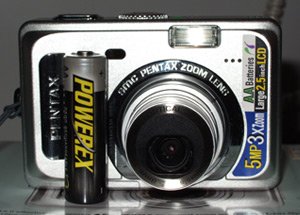
Obviously missing from the S55 are controls over aperture and shutter-speeds, nor are these features present in the vast-majority of ultra-compact cameras (For full-manual control in an ultra-compact body see the Fuji F810, for slow shutter-speed control only see the Fuji F10, Canon SD500, Canon SD400 and Canon SD300 - note that none of these use AA batteries).
Pentax Optio S55 Usability - How easy is it to use?
Taking pictures is very simple with the Pentax S55. The large 2.5" LCD is very nice for framing and provides a clear view of the subject at normal light levels. Lacking an optical viewfinder is one of this camera's weaknesses since very bright light can make the LCD difficult to see. The shutter release button is large and easy to press with a distinct halfway point making it easy to focus before pressing it fully. Photographic modes (including movie and voice-record mode) are easy to select using the top-mounted mode dial which surrounds the power button to protect it from being accidentally pressed.
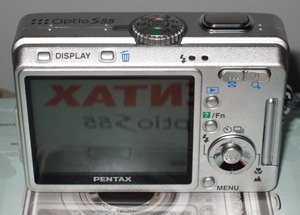
Despite its diminutive size dominated on the rear by the 2.5" LCD, the Pentax S55 has a good number of external controls. Due to the LCD's size, most buttons are quite small and cover almost the entire back of the camera. During use, only the size and placement of the display mode button proved problematic. Luckily for Pentax, it is probably the least used button on the camera's back.
By default, the direction pad controls some commonly used functions (drive-mode, focus-mode, flash-mode and sub-mode selection). After pressing the Fn button, the direction pad give access to 3 or 4 user-selected functions. This is a wonderful feature because users tend to access a small set of features frequently. Personally, the exposure compensation, ISO sensitivity and white-balance were my favorites. Other cameras from Fuji and Canon have quick-access menus too but they are not usually customizable and don't offer access to the most important functions (for example, image resolution and quality are frequently present but personally never used - except for testing). As for the mode dial, it gives direct access to all the important modes and gives indirect access to other modes like filter effects and specialty scene modes.
The tiny display button gives access to several display modes including one with a live-histogram. This is a rare feature on small cameras but is very valuable to judge exposure problems. Strangely, the camera allows the LCD to be turned off entirely even though there is no other viewfinder! The delete button serves to erase pictures in playback mode but also to prevent pictures taken from being stored. Even if the instant preview is on, the camera doesn't slow down and pressing the shutter button partly immediately exits the instant preview. This is good for getting the right shot of a moving subject. Even menus can be zoomed-in using the zoom controller for people who have vision problems.
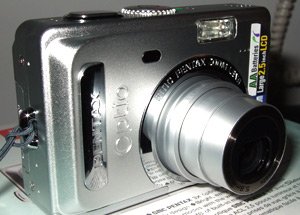
In practice, using the Pentax Optio S55 is comfortable for such a small camera. A small bump with the Pentax logo on the front allows it to be held securely (this is an improvement over the Pentax Optio S40 and S50 which lack this element). On the rear, there is only one place to put your thumb and it is a tight spot. During the review, I never accidentally bumped any buttons but I believe it could happen to the direction pad for people with large hands.
The S55 has separate doors for its SD card slot and its battery compartment which makes it impossible to drop one while changing the other. The SD slot door seems rather sturdy, while the battery door seems of average built. The plastic tripod socket is uncomfortably located at one edge of the camera. However, the camera's light weight did not cause any problems while mounted on a tripod. A cheap quality wrist strap is provided with the camera but serves its purpose well. Pentax offers a sturdy plastic-covered metal neck chain if desired. The S55 has good-looking styling but its chrome surfaces show fingerprints easily.
Pentax Optio S55 Performance - How well do it take pictures?
Straight-out the Pentax Optio S55 produces good looking pictures adequate for printing at sizes up to 9"x12". The pictures have nice natural colors and better than average contrast. This allows it to keep more details in bright areas of pictures than other cameras in its class. Noise levels are kept quite low up to ISO 200 but become visible at ISO 400. At ISO 400, noise is less visible than average but so are fine details which are slightly softened. Below ISO 400, images are quite sharp edge-to-edge except at maximum wide-angle where some corner softness is visible. The corner softness at wide-angle is much less pronounced than with the vast majority of ultra-compact digital cameras. Noise levels of each ISO setting can be seen on 100% crops here. See scaled images approximating 4x6 prints from the S55.
Battery life using 2 NiMh rechargeable AA batteries is better than average. Very few cameras do much better using lithium-ion batteries but considering the low cost of AA batteries (and the constant arrival of better models), there is no need to worry about the S55's battery life. The S55 can also use CR-V3 lithium batteries for even better battery life but we have not tested this here.
The speed of this camera appears slightly less than average and definitely far behind that of the Fujifilm Finepix F10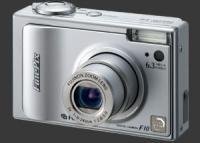
Fujifilm Finepix F10. Focus speed is decent in bright light but tends to become quite slow under low-lighting or when confronted with low-contrast subjects. The zoom motor operates faster than average but behind that of the Fuji F10. In continuous drive mode, using a high-speed card, we found less than 1 FPS but without burst limit.
Pentax Optio S55 Conclusion
 |

Please Support Neocamera
All information on Neocamera is provided free of charge yet running this website is a huge endeavor. Purchases made via affiliate links found throughout the site help keep it running and up-to-date. There is no additional cost to you, so please consider buying via these links to our affilates:





If you found any information on this site valuable and did not purchase via our affiliate links, please considering donating via PayPal:
Any amount will be greatly appreaciated. Thank you for your support!


Pentax S55 Highlights
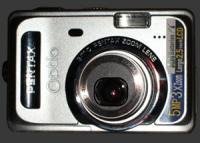


 Compact digital camera
Sensor-Size: 6 x 5mm

Actual size when viewed at 100 DPI
| 5 Megapixels Fixed Lens | ISO 50-400 |
| 3.1X Optical Zoom | Shutter 1/2000-4s |
| 1 FPS Drive, Unlimited Images | Custom white-balance |
| 320x240 @ 30 FPS Video Recording | Spot-Metering |
| 2.5" LCD 115K Pixels | Standard AA Battery |
| Secure Digital |
Camera Bag


Your camera bag is empty. To add a camera or lens click on the star next to its name.
Your camera bag is empty.
Add cameras or lenses by clicking on the star next to their name.
Updates
2024.04.03

Fujifilm X-T5 Review
Newest Fujifilm flagship boasting a 40 MP APS-C sensor, 5-axis IBIS with 7-stop efficiency, 15 FPS continuous drive, 6.2K Video capture, dual control-dials and dual SDXC UHS-II slots in a sturdy weatherproof and freezeproof body.
2023.11.20

Best Digital Cameras of 2023
Find out which are the Best Digital Cameras of 2023. All the new Mirrorless Digital Cameras from entry-level to high-end professional.
2023.07.10

Fujifilm X-H2 Review
40 Megapixels APS-C Hybrid Mirrorless Digital Camera with 7-stop IBIS. Fastest shutter ever and 8K video capture. Large builtin EVF with 0.8X magnification and 5.8 MP, plus an Eye-Start Sensor. Packed with features and large number of controls in a weatherproof and freezeproof body.
2023.05.07

Sony FE 20-70mm F/4G Review
Review of the unique Sony FE 20-70mm F/4G lens. The optical zoom of this lens spans ultra-wide-angle and medium focal-length coverage, making it one of the most versatile Full-Frame lenses on the market.
2023.01.15

Huion Inspiroy Dial 2 Review
Review of the Huion Inspiroy Dial 2 tablet, a medium sized drawing surface with dual dials and customizable buttons. Connects via USB-C or Bluetooth 5.0 with Windows, Linux and Android support.
2022.12.08

How to Pack for a Photo Trip
Find out how to pack for a travel photography trip, carry your gear safely while meeting airline regulations.
2022.11.13

Best Digital Cameras of 2022
The best digital cameras of 2022. A short list of the most outstanding models in their respective categories. Choose one for yourself or as a gift.
2022.09.21

Pentax DA* 60-250mm F/4 SDM Review
Review of the Pentax DA* 60-250mm F/4 SDM, the constant-aperture telephoto zoom with the highest zoom-ratio on the market.
2022.09.20

Pentax DA* 50-135mm F/2.8 SDM Review
Review of the Pentax DA* 50-135mm F/2.8 SDM, the lightest professional telephoto zoom native to the K-mount.
2022.09.10

Pentax DA* 11-18mm F/2.8 DC AW Review
Review of the Pentax DA* 11-18mm F/2.8 DC AW, the widest professional ultra-wide zoom native to the K-mount.
2021.11.24

50 Gifts Under $50 For Photographers in 2021
50 Gifts photographers will love. All for under $50 USD. 2021 Edition.
2021.11.17

Best Digital Cameras for 2021
Neocamera shows which are the very best Digital Cameras for 2021 in every category: Mirrorless, DSLR, Premium Compact, Ultra-Zoom and Rugged.
2024.04.03
2023.11.20
2023.07.10
2023.05.07
2023.01.15
2022.12.08
2022.11.13
2022.09.21
2022.09.20
2022.09.10
2021.11.24
2021.11.17