Camera Basics
 Camera Choosing
 Camera Models
 Camera Buying
 DSLR Buying

Olympus Stylus Tough-6000 Review
 10 Megapixels
 Stabilization: Compensates for tiny involuntary movements of the camera.
 VGA Video: 640 x 480 or more but less than 1280 x 720.
 Action Photography: Shutter speeds of 1/1500 or more.
 Spot Metering
 Weatherproof - Seals protect from dust, humidity and light splashing.
 Waterproof - Submersible under water up to a certain depth.
 Accepts xD memory.
 Neocamera detailed review
 Discontinued: No longer produced by the manufacturer. May still be in stock or found used.
Olympus Stylus Tough-6000 Introduction
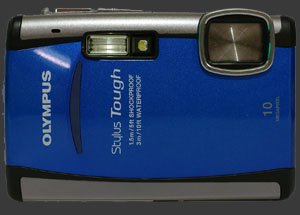
The Olympus Stylus Tough 6000 is a rugged ultra-compact digital camera which can be submerged up to 3 meters under water, dropped from up to 1.5 meters onto concrete and frozen to -10C.
The Tough 6000 packs a 10 megapixels sensor with a 3.6X non-protruding wide-angle lens and a 2.7" LCD in a body which is 0.9" thick. This makes the Tough 6000 one of the slimmest digital cameras with a wide-angle lens.
Like most ultra-compacts, exposure on the Tough 6000 is entirely automatic. Aside from the standard plus-or-minus 2 stops exposure-compensation, exposure is always controlled by the camera alone. With a choice of spot or evaluative metering and several scene-modes, this camera shows some flexibility. Like most Olympus cameras, the Tough 6000 uses xD memory cards and a proprietary lithium-ion battery. Olympus also provides an adapter to use MicroSD cards instead of xD ones.
| Key Features |
|---|
| Waterproof up to 3 meters underwater |
| Shockproof up to 1.5 meters fall onto concrete |
| Freeze proof up to -10C |
| 10 Megapixels sensor |
| 3.6X Non-protruding stabilized wide-angle optical zoom, equivalent to 28-102mm, F3.5/5.1-F8 |
| ISO Sensitivity from 50 to 1600 |
| Shutter-speeds from 1/2000s to 4s |
| Automatic white-balance, 7 white-balance presetsSunny, Cloudy, Incandescent, Fluorescent 1, Fluorescent 2, Fluorescent 3 |
| Evaluative and spot metering |
| Normal, Macro, Super-Macro and Super-Macro with LED illumination |
| Exposure compensation, -2..+2 EV, 1/3 EV steps |
| Shadow adjustment feature |
| Continuous drive at full-resolution and high-speed drive at 3 megapixels, speed unspecified |
| 10 Second self-timer |
| 640x480 30 FPS Movie mode |
| 2.7" LCD 230K Pixels |
When the Olympus 1030SW was reviewed here, there were very few other rugged cameras, all from Olympus. In 2009, the situation became quite different. Now, the Tough 6000 has competitors from Canon, Panasonic and Fuji.
Olympus Stylus Tough-6000 Suitability - What is it good for?
Suitability for this camera is less about subject than location. This is a take-anywhere camera. It is built tough, so even if you plan dangling from a rope against a vertical stone wall with the wind pounding the camera into the rock, it will take it. Its complete weather-tight design will withstand any adverse weather and allow it to be submerged under water at depths of 3 meters, sufficient for most swimmers.
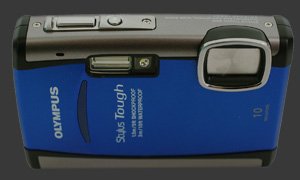
The 3.6X optical zoom with a range equivalent to 28-102mm is great on the wide-side but falls short on the telephoto side. Remember, with a camera like this, you can get closer. This wide-leaning range is better suited for landscape and architecture photography, but will also handle portrait and social photography.
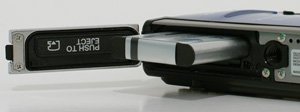
The bright 2.7" LCD makes it easy to frame images and the small LED can add light to close-range subjects. Even in a dark cave, you can use the Olympus Stylus Tough 6000 for macro photography. The only hindrance to taking this camera anywhere is its dependence on a small proprietary lithium-ion battery.
Olympus Stylus Tough-6000 Usability - How easy is it to use?
The Olympus Stylus Tough 6000 is made for durability, not comfort. The camera itself is a solid metal case with no significant protrusions, only buttons on the rear and a small frame around the lens opening. This makes it difficult to hold securely, although there is a tiny rubber area that helps a bit. All buttons are placed within easy reach. Unlike most cameras though, this one won't break unless it is dropped from more than 1.5 meters.
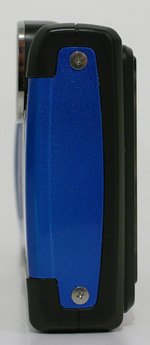
One annoyance that we often see on cameras this size with a large LCD is that the mode-dial ends up below your thumb, the Tough 6000 is no exception to this. Another thing that often ends up below one finger is the lens, as it is placed on the upper corner of the camera frame. While the first folded-optic cameras had this problem, Konica-Minolta fixed it when it introduced the X50 which mounted the lens horizontally near the middle of the camera body. Pentax later copied this style in its Optio Z10. Apparently, Olympus has not caught up with this improvement yet.
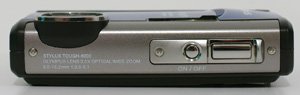
The shutter-release has a distinct halfway point and is easy to use. The power button is recessed to prevent accidental activation. Most other buttons on this camera are quite small but they all feel very solid and respond nicely. Zooming is implemented using a typical rocker-switch.
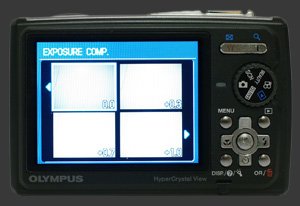
Olympus left more external controls on this camera than on most ultra-compacts. Plus, each direction on the 4-way controller is assigned a function: up is for exposure compensation, right is for flash-mode, down is for the self-timer and left is for focusing mode. The center button on the 4-way controller serves to bring up the function menu which gives quick access to white-balance, ISO, drive-mode, metering, image resolution and image-quality. Unfortunately, this digital camera competes with the Fuji F100fd for slowest interface to exposure-compensation. It takes several seconds for the Exposure Compensation screen to appear and an additional 2 seconds to get below 0 EV and above +1 EV.
An additional button gives access to a menu selection screen, meaning that menus are an extra click away than usual. There is also a button to enter playback mode without using the mode dial. One more button is for the display more and the LED, if pressed for a few seconds. The last button on the camera's back enters a 4-item iconic menu: Panorama, Tab Control, Shadow Adjustment and Multi Window. The final control on the Olympus Tough 6000 is an 6-position mode-dial.
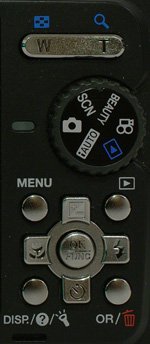
Upon entering Panorama mode, either using the Menu system or the OR button, one of three options must be chosen: Combine In Camera 1, Combine In Camera 2 and Combine In PC. The Combine In PC mode is the usual way of letting the user take multiple images with the exposure settings locked. Both in-camera options, automatically assemble panoramas from 3 horizontal images. The difference is that Combine In Camera 1 automatically takes the second and third pictures when it recognizes features seen in the previous images. For Combine In Camera 2, the user has to take each shot but the camera shows a vertical stripe of pixels from the previous image as a guide. The result is a relatively low-resolution panorama produced in the camera.
Tap Control is another Stylus Tough exclusive. When enabled, certain functions of the camera can be set by tapping the camera on different sides. It is designed to help with glove users who have problems operating the camera's small buttons. Shadow Adjustment is simply processing to brighten dark parts of an image. In some cases, it allows to bring out details in shadow areas, in others it can make an image look flat. In all cases, it increases noise in dark regions. Multi Window is a new mode which shows multiple previews on the LCD. Any one of 4 parameters can be chosen and small images will appear side-by-side to show how the image looks with up to 4 (if possible) variations.
The Olympus Stylus Tough 6000 features an excellent 2.7" LCD screen with 230K pixels. It is nice and sharp, with very good visibility in bright light and low-light. The LCD image refreshes smoothly in good light except during continuous shooting. The live-histogram, which can be optionally displayed, keeps up quite smoothly too.
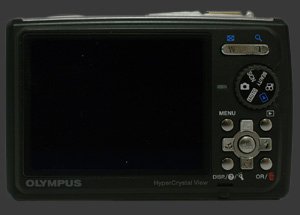
The front of this camera features a flash and a LED. The flash is typical for a camera of this size. The LED serves to illuminate very near subject. A dedicated LED super-macro mode which activates the LED when the shutter is pressed halfway exits as well. The great thing about this is that you can see the illumination effect before taking the picture. As a gimmick, the LED can also turn the Olympus into a very expensive flashlight.
Olympus Stylus Tough-6000 Conclusion
The Olympus Stylus Tough 6000 is all about being a tough water-proof digital camera with a wide-angle lens. There are very few cameras like this but if you do not consider all these characteristics to be important, it is fairly easy to find a better ultra-compact. If you do give importance to these, then the Tough 6000 holds its own quite well.
Given good image quality and decent noise up to ISO 200, the Tough 6000 is an outdoors-type digital camera which easily produces print-ready images with accurate color and white-balance. Performance is slow for action but unfortunately average among ultra-compact. Taking issue of this camera's price when considering this is important because excellent image quality and speed - but without the rugged or waterproof exterior - can be had for a similar price.
Overall, the Olympus Stylus Tough 6000 represents a good price-ruggedness compromise without sacrificing image quality too much. Olympus has the Tough 8000 which is more expensive but can be submerged up to 10 meters and dropped from 2m, which mostly benefits snorkelers instead of swimmers.
 |



 
|

Please Support Neocamera
All information on Neocamera is provided free of charge yet running this website is a huge endeavor. Purchases made via affiliate links found throughout the site help keep it running and up-to-date. There is no additional cost to you, so please consider buying via these links to our affilates:





If you found any information on this site valuable and did not purchase via our affiliate links, please considering donating via PayPal:
Any amount will be greatly appreaciated. Thank you for your support!


Olympus Tough-6000 Highlights
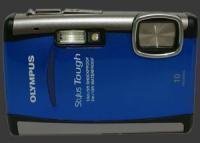


 Ultra-Compact digital camera
Sensor-Size: 6 x 5mm

Actual size when viewed at 100 DPI
| 10 Megapixels Ultra Compact | ISO 50-1600 |
| 3.6X Wide Optical Zoom | Shutter 1/2000-4s |
| Built-in Stabilization | Spot-Metering |
| Waterproof to 3m | Lithium-Ion Battery |
| Weatherproof down to -10C | xD, Internal Memory |
| 640x480 @ 30 FPS Video Recording | |
| 2.7" LCD 230K Pixels |
Camera Bag


Your camera bag is empty. To add a camera or lens click on the star next to its name.
Your camera bag is empty.
Add cameras or lenses by clicking on the star next to their name.
Updates
2024.04.03

Fujifilm X-T5 Review
Newest Fujifilm flagship boasting a 40 MP APS-C sensor, 5-axis IBIS with 7-stop efficiency, 15 FPS continuous drive, 6.2K Video capture, dual control-dials and dual SDXC UHS-II slots in a sturdy weatherproof and freezeproof body.
2023.11.20

Best Digital Cameras of 2023
Find out which are the Best Digital Cameras of 2023. All the new Mirrorless Digital Cameras from entry-level to high-end professional.
2023.07.10

Fujifilm X-H2 Review
40 Megapixels APS-C Hybrid Mirrorless Digital Camera with 7-stop IBIS. Fastest shutter ever and 8K video capture. Large builtin EVF with 0.8X magnification and 5.8 MP, plus an Eye-Start Sensor. Packed with features and large number of controls in a weatherproof and freezeproof body.
2023.05.07

Sony FE 20-70mm F/4G Review
Review of the unique Sony FE 20-70mm F/4G lens. The optical zoom of this lens spans ultra-wide-angle and medium focal-length coverage, making it one of the most versatile Full-Frame lenses on the market.
2023.01.15

Huion Inspiroy Dial 2 Review
Review of the Huion Inspiroy Dial 2 tablet, a medium sized drawing surface with dual dials and customizable buttons. Connects via USB-C or Bluetooth 5.0 with Windows, Linux and Android support.
2022.12.08

How to Pack for a Photo Trip
Find out how to pack for a travel photography trip, carry your gear safely while meeting airline regulations.
2022.11.13

Best Digital Cameras of 2022
The best digital cameras of 2022. A short list of the most outstanding models in their respective categories. Choose one for yourself or as a gift.
2022.09.21

Pentax DA* 60-250mm F/4 SDM Review
Review of the Pentax DA* 60-250mm F/4 SDM, the constant-aperture telephoto zoom with the highest zoom-ratio on the market.
2022.09.20

Pentax DA* 50-135mm F/2.8 SDM Review
Review of the Pentax DA* 50-135mm F/2.8 SDM, the lightest professional telephoto zoom native to the K-mount.
2022.09.10

Pentax DA* 11-18mm F/2.8 DC AW Review
Review of the Pentax DA* 11-18mm F/2.8 DC AW, the widest professional ultra-wide zoom native to the K-mount.
2021.11.24

50 Gifts Under $50 For Photographers in 2021
50 Gifts photographers will love. All for under $50 USD. 2021 Edition.
2021.11.17

Best Digital Cameras for 2021
Neocamera shows which are the very best Digital Cameras for 2021 in every category: Mirrorless, DSLR, Premium Compact, Ultra-Zoom and Rugged.
2024.04.03
2023.11.20
2023.07.10
2023.05.07
2023.01.15
2022.12.08
2022.11.13
2022.09.21
2022.09.20
2022.09.10
2021.11.24
2021.11.17