Camera Basics
 Camera Choosing
 Camera Models
 Camera Buying
 DSLR Buying

Nikon Coolpix S640 Review
 12 Megapixels
 High ISO: ISO 6400 or more is available at full-resolution.
 Stabilization: Compensates for tiny involuntary movements of the camera.
 VGA Video: 640 x 480 or more but less than 1280 x 720.
 Custom White-Balance: Specifies exactly what should be white to the camera.
 Action Photography: Shutter speeds of 1/1500 or more.
 Accepts Secure Digital High Capacity (SDHC) and SD memory.
 Neocamera detailed review
 Discontinued: No longer produced by the manufacturer. May still be in stock or found used.
Nikon Coolpix S640 Introduction
The Nikon Coolpix S640 is an ultra-compact digital camera with a 12 megapixels sensor, a 5X stabilized wide-angle optical zoom lens and a 2.7" LCD. It packs all this in a 0.8" slim body. The optical zoom lens has a versatile range equivalent too 28-140mm. The Nikon S640 has a wide range of ISO sensitivities, from 100 to 6400.
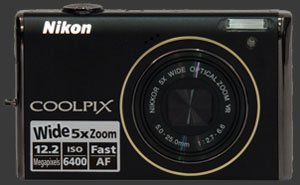
Headline features of the S640 are ultra-fast autofocus system and near-instant shutter-lag. Nikon claims that its autofocus speed rivals DSLR cameras, see further down this review for all the details.
Exposure on the S640 is entirely automatic. Aside from +/- 2 stops of exposure-compensation, exposure is controlled by the camera alone. With a choice of center-weighed or evaluative metering, this camera shows little flexibility.
Key Features
- 12 Megapixels sensor
- 5X Stabilized optical zoom, equivalent to 28-140mm
- ISO Sensitivity from 100 to 6400
- Shutter-speeds from 1/1500s to 4s
- Automatic white-balance, 5 white-balance presetsDaylight, Incandescent, Fluorescent, Cloudy and Flash and custom white-balance
- Evaluative and center-weighed metering
- Single shot and continuous focus drive
- Best-Shot-Selection mode
- Normal and macro focus modes
- Auto, manual, center or face focus point selection
- Exposure compensation, -2..+2 EV, 1/3 EV steps
- 0.8 FPS continuous drive
- Self-timer, 2 or 10 seconds
- 640x480 30 FPS Movie mode, single or continuous focus mode
- 2.7" LCD 230K Pixels
- Standard, vivid, b&w, sepia, cyanotype and pastel color modes
- Smile-Shutter, Active-Child, Auto-Scene plus 16 other scene modes
- Voice-recording mode
Nikon Coolpix S640 Suitability - What is it good for?
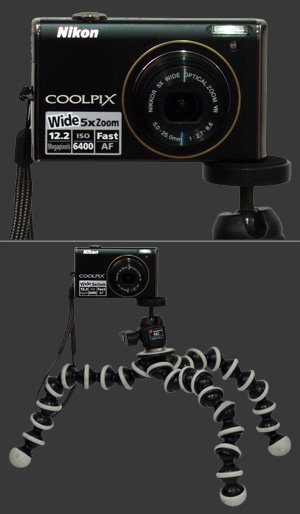 This small ultra-compact distinguishes itself by a wide-angle lens which makes it suitable for photography in close-quarters. Landscape and architecture shots can greatly benefit from a wide-angle lens. The focal-length, being equivalent to 28-140mm in 35mm terms, should render flattering portraits and even more distant things.
While the Nikon S640 is a general purpose point-and-shoot camera, its feature set is rather limited and gives almost no direct controls to the photographer. Custom white-balance and focus-point-selection are the main direct controls. Note that the shutter-speed range goes from 1/1500 to 4s. This is neither quick enough for fast action, nor long enough for night photography.
There is no optical viewfinder on the Nikon S640 but its 2.7" LCD with 230,000 pixels is among the very best on an ultra-compact digital camera. The LCD shows really good outdoor visibility, thanks to an anti-reflection layer which also provides a broad viewing angle. The claims of higher contrast seem to hold true, as this display can show a good dynamic range, similar to that of images captured. This greatly helps judging if exposure is good or not, particularly in the absence of a histogram.
The Nikon Coolpix S640 also records 640x480 30 FPS movies in single-shot or continuous focus modes. It has is a Panorama mode which helps take a sequence of images in any direction, locks exposure and focus and disables all settings including ISO, WB, Flash, EC and drive-mode. The majority of remaining features are standard among this class of cameras. The ones that are not are covered in more detail in the next section. Audio can also be recorded either along-side an image.
Nikon Coolpix S640 Usability - How easy is it to use?
As the S640 is one of the smallest cameras, its size is not without compromise. The build quality is excellent everywhere except for the flimsy but flexible battery-door compartment cover. The tiny rubber bands holding the mini-USB and AC-adapter covers do not look like they can use a lot wear-and-tear. Since this digital camera only recharges via USB, at least the USB cover will get a lot of use. Not only that, the camera is trapped while charging, requiring more care and fiddling if you want to keep more than one charged.
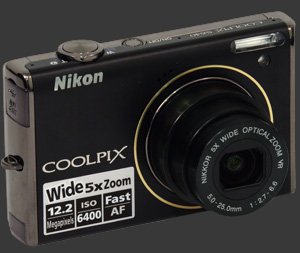
Its nice but its slippery front surface lacks any type of grip. On the rear, a small depression with 4 protruding dots provide the only purchase on the camera. The wrist-strap provides security from accidental falls. A poorly placed tripod socket is found at one end of the camera casing.
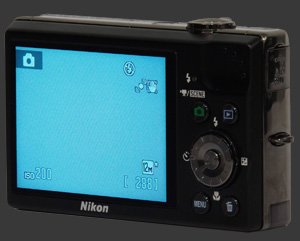 The camera is powered by a recessed but easy to use button on the top-panel. Next to it is the shutter-button which has short travel and is quite responsive. All other controls are easily accessible around the combined dial and 4-way controller. The rotating dial is used in record mode to scroll through options. In playback mode, it quickly scrolls through images.
The zoom is operated electronically via a rocker switch surrounding the shutter-release. There are 12 steps to the zoom which is a coarse granularity for a 5X optical zoom lens.
The Camera/Scene/Movie button activates a mode-selection menu. Pressing the shutter does not exit the virtual mode dial, instead the mode or OK button must be pressed. This means that the Nikon Coolpix S640 is not always shooting-priority. The Play button enters playback mode. To exit, either tap the shutter or press the Camera button.
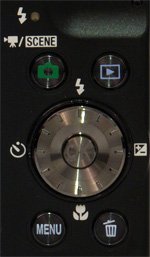 There is an Auto mode which is used for general-type shooting. There are 18 scene modes to choose from, including panorama-assist mode. Two special modes are kept separate: smart portrait and subject tracking. Smile portrait has its own menu items to control skin softening, smile detection and blink-proof. Subject tracking tries to keep a moving subject in focus. The focus mode used for subject tracking is not accessible outside of this mode. The last mode-selection option is movie-mode. Finally, in Auto-Scene mode the camera guesses which scene-mode would be required and takes the shot in that scene-mode
The Menu button obviously activates the current mode's menu. The Delete button works both in Shooting and Playback mode. In Playback mode it affects the image shown. In Camera mode it affects the last picture taken. In both cases, it asks confirmation before deleting the target image.
The central control is the rotating 4-way controller. Each direction is assigned a function in Shooting mode. Up is for Flash-mode. Right is for exposure-compensation. Down is for macro-mode and Left selects the self-timer. A direction button invokes the list of options. To make a selection, either the vertical buttons or rotating dial must be used and the OK button must be pressed.
The 2.7" LCD shows each image after it is taken. There is no way to disable this, so we cannot know if it would be any faster without the image review.
The S640 uses SD or SD-HC memory cards, which are presently the cheapest and most common form of flash memory. Images are numbered in a standard form but the number keeps increasing even after changing the memory card. Not only is this rather annoying, there is also no menu option to reset the counter to zero. Then again, maybe only camera reviewers care about this.
Nikon Coolpix S640 Conclusion
The Nikon Coolpix S640 is one of many ultra-compact point-and-shoot cameras with a wide-angle lens. This model manages to stand out by its ultra-fast autofocus system, something which is unmatched among such small cameras. This feature makes it more usable for moving subjects than other cameras in its class.
The remaining features are barely minimal and one can find many more capable ultra-compact digital cameras. This is no reason alone to dismiss the S640 as it gives it simplicity and usability. For the target user who rarely jumps into menu system, its basic point-and-shoot feature-set may be all that's needed. In fact, the S640 makes the time between pointing and shooting quite short.
The image quality, without being top-of-class, is very reliable with reasonable noise-levels, good color, very good white-balance and barely any optical distortion. This makes it easy to forgive the purple-fringing and other minor problems listed earlier. The only two weak areas are the occasional failure to lock focus and the long gap required between shots.
Competition wise, the undeniable superior to the S640 is the Fuji Finepix F200 EXR which not only shows the most impressive image quality in its class but also a very complete feature set including manual exposure, a stabilized 5X wide-angle optical zoom and a rather speedy overall performance.
 |


 
|

Please Support Neocamera
All information on Neocamera is provided free of charge yet running this website is a huge endeavor. Purchases made via affiliate links found throughout the site help keep it running and up-to-date. There is no additional cost to you, so please consider buying via these links to our affilates:




If you found any information on this site valuable and did not purchase via our affiliate links, please considering donating via PayPal:
Any amount will be greatly appreaciated. Thank you for your support!


Nikon S640 Highlights
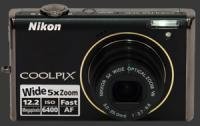


 Ultra-Compact digital camera
Sensor-Size: 6 x 5mm

Actual size when viewed at 100 DPI
| 12 Megapixels Ultra Compact | ISO 100-6400 |
| 5X Wide Optical Zoom | Shutter 1/1500-4s |
| Built-in Stabilization | Custom white-balance |
| 640x480 @ 30 FPS Video Recording | Lithium-Ion Battery |
| 3" LCD 230K Pixels | Secure Digital High Capacity |
Camera Bag


Your camera bag is empty. To add a camera or lens click on the star next to its name.
Your camera bag is empty.
Add cameras or lenses by clicking on the star next to their name.
Updates
2024.04.03

Fujifilm X-T5 Review
Newest Fujifilm flagship boasting a 40 MP APS-C sensor, 5-axis IBIS with 7-stop efficiency, 15 FPS continuous drive, 6.2K Video capture, dual control-dials and dual SDXC UHS-II slots in a sturdy weatherproof and freezeproof body.
2023.11.20

Best Digital Cameras of 2023
Find out which are the Best Digital Cameras of 2023. All the new Mirrorless Digital Cameras from entry-level to high-end professional.
2023.07.10

Fujifilm X-H2 Review
40 Megapixels APS-C Hybrid Mirrorless Digital Camera with 7-stop IBIS. Fastest shutter ever and 8K video capture. Large builtin EVF with 0.8X magnification and 5.8 MP, plus an Eye-Start Sensor. Packed with features and large number of controls in a weatherproof and freezeproof body.
2023.05.07

Sony FE 20-70mm F/4G Review
Review of the unique Sony FE 20-70mm F/4G lens. The optical zoom of this lens spans ultra-wide-angle and medium focal-length coverage, making it one of the most versatile Full-Frame lenses on the market.
2023.01.15

Huion Inspiroy Dial 2 Review
Review of the Huion Inspiroy Dial 2 tablet, a medium sized drawing surface with dual dials and customizable buttons. Connects via USB-C or Bluetooth 5.0 with Windows, Linux and Android support.
2022.12.08

How to Pack for a Photo Trip
Find out how to pack for a travel photography trip, carry your gear safely while meeting airline regulations.
2022.11.13

Best Digital Cameras of 2022
The best digital cameras of 2022. A short list of the most outstanding models in their respective categories. Choose one for yourself or as a gift.
2022.09.21

Pentax DA* 60-250mm F/4 SDM Review
Review of the Pentax DA* 60-250mm F/4 SDM, the constant-aperture telephoto zoom with the highest zoom-ratio on the market.
2022.09.20

Pentax DA* 50-135mm F/2.8 SDM Review
Review of the Pentax DA* 50-135mm F/2.8 SDM, the lightest professional telephoto zoom native to the K-mount.
2022.09.10

Pentax DA* 11-18mm F/2.8 DC AW Review
Review of the Pentax DA* 11-18mm F/2.8 DC AW, the widest professional ultra-wide zoom native to the K-mount.
2021.11.24

50 Gifts Under $50 For Photographers in 2021
50 Gifts photographers will love. All for under $50 USD. 2021 Edition.
2021.11.17

Best Digital Cameras for 2021
Neocamera shows which are the very best Digital Cameras for 2021 in every category: Mirrorless, DSLR, Premium Compact, Ultra-Zoom and Rugged.
2024.04.03
2023.11.20
2023.07.10
2023.05.07
2023.01.15
2022.12.08
2022.11.13
2022.09.21
2022.09.20
2022.09.10
2021.11.24
2021.11.17