Camera Basics
 Camera Choosing
 Camera Models
 Camera Buying
 DSLR Buying

Nikon Coolpix S600 Review
 10 Megapixels
 Stabilization: Compensates for tiny involuntary movements of the camera.
 VGA Video: 640 x 480 or more but less than 1280 x 720.
 Custom White-Balance: Specifies exactly what should be white to the camera.
 Action Photography: Shutter speeds of 1/1500 or more.
 Spot Metering
 Accepts Secure Digital High Capacity (SDHC) and SD memory.
 Neocamera detailed review
 Discontinued: No longer produced by the manufacturer. May still be in stock or found used.
Nikon Coolpix S600 Introduction
The Nikon Coolpix S600 packs a 10 megapixels sensor with a 4X stabilized wide-angle lens and a 2.7" LCD in a body which is 0.9" thick. The Nikon S600 is definitely one of the smallest ultra-compacts with a stabilized wide-angle lens.
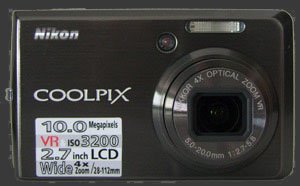 Exposure on the S600 is entirely automatic. Aside from +/- 2 stops of exposure-compensation, exposure is always controlled by the camera alone. With a choice of center-weighed or evaluative metering, this camera shows little flexibility. One headline feature of the S600 is its high-sensitivity range which goes to ISO 3200. It uses SD or SD-HC cards for memory and a lithium-ion battery for power. This is pretty much standard among recent ultra-compacts.
| Key Features |
|---|
| 10 Megapixels sensor |
| 4X Stabilized optical zoom, equivalent to 28-112mm |
| ISO Sensitivity from 100 to 3200 |
| Shutter-speeds from 1/1500s to 4s |
| Automatic white-balance, 5 white-balance presetsDaylight, Incandescent, Fluorescent, Cloudy and Flash and custom white-balance |
| Evaluative and center-weighed metering |
| Single shot and continuous focus drive |
| Normal and macro focus modes |
| Auto, manual or center focus point selection |
| Exposure compensation, -2..+2 EV, 1/3 EV steps |
| 10 Images at 1.1 FPS continuous drive |
| Self-timer, 2 or 10 seconds |
| 640x480 30 FPS Movie mode, single or continuous focus mode |
| 2.7" LCD 230K Pixels |
| Standard, vivid, b&w, sepia, cyanotype and pastel color modes |
| Voice-recording mode |
Nikon Coolpix S600 Suitability - What is it good for?
This small ultra-compact distinguish itself by its wide-angle lens which makes it more suitable for landscape, architecture and close-quarter indoor shots than most digital cameras. With an equivalent to 28-112mm in 35mm terms, the S600 can render flattering portraits and a variety of close-by subject.
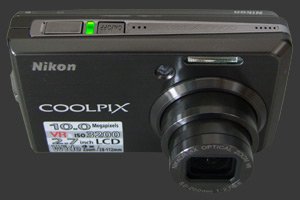 While the Nikon Coolpix S600 is a general purpose point-and-shoot camera, its feature set is rather limited. Aside from custom white-balance and 4 focus-point selection modes, its features appear on nearly all ultra-compacts. Notice the shutter-speed range of 1/1500 to 4s which is neither fast enough for high-speed action, nor long enough for night photography.
The 2.7" LCD makes it easy to frame images, although visibility can be an issue under bright light and there is no optical viewfinder to fallback on. Note that we only complain about the lack of an optical viewfinder when the LCD is inadequate under expected conditions. This is one of those cases.
The Coolpix also records VGA quality movies and audio only clips. Movies can be recorded in single-shot or continuous focus modes.
Nikon Coolpix S600 Usability - How easy is it to use?
As the S600 is one of the smallest cameras, its size is not without compromise. The build quality is excellent everywhere except for the flimsy but flexible battery-door compartment cover. Its nice but slippery surface lacks any type of grip and, on the rear, there is barely space for the tip of your thumb to rest. The provided wrist-strap provides security from accidental falls. One construction issue is that the plastic lens cover lets in quite a bit of dust. The tripod socket is poorly placed at one end of the camera casing.
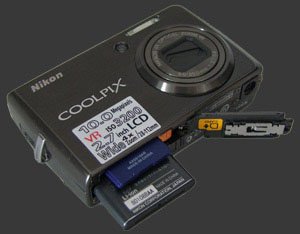 The camera is powered by a recessed but easy to use button on the top-panel. Next to it is the shutter-button which has short travel but is responsive enough. Most other controls are easily accessible, almost all of them located around the combined control-dial and 4-way controller. Speaking of which, the control-dial is overly sensitive and prone to accidental changes.
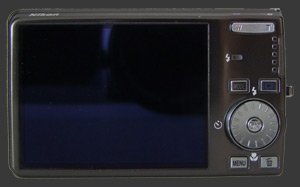
The Mode button activates a virtual on-screen mode dial. Actually, it activates two: one for in Shooting mode and one in Playback mode. In shooting mode, the modes are: Shooting, Hi ISO, Scene, Voice-Recording, Movie and Setup menu. In play mode, the modes are: Play, Date List, Sound Playback, Setup. The Play button enters and exits playback mode. This is the one which triggers the virtual mode-dial to change. It is almost usable at all times. Note that the camera is not shooting priority, the Play button must used to enter and exit playback mode.
 The Menu button obviously activates the current mode's menu. While this is typical for most cameras, there is normally a path from such menu to the setup menu. This is not the case with the S600. Instead, one must use the virtual mode-dial to enter Setup mode. Setup mode solely consists of a two-page menu system. The Delete button works both in Shooting and Playback mode. In Shooting mode it affects the last picture taken. In Playback mode it affects the currently displayed image. In both cases, it asks confirmation before deleting the target image.
The central control is the rotating 4-way controller. Each direction is assigned a function in Shooting mode. Up selects the flash-mode, Right activates exposure-compensation, Down toggles macro-mode and Left selects a self-timer. The dial rotation is used to change exposure compensation, camera modes and navigate between images.
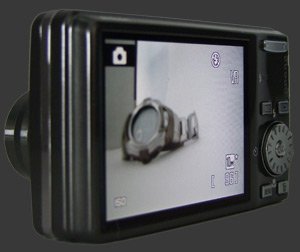
The large 2.7" LCD is mostly exposure-priority. In low-light, it shows an excessively bright preview which can cause you to apply too much exposure-compensation. This is unfortunate as the preview in good light is quite accurate. In some rare cases, also in low-light, the white-balance is not previewed correctly. Visibility is good in low-light but the display is too reflective, thus causing difficulty in bright light.
The S600 uses SD or SD-HC memory cards, which are presently the cheapest and most common form of flash memory. Images are numbered in a standard form but the number keeps increasing even after changing the memory card. Not only is this rather annoying, there is also no menu option to reset the counter to zero. Then again, maybe only camera reviewers care about this.
Nikon Coolpix S600 Conclusion
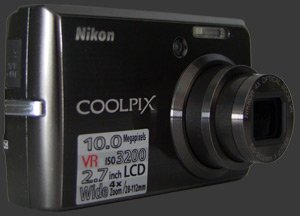 The Nikon Coolpix S600 represent the typical modern ultra-compact with a wide-angle lens. A quick search revealed the existence of at least 10 such models with 10 or more megapixels sensors, with half of these also equipped with image stabilization. The point is that this little digital camera has a lot to compete against.
Overall, this ultra-compact delivers a performance which is good on image quality but behind in terms of speed. Good sharpness and a fine noise pattern deliver quite usable images up to ISO 800. Beyond that, noise and noise-reduction destroys colors and details. Speed is on the slow side when we look at the most important aspects: shutter-lag, focusing and shot-to-shot speeds.
While build quality and battery-life are good, other areas including white-balance in artificial light, handling, user interface and color over-saturation proved problematic, at least compared to its best competitors.
Based on this mix of above and below average show of performance, the S600 is awarded an Average rating. Its main competitors being the Fuji Finepix F100fd, the Sony Cybershot DSC-W170, the Panasonic Lumix DMC-FX35 and the Casio Exilim EX-Z200. Having seen how good the F100fd is, it is hard not to recommend it over the S600.
 |


|

Please Support Neocamera
All information on Neocamera is provided free of charge yet running this website is a huge endeavor. Purchases made via affiliate links found throughout the site help keep it running and up-to-date. There is no additional cost to you, so please consider buying via these links to our affilates:




If you found any information on this site valuable and did not purchase via our affiliate links, please considering donating via PayPal:
Any amount will be greatly appreaciated. Thank you for your support!


Nikon S600 Highlights


 Ultra-Compact digital camera
Sensor-Size: 6 x 5mm

Actual size when viewed at 100 DPI
| 10 Megapixels Ultra Compact | ISO 100-3200 |
| 4X Wide Optical Zoom | Shutter 1/1500-4s |
| Built-in Stabilization | Custom white-balance |
| 1.1 FPS Drive, 10 Images | Spot-Metering |
| 640x480 @ 30 FPS Video Recording | Lithium-Ion Battery |
| 2.7" LCD 230K Pixels | Secure Digital High Capacity |
Camera Bag


Your camera bag is empty. To add a camera or lens click on the star next to its name.
Your camera bag is empty.
Add cameras or lenses by clicking on the star next to their name.
Updates
2024.04.03

Fujifilm X-T5 Review
Newest Fujifilm flagship boasting a 40 MP APS-C sensor, 5-axis IBIS with 7-stop efficiency, 15 FPS continuous drive, 6.2K Video capture, dual control-dials and dual SDXC UHS-II slots in a sturdy weatherproof and freezeproof body.
2023.11.20

Best Digital Cameras of 2023
Find out which are the Best Digital Cameras of 2023. All the new Mirrorless Digital Cameras from entry-level to high-end professional.
2023.07.10

Fujifilm X-H2 Review
40 Megapixels APS-C Hybrid Mirrorless Digital Camera with 7-stop IBIS. Fastest shutter ever and 8K video capture. Large builtin EVF with 0.8X magnification and 5.8 MP, plus an Eye-Start Sensor. Packed with features and large number of controls in a weatherproof and freezeproof body.
2023.05.07

Sony FE 20-70mm F/4G Review
Review of the unique Sony FE 20-70mm F/4G lens. The optical zoom of this lens spans ultra-wide-angle and medium focal-length coverage, making it one of the most versatile Full-Frame lenses on the market.
2023.01.15

Huion Inspiroy Dial 2 Review
Review of the Huion Inspiroy Dial 2 tablet, a medium sized drawing surface with dual dials and customizable buttons. Connects via USB-C or Bluetooth 5.0 with Windows, Linux and Android support.
2022.12.08

How to Pack for a Photo Trip
Find out how to pack for a travel photography trip, carry your gear safely while meeting airline regulations.
2022.11.13

Best Digital Cameras of 2022
The best digital cameras of 2022. A short list of the most outstanding models in their respective categories. Choose one for yourself or as a gift.
2022.09.21

Pentax DA* 60-250mm F/4 SDM Review
Review of the Pentax DA* 60-250mm F/4 SDM, the constant-aperture telephoto zoom with the highest zoom-ratio on the market.
2022.09.20

Pentax DA* 50-135mm F/2.8 SDM Review
Review of the Pentax DA* 50-135mm F/2.8 SDM, the lightest professional telephoto zoom native to the K-mount.
2022.09.10

Pentax DA* 11-18mm F/2.8 DC AW Review
Review of the Pentax DA* 11-18mm F/2.8 DC AW, the widest professional ultra-wide zoom native to the K-mount.
2021.11.24

50 Gifts Under $50 For Photographers in 2021
50 Gifts photographers will love. All for under $50 USD. 2021 Edition.
2021.11.17

Best Digital Cameras for 2021
Neocamera shows which are the very best Digital Cameras for 2021 in every category: Mirrorless, DSLR, Premium Compact, Ultra-Zoom and Rugged.
2024.04.03
2023.11.20
2023.07.10
2023.05.07
2023.01.15
2022.12.08
2022.11.13
2022.09.21
2022.09.20
2022.09.10
2021.11.24
2021.11.17