Camera Basics
 Camera Choosing
 Camera Models
 Camera Buying
 DSLR Buying

Nikon Coolpix P300 Review
 12 Megapixels
 Stabilization: Compensates for tiny involuntary movements of the camera.
 Continuous Drive
 Full 1080p HD Video: 1920 x 1080 resolution or more but less than 4K.
 Manual Controls: Both fully-manual (M) and semi-automatic modes (T and V).
 Custom White-Balance: Specifies exactly what should be white to the camera.
 Action Photography: Shutter speeds of 1/1500 or more.
 Night Photography: Reaches shutter-speeds longer than 4 seconds.
 Accepts Secure Digital Extended Capacity (SDXC), SDHC and SD memory.
 Neocamera detailed review
 Discontinued: No longer produced by the manufacturer. May still be in stock or found used.
 1 - Capability2 - Usability3 - Performance
Nikon Coolpix P300 Introduction

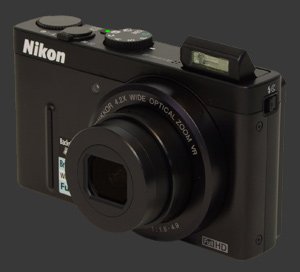
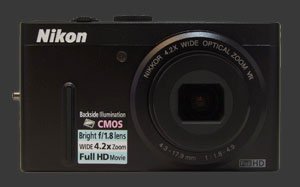
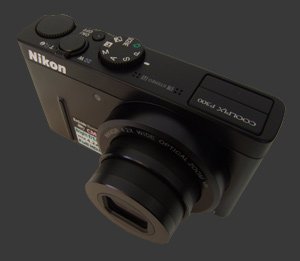
The Nikon Coopix P300 is a small compact digital camera with an all-new design from Nikon. The camera is built around a 12 megapixels high-speed CMOS sensor and a very bright F/1.8 ultra-wide angle lens, equivalent to 24-100mm. This model is aimed at advanced users seeking efficient manual controls and is among the smallest digital cameras to feature dual control-dials. There is also an actual mode dial with positions for P, S, A M exposure modes.
The CMOS sensor lets the Coolpix P300 shoot continuously at 8 FPS and record 1080p HD video, which is nicely complemented by a built-in stereo microphone. Advanced video recording modes from high-speed to slow-motion round off this camera's video capabilities. Further use of the CMOS sensor includes Sweeping Panorama up to 360° and multi-frame high-ISO noise-reduction.
Nikon Coolpix P300 Key Features
- 12 Megapixels CMOS sensor
- Stabilized 4.2X ultra-wide-angle optical zoom, equivalent to 24-100mm in 35mm terms
- Ultra-bright F/1.8 maximum aperture at wide angle, down to F/4.9 at telephoto
- ISO Sensitivity from 160 to 3200
- Shutter-speeds from 1/2000s to 8s
- White-balance: Automatic, 5 presetsDaylight, Incandescent, Fluorescent, Cloudy, Flash and custom
- Matrix and center-weighed metering
- Program, Aperture-Priority, Shutter-Priority and Manual exposure modes
- Exposure compensation, -2..+2 EV, 1/3 EV steps
- Flash compensation, -2..+2 EV, 1/3 EV steps
- Bracketing, 3 frames, up to 1 EV steps
- 8 FPS Continuous drive, up to 7 frames
- 120 and 60 FPS Ultra-high speed drive at 1 MP
- 2, 10s and smile self-timer
- Automatic, Manual, Center, Tracking and Face-Priority focus-point selection
- Single (AF-S) and Continuous (AF-C) focus
- Adjustable hue and saturation, 11 steps each
- 3" LCD 920K Pixels, 100% coverage
- 1920x1080 @ 30 FPS Full HD video recording
- 1280x720 @ 60 FPS and 640x480 @ 120 FPS High-speed video
- 1920x1080 @ 15 FPS Slow-speed video
- Built-in stereo microphone
- SDXC memory support
- Lithium-Ion battery
Nikon Coolpix P300 Suitability - What is it good for?
The Nikon P300 is defined by a combination of size and features. This is an advanced camera, yet it is much smaller than most cameras with manual controls. The P300 is therefore more likely to be taken places where the weight and visibility of a larger camera is problem. The P300 is so small that it barely exceeds the thickness of an ultra-compact and should easily fit in most jacket pockets.
The 4.2X optical zoom lens has a range from 24mm to 100mm in 35mm-equivalent terms. The ultra-wide-end is suitable for landscape, interiors and architecture. The telephoto-end is somewhat short but perfectly usable for portraits. Anything which requires more distance such as typical street photography is going to be severely limited. The extremely bright F/1.8 aperture lets the P300 shoot with less light, at lower ISO and with less motion blur than most of its peers, something which is very useful for indoor and social photography. Do note that the maximum aperture closes down to F/4.9 at the long end. The 12 megapixels sensor permits sharp prints up to 15x20", at least at ISO sensitivities where noise is low.
 This Coolpix is reasonably suited for creative photography. Manual controls provide complete control over exposure within the limits of the camera. Specifically, the top 1/2000s shutter-speed is fast enough to freeze most action while the slowest one of 8s works for typical night photography. It is important to know that 8s is only possible at ISO 160 and by ISO 200 the slowest speed drops to 4s, It then drops to 2s at ISO 800 and by one more stop for each additional ISO stop.
Despite having continuous modes running from 8 FPS to 120 FPS, this digital camera is unsuitable for action photography since the LCD remains blank or severely lags action in continuous drive mode. This makes it impossible to keep up with action. With an ISO range reaching 3200, low-light handheld shooting is possible.
Nikon Coolpix P300 Capability - What can it do?
The Nikon Coopix P300 has a capable but relatively simple feature set. It has everything one expects from a compact digital camera, plus full manual-controls over exposure. In terms of advanced controls though, it is notably missing spot-metering and manual focusing which the larger Nikon Coolpix P7000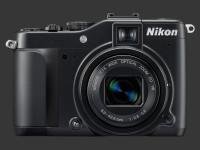
Nikon Coolpix P7000 and many other advanced compacts include.

Beyond the 12 megapixels sensor and 4X stabilized optical zoom, the Nikon Coolpix P300 packs the following features, followed by explanations when required:
- PASM Exposure modes, with Program-Shift in P mode.
- Auto and 25 selectableNight Landscape Handheld, Night Landscape Tripod, Backlighting, HDR, Portrait, Landscape, Landscape Multi-Frame NR, Sports, Night Portrait Handheld, Night Portrait Tripod, Party/Indoor, Beach, Snow, Sunset, Dusk/Dawn, Close-Up, Food, Museum, Fireworkds, B&W Copy, Panorama Assist, Panorama Sweep 360, Panorama Sweep 180, Pet, Special Effects, scene-modes, including several Panorama and Multi-Frame modes.
- Auto, 5 PresetsDaylight, Incandescent, Fluorescent, Cloudy and Flash and Custom white-balance.
- Matrix and Center-Weighed metering.
- AutoSelectable maximum of 400, 800 or 1000 (Simply called Auto) and manually selectable ISO from 160 to 3200.
- Exposure-compensation, -2..+2 stops in 1/3 EV increments.
- Flash-compensation, -2.+2 stops in 1/3 EV increments.
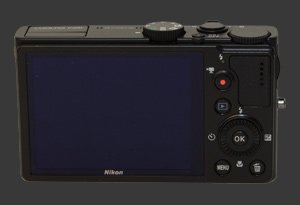
- Dual control-dials, one on top plate, one around the 4-way controller.
- Single (AF-S) or continuous (AF-C) autofocus modes, available for images and video.
- Auto, 99-Area Manual, Center, Subject-Tracking or Face-Detect autofocus areas.
- Built-in AF-assist lamp, can be disabled.
- Single-shot, Continuous, BSS, Multi-shot 16, 120 FPS Continuous and 60 FPS Continuous modes.
- Self-timers, 2s, 10s or Smile-Detect.
- Bracketing, 3 frames, 1/3, 2/3 or 1 EV steps.
- Auto, Redeye, Off, On and Slow-Sync flash with mechanical release.
- Optional motion-detection.
- Full 1080p HD video @ 30 FPS, also 1920x1080 @ 15 FPS.
- 720p HD video @ 30 or 60 FPS.
- VGA video @ 30 or 120 FPS.
- Built-in stereo microphone.
Program mode can be shifted via the top control-dial to give the same exposure with different combinations of apertures and shutter-speeds. There is an automatic Scene-Mode selector and a linear list showing 17 modes. A few of those, such as Night Portrait, have sub-modes. There are also two dedicated positions on the mode-dial, one for Back-Lighting and one for Night Landscape. In both Night Landscape and Night Portrait modes, there is one version for hand-held use and one for tripod use. This rarely seen option is quite thoughtful as the camera needs to expose differently. Hand-held variants use a short burst of images that are blended together to perform multi-frame noise-reduction using a fast shutter-speed. Tripod variants simply lowers the ISO and take a single long exposure.
Backlight mode is where the P300 hides its built-in HDR capabilities. There are 3 levels of HDR which are all based on a burst of 3 images of different exposures which are blended together. Each level determines how much total dynamic-range is captured and mapped into the resulting JPEG image. For optimum results, it is best to select the minimum level which can capture the necessary dynamic-range as using a higher level would result in a low-contrast image. The HDR capture in Backlight mode can be turned off, in which case the camera advises to raise the flash to use it as a fill-light.
Panorama mode is the most genuinely useful scene mode. There is an Assist and an Easy version. The Assist one helps line up multiple images taken in any direction to be assembled later by computer. These images are taken with the same exposure settings and stored sequentially in their own folders, making identification of panorama shots immediately obvious. The Easy version has a Normal and Wide variant. In both cases the camera captures a panorama as the user sweeps the camera. The angle-of-view is fixed at 180° for Normal and 360° for Wide.
Most available drives modes are standard for compact Nikon cameras. For those not familiar, BSS takes a burst of images and saves the sharpest one. Multi-Shot 16 mode combines 16 ultra-low resolution images into a low-resolution one. The normal continuous drive mode shoots up to 7 full-resolution images at 8 FPS. There are also 60 and 120 FPS modes which capture 1 megapixel images. The display remains off while shooting continuously at full-resolution. In high-speed mode, the display shows shots post-capture with a significant lag. The Smile-Detect timer takes a picture when the camera detects that someone is smiling.
 |



 
|
 Next1 - Capability2 - Usability3 - Performance
Please Support Neocamera
All information on Neocamera is provided free of charge yet running this website is a huge endeavor. Purchases made via affiliate links found throughout the site help keep it running and up-to-date. There is no additional cost to you, so please consider buying via these links to our affilates:




If you found any information on this site valuable and did not purchase via our affiliate links, please considering donating via PayPal:
Any amount will be greatly appreaciated. Thank you for your support!


Nikon P300 Highlights


 Compact digital camera
Sensor-Size: 6 x 5mm

Actual size when viewed at 100 DPI
| 12 Megapixels Fixed Lens | ISO 160-3200 |
| 4.2X Ultra-Wide Optical Zoom | Shutter 1/2000-8s |
| Built-in Stabilization | Full manual controls |
| 8 FPS Drive, 7 Images | Custom white-balance |
| 1920x1080 @ 30 FPS Video Recording | Lithium-Ion Battery |
| 3" LCD 920K Pixels | Secure Digital Extended Capacity, Internal Memory |
Camera Bag


Your camera bag is empty. To add a camera or lens click on the star next to its name.
Your camera bag is empty.
Add cameras or lenses by clicking on the star next to their name.
Updates
2024.04.03

Fujifilm X-T5 Review
Newest Fujifilm flagship boasting a 40 MP APS-C sensor, 5-axis IBIS with 7-stop efficiency, 15 FPS continuous drive, 6.2K Video capture, dual control-dials and dual SDXC UHS-II slots in a sturdy weatherproof and freezeproof body.
2023.11.20

Best Digital Cameras of 2023
Find out which are the Best Digital Cameras of 2023. All the new Mirrorless Digital Cameras from entry-level to high-end professional.
2023.07.10

Fujifilm X-H2 Review
40 Megapixels APS-C Hybrid Mirrorless Digital Camera with 7-stop IBIS. Fastest shutter ever and 8K video capture. Large builtin EVF with 0.8X magnification and 5.8 MP, plus an Eye-Start Sensor. Packed with features and large number of controls in a weatherproof and freezeproof body.
2023.05.07

Sony FE 20-70mm F/4G Review
Review of the unique Sony FE 20-70mm F/4G lens. The optical zoom of this lens spans ultra-wide-angle and medium focal-length coverage, making it one of the most versatile Full-Frame lenses on the market.
2023.01.15

Huion Inspiroy Dial 2 Review
Review of the Huion Inspiroy Dial 2 tablet, a medium sized drawing surface with dual dials and customizable buttons. Connects via USB-C or Bluetooth 5.0 with Windows, Linux and Android support.
2022.12.08

How to Pack for a Photo Trip
Find out how to pack for a travel photography trip, carry your gear safely while meeting airline regulations.
2022.11.13

Best Digital Cameras of 2022
The best digital cameras of 2022. A short list of the most outstanding models in their respective categories. Choose one for yourself or as a gift.
2022.09.21

Pentax DA* 60-250mm F/4 SDM Review
Review of the Pentax DA* 60-250mm F/4 SDM, the constant-aperture telephoto zoom with the highest zoom-ratio on the market.
2022.09.20

Pentax DA* 50-135mm F/2.8 SDM Review
Review of the Pentax DA* 50-135mm F/2.8 SDM, the lightest professional telephoto zoom native to the K-mount.
2022.09.10

Pentax DA* 11-18mm F/2.8 DC AW Review
Review of the Pentax DA* 11-18mm F/2.8 DC AW, the widest professional ultra-wide zoom native to the K-mount.
2021.11.24

50 Gifts Under $50 For Photographers in 2021
50 Gifts photographers will love. All for under $50 USD. 2021 Edition.
2021.11.17

Best Digital Cameras for 2021
Neocamera shows which are the very best Digital Cameras for 2021 in every category: Mirrorless, DSLR, Premium Compact, Ultra-Zoom and Rugged.
2024.04.03
2023.11.20
2023.07.10
2023.05.07
2023.01.15
2022.12.08
2022.11.13
2022.09.21
2022.09.20
2022.09.10
2021.11.24
2021.11.17