Camera Basics
 Camera Choosing
 Camera Models
 Camera Buying
 DSLR Buying

Nikon Coolpix P100 Review
 10 Megapixels
 Ultra-Zoom: At least 10X optical zoom.
 Electronic View Finder
 Stabilization: Compensates for tiny involuntary movements of the camera.
 Continuous Drive
 Full 1080p HD Video: 1920 x 1080 resolution or more but less than 4K.
 Manual Controls: Both fully-manual (M) and semi-automatic modes (T and V).
 Custom White-Balance: Specifies exactly what should be white to the camera.
 Action Photography: Shutter speeds of 1/1500 or more.
 Night Photography: Reaches shutter-speeds longer than 4 seconds.
 Spot Metering
 Accepts Secure Digital High Capacity (SDHC) and SD memory.
 Neocamera detailed review
 Discontinued: No longer produced by the manufacturer. May still be in stock or found used.
 1 - Capability2 - Usability3 - Performance
Nikon Coolpix P100 Introduction
The Nikon Coolpix P100 joins a small number of ultra-zooms built around a CMOS sensor to provide a number of headline high-speed features. In this case, the P100 has a very wide stabilized 26X optical zoom lens, going from 26 to 678mm in 35mm-equivalent terms, and a 10 megapixels BSI sensor for improved low-light performance over traditional sensors.
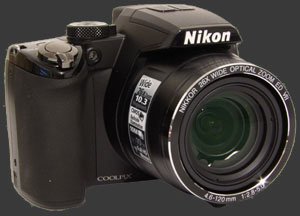 The Nikon P100 uses its CMOS sensor to provide these high speed features:
- 10 FPS continuous shooting at full-resolution
- 1920x1080 @ 30 FPS 16:9 1080p HD video recording
- Stereo sound recording and wind-filter for 30 FPS video
- High-speed 640x480 @ 120 FPS video mode
- Higher-speed 320x230 @ 240 FPS video mode
- Backlit HDR mode
The P100 is among the most highly specified ultra-zooms models:
- 10 Megapixels sensor
- 26X Wide-angle optical zoom lens
- Optical image stabilization
- ISO 160-3200 at full-resolution
- Shutter speeds from 1/2000s to 8s
- Full manual controls including manual focus
- Automatic, preset and custom white-balance
- Exposure bracketing, 3 frames, 1/3, 2/3 or 1 EV steps
- Tiltable 3" LCD with 460K pixels
Nikon Coolpix P100 Suitability - What is it good for?
The Nikon Coolpix P100 is highly versatile due to a 26X optical zoom which starts at a very wide-angle 26 and reaches 678mm, in 35mm equivalent terms. This wide range covers most photographic uses, particularly well in the telephoto range for wildlife and bird photography. This super-long reach puts the P100 even beyond the reach of DSLR lenses under $1000 USD. Macro is also possible with the Nikon P100 which can focus as close as 1cm (0.4").
The Coolpix P100 also features full-manual controls for creative and versatile exposures. With a shutter-speed range from 1/2000 to 8s, this digital camera can handle action and night photography. The limiting factor here is the noise and speed of this camera. This is where the CMOS sensor greatly helps, allowing for the continuous drive to reach 10 FPS in high-speed mode and 2.8 FPS in low-speed mode.
The P100 is certainly among the smallest ultra-zooms to reach beyond 15X of optical zoom. Its relatively small size means that it is easy to carry such a powerful zoom and shoot discretely with it. Size is key to versatility as a smaller camera gets taken to more places.
With a 10 megapixels sensor, images from the Coolpix P100 are suitable for moderately large prints, up to 20" x 15" provided ISO is kept low enough. Needless to say, any computer display or web-use will not be a problem.
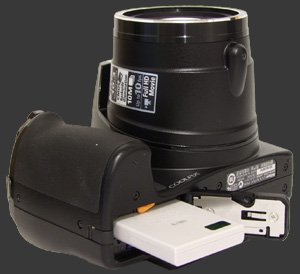
Storage and power options for this digital camera are typical of ultra-zooms. The P100 supports SDHC cards which always means SD too. it is powered by a small proprietary lithium-ion battery.
Nikon Coolpix P100 Capability - What can it do?
As an ultra-zoom, most of the flexibility comes from the P100's huge zoom range. Like most ultra-zooms, this digital camera is equipped with a number of advanced features. Below is a list of its most useful features, followed by explanations, when required.
- Program exposure with shift, shutter-priority, aperture priority and manual exposure
- Metering: matrix, center-weighed, center spot and AF-point spot
- Exposure compensation: +2 to -2 EV, in 1/3 stop increments
- Flash compensation: +2 to -2 EV, in 1/3 stop increments
- Exposure bracket: 3 shots, 1/3, 2/3 or 1 EV steps
- Auto ISO maximum selectable from 160 to 3200
- White-balance: Auto, 5 presets and custom
- Flash: Auto, red-eye, off, on, slow-sync and burst.
- Focus distance: Normal auto focus, macro, infinity and manual
- Focus area: Auto (9-point), Center, Manual (99-point) and Face-Priority
- Drive: Single-shot, 10 FPS Continuous, 2.8 FPS Continuous, BSS, Multi-Shot 16, Interval Timer
- Self-timer: 10s or 2s
- Ultra-high speed continuous shooting
- Custom image parameters: 5 contrast and sharpness settings, 3 saturation settings
- Optional forced noise-reduction
- Optional distortion compensation
- Optional vibration reduction
- HDR Backlit capture
- Panorama assist
- Subject tracking
- Scene-mode auto-detection
- 1920x1080 @ 30 FPS HD 1080p video
- 640x480 @ 120 FPS High-speed video
- 320x240 @ 240 FPS High-speed video
A few features appear in other Nikon Coolpix cameras but may not be familiar to everyone. BSS is Best Shot Selector which is a mode that takes several shots in succession and stores the least blurry one. Another one is Multishot-16. This mode records 16 ultra-low resolution photographs into a single low resolution image.
The continuous modes are all new to the Nikon P100. At full-resolution, high-speed mode takes up to 6 shots at 10 FPS, therefore during a 0.6s period. A low-speed mode, which is fast by ultra-zoom standards, takes up to a maximum of 200 frames at 2.8 FPS. A dedicated mode is provided for ultra-high speed shooting. At two megapixels, a rate of 60 FPS can be used to capture up to 25 images. At one megapixel, up to 60 frames can be captured at 120 FPS. The chance of capturing an exact moment is increased when the pre-shooting cache is enabled. This saves continuously captures images as the shutter-release is pressed halfway and saves the last five when the shutter is fully pressed.
Noise reduction can be forced, otherwise it is automatic only. Distortion compensation triggers processing to compensate for optical distortion inherent to the lens.
In addition to normal and macro focus, the Nikon P100 has manual focus and infinity focus as well. Focus is locked at infinity in infinity mode. This is useful in low-light when the camera is unable to focus at all.
The Nikkor 26X optical zoom lens of this digital camera covers from 26 to 678mm in 35mm terms. This is 2mm wider than what is considered wide-angle and reaches the telephoto range used for wildlife photography and birding. A handful of cameras have a the same range of focal length with both Olympus and Fuji having different 30X optical zoom ranges, either from 28 to 840mm for the Olympus SP-800

Vibration Reduction is Nikon's image stabilization. The Nikon Coolpix P100 is equipped with stabilization which compensates for involuntary camera movements, up to 3 stops compared to no stabilization. This helps with the usability of such a long zoom. Recall that the rule-of-thumb is to shoot at 1 over the focal-length. Thus, at the 678mm end, shooting at 1/750s is expected for shots to come out sharp. Considering the maximum aperture is F5 at 678mm and the desire to use low ISO settings, a shutter-speed of 1/750s can be difficult. This is reduced to 1/200s or even 1/100s when stabilization is enabled.
There are four notable scene modes on this Coolpix. A backlit HDR mode uses the speed of the CMOS sensor to capture a second exposure to fill in blown-out details from the background in a backlit situation. Subjects can be tracked in subject tracking mode. The smart portrait mode uses image processing to detect faces, smiles, blinks and smooth skin tones. Finally, panorama mode can help shoot panoramas in any direction.
It is worth noting that the usefulness of several modes is limited because the P100 blocks the photographer from choosing most options outside of the standard P, A, S and M modes. In panorama mode, neither ISO nor EC can be changed. Bracketing also does not work with the self-timer which limits cases where this feature is the most useful. Also, features which generate multiple images, such as HDR-Backlit, display resulting images as a sequence which cannot have its histogram shown. Since the brightness of the LCD and EVF is rarely spot on, the histogram is the only way to verify that exposure is adequate. It appears that several modes designed to help users are affected by this behavior and therefore.
 |



 
|
 Next1 - Capability2 - Usability3 - Performance
Please Support Neocamera
All information on Neocamera is provided free of charge yet running this website is a huge endeavor. Purchases made via affiliate links found throughout the site help keep it running and up-to-date. There is no additional cost to you, so please consider buying via these links to our affilates:




If you found any information on this site valuable and did not purchase via our affiliate links, please considering donating via PayPal:
Any amount will be greatly appreaciated. Thank you for your support!


Nikon P100 Highlights


 Large digital camera
Sensor-Size: 6 x 5mm

Actual size when viewed at 100 DPI
| 10 Megapixels Ultra Zoom | ISO 160-3200 |
| 26.1X Wide Optical Zoom | Shutter 1/2000-8s |
| Built-in Stabilization | Full manual controls |
| 0.24" Built-in EVF 230K Pixels | Custom white-balance |
| 10 FPS Drive, 6 Images | Spot-Metering |
| 1920x1080 @ 30 FPS Video Recording | Lithium-Ion Battery |
| 3" LCD 460K Pixels | Secure Digital High Capacity |
Camera Bag


Your camera bag is empty. To add a camera or lens click on the star next to its name.
Your camera bag is empty.
Add cameras or lenses by clicking on the star next to their name.
Updates
2024.04.03

Fujifilm X-T5 Review
Newest Fujifilm flagship boasting a 40 MP APS-C sensor, 5-axis IBIS with 7-stop efficiency, 15 FPS continuous drive, 6.2K Video capture, dual control-dials and dual SDXC UHS-II slots in a sturdy weatherproof and freezeproof body.
2023.11.20

Best Digital Cameras of 2023
Find out which are the Best Digital Cameras of 2023. All the new Mirrorless Digital Cameras from entry-level to high-end professional.
2023.07.10

Fujifilm X-H2 Review
40 Megapixels APS-C Hybrid Mirrorless Digital Camera with 7-stop IBIS. Fastest shutter ever and 8K video capture. Large builtin EVF with 0.8X magnification and 5.8 MP, plus an Eye-Start Sensor. Packed with features and large number of controls in a weatherproof and freezeproof body.
2023.05.07

Sony FE 20-70mm F/4G Review
Review of the unique Sony FE 20-70mm F/4G lens. The optical zoom of this lens spans ultra-wide-angle and medium focal-length coverage, making it one of the most versatile Full-Frame lenses on the market.
2023.01.15

Huion Inspiroy Dial 2 Review
Review of the Huion Inspiroy Dial 2 tablet, a medium sized drawing surface with dual dials and customizable buttons. Connects via USB-C or Bluetooth 5.0 with Windows, Linux and Android support.
2022.12.08

How to Pack for a Photo Trip
Find out how to pack for a travel photography trip, carry your gear safely while meeting airline regulations.
2022.11.13

Best Digital Cameras of 2022
The best digital cameras of 2022. A short list of the most outstanding models in their respective categories. Choose one for yourself or as a gift.
2022.09.21

Pentax DA* 60-250mm F/4 SDM Review
Review of the Pentax DA* 60-250mm F/4 SDM, the constant-aperture telephoto zoom with the highest zoom-ratio on the market.
2022.09.20

Pentax DA* 50-135mm F/2.8 SDM Review
Review of the Pentax DA* 50-135mm F/2.8 SDM, the lightest professional telephoto zoom native to the K-mount.
2022.09.10

Pentax DA* 11-18mm F/2.8 DC AW Review
Review of the Pentax DA* 11-18mm F/2.8 DC AW, the widest professional ultra-wide zoom native to the K-mount.
2021.11.24

50 Gifts Under $50 For Photographers in 2021
50 Gifts photographers will love. All for under $50 USD. 2021 Edition.
2021.11.17

Best Digital Cameras for 2021
Neocamera shows which are the very best Digital Cameras for 2021 in every category: Mirrorless, DSLR, Premium Compact, Ultra-Zoom and Rugged.
2024.04.03
2023.11.20
2023.07.10
2023.05.07
2023.01.15
2022.12.08
2022.11.13
2022.09.21
2022.09.20
2022.09.10
2021.11.24
2021.11.17