Camera Basics
 Camera Choosing
 Camera Models
 Camera Buying
 DSLR Buying

Fujifilm X-S1 Review
 12 Megapixels
 Ultra-Zoom: At least 10X optical zoom.
 Electronic View Finder
 Stabilization: Compensates for tiny involuntary movements of the camera.
 Level: Measures camera tilt and helps to keep the horizon level.
 Continuous Drive
 Full 1080p HD Video: 1920 x 1080 resolution or more but less than 4K.
 Manual Controls: Both fully-manual (M) and semi-automatic modes (T and V).
 Custom White-Balance: Specifies exactly what should be white to the camera.
 Action Photography: Shutter speeds of 1/1500 or more.
 Night Photography: Reaches shutter-speeds longer than 4 seconds.
 Hotshoe: Allows external flash units to be attached.
 Spot Metering
 Weatherproof - Seals protect from dust, humidity and light splashing.
 Accepts Secure Digital Extended Capacity (SDXC), SDHC and SD memory.
 Neocamera detailed review
 Discontinued: No longer produced by the manufacturer. May still be in stock or found used.
 1 - Capability2 - Usability3 - Performance
Fujifilm X-S1 Usability - How easy is it to use?
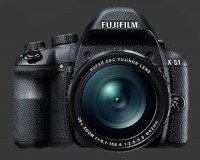
The Fuji X-S1 looks and feels like a mid-size DSLR. It is very well built with a strong rubber coating around most of the camera and seals inside to provide protection against the elements. This is the only weatherproof digital camera in its class. The body is ergonomically designed with a good grip and protruding lens. The X-S1 comes with a tethered center-pinch lens cap. The lens is also threaded for 62mm filters.
Basic camera operation of the Fuji X-S1 is strait forward. Advanced users appreciate having external controls for all commonly used features and the X-S1 with its numerous external buttons does not fail to please its intended audience. For beginners, this camera also has a number of Automatic and Scene modes which are extremely easy to use.
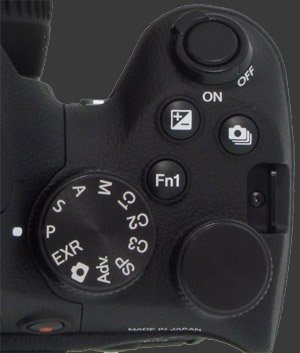 The X-S1 is powered on by a rotating switch which surrounds the shutter release. It feels solid and has two well-defined positions with audible clicks. Every other button feels just as solid and is relatively large, making the camera more usable with gloves on than most.
This digital camera has an aggressive auto-sleep feature which turns the camera off after a period of inactivity. With the Quick-Start option enabled in the Setup menu, waking up the camera within 20 minutes of inactivity requires a full-press of the shutter. After that, or without the option enabled, waking the camera up requires moving the power-switch to the Off position and back to On. This makes it slower to wake up than most cameras which are woken up by a half-press of the shutter-release.
A pleasure of few digital cameras is a mechanical zoom lens. Fuji has equipped the X-S1 with a large zoom ring which turns smoothly. This controls the lens directly which makes zooming fast and infinitely precise. There is a slight audible noise when zooming but much less than that of a power zoom lens. Behind the zoom ring is a fly-by-wire focus ring which controls focus in Manual Focus (MF) mode.
The shutter release is pretty standard with a short travel distance. There are three buttons behind the shutter-release: EC, Drive-Mode and Fn1. They are located within easy reach of the index finger and respond quickly. It is important to memorize their position since they cannot be distinguished by feel. The only real issue with these buttons is that they are sticky. So, once pressed, the same button as to be pressed again to get back out to normal. This is less efficient and more error-prone than the traditional hold-and-dial system.
The Fn1 button is customizable to one of nine options: Image Size, Image Quality, Dynamic Range, Film Simulation, AF Mode, Face Recognition, Face-Detection, Intelligent Digital Zoom and Focus Check. The most useful options here are Dynamic Range, AF mode and Focus Check. Behind Fn1 are a mode-dial and top-mounted control-wheel. Both dials have strong detents to avoid accidental changes.
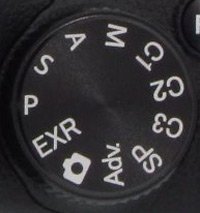 The mode-dial has 11 positions. The traditional PASM modes are there and P includes Program Shift while M includes Bulb. There are also 3 custom settings which can be set any mode except Scene modes. They occupy two positions on the dial: SP and Adv. The former groups 17 traditional modes while the latter regroups the Pro Low-Light, Pro Focus and Motion Panorama modes. Regardless of which side they are on, all these modes are completely automatic.
The camera rear is dominated by a large 3" LCD with 460K pixels. The LCD can tilt up or down thanks to a double vertical hinge. While the hinge seems solid enough, it does not compare to the rest of the X-S1. Above it is a big 0.47" EVF with a high-resolution of 1.44 megapixels. This one is sharp and shows motion smoothly at its default 50 Hz refresh rate. This can be lowered to 30 Hz to save battery. Despite Fuji specifications saying that both EVF and LCD provide 100% coverage, sadly the review unit showed noticeably less.
To the right of the EVF is an Eye-Start Sensor which switches between the LCD and EVF automatically. Normally, once used to one of these, it is hard to accept anything else. This time its sensitivity is poor and requires the user to really press against the camera at an angle to trigger it. It is unclear if anything can be done to improve it though since this camera lacks a setting for Eye-Start sensitivity. Besides this, the only other ergonomic issue with the X-S1 is that it is not Exposure-Priority. Even the optional Live-Histogram does not help since it is based on the display brightness rather than exposure. Recall the the S100FS actually shows the right preview when the shutter is half-pressed.
 To the left of the LCD is a column of buttons:
- Play: Enters and exists Playback mode.
- AE: Brings up a menu to select between 3 metering patters: Multi-Segment, Average and Spot. It is possible to do so in Program, Aperture Priority, Shutter-Priority, Manual, EXR-HR, EXR-DR and EXR-SN modes. Scene modes and Auto EXR always use multi-segment metering.
- AF: Brings up the focus-point selection screen in Area focus-point selection mode. In this mode, focus can be set to any one of 49 areas and the area can be set to one of 5 sizes.
- ISO: Brings up the ISO menu which depends on the camera mode. There are set options from 100 to 3200 at full-size and from 6400 to 12800 at reduced sizes. There are also 4 automatic settings with selectable maximum between 400 and 3200. Options not available for the current exposure mode are simply not displayed.
- WB: Selects a white-balance option. In the case of Custom White-Balance, the user can immediately set it by pressing the shutter-release or reuse the measured temperature by pressing the OK button. While-balance fine-tuning is not available here, instead the menu must be used.
Unfortunately ISO is among those buttons, making it hard to change with the camera at eye-level. it could have been switched with Drive Mode which is not used as often.
On the same side of the camera and above the LCD, there a button labeled EVF/LCD which cycles between EVF, LCD or Eye-Sensor modes. On the other side of the EVF is the dedicated Video Record button. As many modern cameras, the X-S1 lacks a video mode.
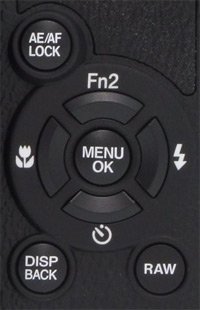 To the right of the LCD are several more buttons, including the 4-way controller which is made itself of 4 buttons. There is a combined AE-L/AF-L button whose exact behavior is determined by the Setup menu. Skipping over the 4-way controller are the DISP/BACK and RAW buttons. The former cycles between display modes, one of which is customizable to include a single-axis digital-level and multiple framing grids. The latter temporarily switches between RAW and JPEG modes.
The 4-way controller has a center button to activate the menu system and select menu options. The menu system is easy to navigate and most options are quite intuitive. The menu is divided into 2 main tabs. The camera menu is then divided into 4 pages and the setup menu into 6.
Each direction of the 4-way controller activates a function in shooting mode:
- Right: Sets the Flash mode by cycling through available options, but only when the flash is up. The choices available are Auto, Forced and Slow-Synchro.
- Down: Selects a 2s or 10s. Finally, the timers do not reset themselves after each use.
- Left: Cycles Normal, Macro and Super-Macro mode. Super-Macro mode can focus as close as 1cm from the front of the lens but only at wide-angle. In Macro mode the minimum distance os 7cm at wide-angle and 2m at telephoto.
- Up: Known ad Fn2, this one is customizable like the Fn1 button discussed earlier in the review page.
At the front of the camera, next to the lens barrel is a 3-way switch that selects AF-S, AF-C or MF mode. In MF mode, the fly-by-wire focus-ring becomes active and so is the Manual Focus-Check function is assigned to one of the two function buttons.
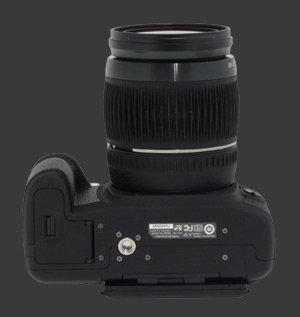
There is an off-center tripod mount at the bottom of the Fuji X-S1. It is not aligned with the center of the lens which is problematic for panoramas. There are separate doors for the battery and memory-card compartments. While shooting from a tripod, one can change memory cards but not battery.
 |



 
|

 Next1 - Capability2 - Usability3 - Performance
Please Support Neocamera
All information on Neocamera is provided free of charge yet running this website is a huge endeavor. Purchases made via affiliate links found throughout the site help keep it running and up-to-date. There is no additional cost to you, so please consider buying via these links to our affilates:




If you found any information on this site valuable and did not purchase via our affiliate links, please considering donating via PayPal:
Any amount will be greatly appreaciated. Thank you for your support!


Fujifilm X-S1 Highlights


 Large digital camera
Sensor-Size: 9 x 7mm

Actual size when viewed at 100 DPI
| 12 Megapixels Ultra Zoom | ISO 100-3200 |
| 26X Mechanically Linked Ultra-Wide Optical Zoom | Shutter 1/4000-30s |
| Built-in Stabilization | Full manual controls, including Manual Focus |
| 0.47" Built-in EVF 1.4 Megapixels | Custom white-balance with 2 axis fine-tuning |
| Automatic Eye-Start sensor | Spot-Metering |
| 1 Axis Digital Level | Hot-Shoe |
| Weatherproof | Stereo audio input |
| 7 FPS Drive, 8 Images | Lithium-Ion Battery |
| 1920x1080 @ 30 FPS Video Recording | Secure Digital Extended Capacity, Internal Memory |
| 3" LCD 460K Pixels |
Camera Bag


Your camera bag is empty. To add a camera or lens click on the star next to its name.
Your camera bag is empty.
Add cameras or lenses by clicking on the star next to their name.
Updates
2024.04.03

Fujifilm X-T5 Review
Newest Fujifilm flagship boasting a 40 MP APS-C sensor, 5-axis IBIS with 7-stop efficiency, 15 FPS continuous drive, 6.2K Video capture, dual control-dials and dual SDXC UHS-II slots in a sturdy weatherproof and freezeproof body.
2023.11.20

Best Digital Cameras of 2023
Find out which are the Best Digital Cameras of 2023. All the new Mirrorless Digital Cameras from entry-level to high-end professional.
2023.07.10

Fujifilm X-H2 Review
40 Megapixels APS-C Hybrid Mirrorless Digital Camera with 7-stop IBIS. Fastest shutter ever and 8K video capture. Large builtin EVF with 0.8X magnification and 5.8 MP, plus an Eye-Start Sensor. Packed with features and large number of controls in a weatherproof and freezeproof body.
2023.05.07

Sony FE 20-70mm F/4G Review
Review of the unique Sony FE 20-70mm F/4G lens. The optical zoom of this lens spans ultra-wide-angle and medium focal-length coverage, making it one of the most versatile Full-Frame lenses on the market.
2023.01.15

Huion Inspiroy Dial 2 Review
Review of the Huion Inspiroy Dial 2 tablet, a medium sized drawing surface with dual dials and customizable buttons. Connects via USB-C or Bluetooth 5.0 with Windows, Linux and Android support.
2022.12.08

How to Pack for a Photo Trip
Find out how to pack for a travel photography trip, carry your gear safely while meeting airline regulations.
2022.11.13

Best Digital Cameras of 2022
The best digital cameras of 2022. A short list of the most outstanding models in their respective categories. Choose one for yourself or as a gift.
2022.09.21

Pentax DA* 60-250mm F/4 SDM Review
Review of the Pentax DA* 60-250mm F/4 SDM, the constant-aperture telephoto zoom with the highest zoom-ratio on the market.
2022.09.20

Pentax DA* 50-135mm F/2.8 SDM Review
Review of the Pentax DA* 50-135mm F/2.8 SDM, the lightest professional telephoto zoom native to the K-mount.
2022.09.10

Pentax DA* 11-18mm F/2.8 DC AW Review
Review of the Pentax DA* 11-18mm F/2.8 DC AW, the widest professional ultra-wide zoom native to the K-mount.
2021.11.24

50 Gifts Under $50 For Photographers in 2021
50 Gifts photographers will love. All for under $50 USD. 2021 Edition.
2021.11.17

Best Digital Cameras for 2021
Neocamera shows which are the very best Digital Cameras for 2021 in every category: Mirrorless, DSLR, Premium Compact, Ultra-Zoom and Rugged.
2024.04.03
2023.11.20
2023.07.10
2023.05.07
2023.01.15
2022.12.08
2022.11.13
2022.09.21
2022.09.20
2022.09.10
2021.11.24
2021.11.17