Camera Basics
 Camera Choosing
 Camera Models
 Camera Buying
 DSLR Buying

Fujifilm X-S1 Review
 12 Megapixels
 Ultra-Zoom: At least 10X optical zoom.
 Electronic View Finder
 Stabilization: Compensates for tiny involuntary movements of the camera.
 Level: Measures camera tilt and helps to keep the horizon level.
 Continuous Drive
 Full 1080p HD Video: 1920 x 1080 resolution or more but less than 4K.
 Manual Controls: Both fully-manual (M) and semi-automatic modes (T and V).
 Custom White-Balance: Specifies exactly what should be white to the camera.
 Action Photography: Shutter speeds of 1/1500 or more.
 Night Photography: Reaches shutter-speeds longer than 4 seconds.
 Hotshoe: Allows external flash units to be attached.
 Spot Metering
 Weatherproof - Seals protect from dust, humidity and light splashing.
 Accepts Secure Digital Extended Capacity (SDXC), SDHC and SD memory.
 Neocamera detailed review
 Discontinued: No longer produced by the manufacturer. May still be in stock or found used.
 1 - Capability2 - Usability3 - Performance
Fujifilm X-S1 Performance - How well does it take pictures?
The Fuji X-S1 shows very good image quality for an ultra-zoom. It uses a slightly larger sensor than competitors and a BSI-CMOS sensor which is optimized to gather as much light as possible. This allows it to achieve image quality which has not been seen from an ultra-zoom for a long time. Actually, about 4 years when we reviewed a Fujifilm Finepix S100FS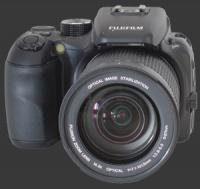
Fujifilm Finepix S100FS. With similarly sized pixels, it is no surprise that these cameras are evenly matched.
The 12 megapixels EXR CMOS sensor of the X-S1 outranks all current competitors in terms of image noise. There is certainly some powerful noise-reduction at work as even base ISO images are a it softer in low-light than they normally are. ISO 100 to 400 produce clean images with good retention of details. ISO 800 is a little noisier but does not wipe-out fine-details. Noise increases gradually from there and, starting at ISO 1600, the X-S1 even beats the S100FS in print-quality, making it a better choice by a small margin for low light situations.
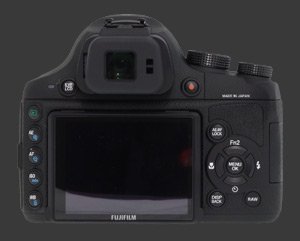
The EXR technology built into the X-S1 offers two additional modes which output images with 6 megapixels. These modes, called Low-Noise Priority and Dynamic-Range Priority, produce images that look dramatically better. While 6 megapixels seems little compared to modern digital cameras, it is more than the vast majority of people need. High-quality prints up to 9"x12" are easily possible with that resolution. Online sharing, HDTV and digital projectors all require much less.
This Fuji EXR sensor is spectacular in terms of dynamic-range and can capture 4 extra stops of highlights in EXR-DR mode. This makes the X-S1 well suited for photography in broad daylight. In standard mode, it can have both 12 megapixels of resolution and keep 2 extra stops of highlights as long as ISO 400 or higher is selected.
The Multi-Segment metering system of this digital camera is very good. The excellent dynamic-range obviously helps and results in exposure that is more reliable than most fixed-lens cameras. See the church interior shots in the Sample Images page for extreme examples of difficult exposure. Unfortunately, both the LCD and EVF do not preview exposure, so cases when exposure compensation is required are difficult to judge.
The latest Fuji cameras give exaggerated colors by default but the four Film Simulation options cater to most tastes. For natural looking images, the choice option is Astia. Saturation can be further adjust in 5 fine steps. There are also separate 5 steps of adjustment for Highlight and Shadow tones.
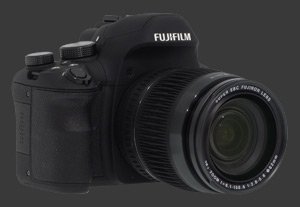
Automatic White-Balance on this digital camera is good outdoors but has more trouble than usual in the presence of artificial light. It commonly leaves a strong warm cast which can be understood but sometimes overcompensates and makes the scene too blue instead. This is obviously solvable by using a preset or custom white-balance but is less than ideal. Custom white-balance is very close to neutral but not always perfect.
The ultra-wide 26X optical zoom lens performs very well for such a huge range. At medium focal-lengths the review unit only showed very slight software at the upper left corner of images. Any such asymmetric issue may simply be with a particular camera but, in any case, it is very mild. At the wide end, things look really good except at the extreme corners. Towards the long end of the zoom, edge softness can be seen a further away from the corners.
Distortion is very well controlled and barely noticeable throughout the zoom range. Chromatic aberrations are difficult to find as well. Fuji may be applying in-camera correction but there is no way to turn it off. The lens starts at a relatively bright F/2.8 maximum aperture at 24mm, drops down to F/4 around 90mm and closes down to F/5.6 beyond 300mm all the way to 624mm.
The speed of the Fuji X-S1 is excellent. Focusing particularly is top-notch for a camera using Contrast-Detection. The camera locks focus in ¼s to ½s near wide-angle. This slows down at the telephoto end, usually taking about ½s but rarely more than ¾s. The shutter lag is nearly instant and there is a short black-out after that. Shot to shot speeds are just under 1½s. This is a decent rate for a fixed lens camera but on the slow side if you try to follow action.
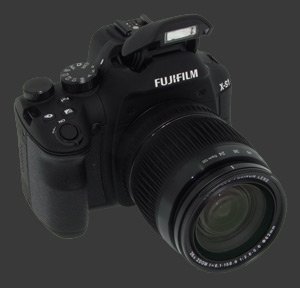
Startup takes less than a second and shutdown is much faster. Given this camera does not need to extend or retract its lens, it is naturally expected that it can power on and off quickly. Despite the speed of its burst modes, this camera is not ideal for action photography since the EVF and LCD lag behind action while shooting at full resolution. Going to 10 FPS at 6 megapixels makes it possible to follow a moving subject a little better. Otherwise, this digital camera generally remains responsive. Except while recording an image, a button press is usually answered almost immediately.
Entering and exiting playback mode is quite fast. Since this is a shooting-priority camera, it instantly goes back into shooting mode when pressing the shutter halfway. Scrolling and zooming through images is fast. Panning speed is very good at high magnification but gets slower as magnification decreases. The last performance measurement is battery-life which is measured at 500 shots-per-charge when using the EVF according to the CIPA standard. This is better than most.
NOTE When reviewed a year ago, the Fuji X-S1 showed an unnatural blooming of light sources for scenes of extreme contrast. This can be seen on the left below. Normally light sources bloom in a star-shape rather than a sharp edge circle. This can be seen in on the right below. We have just recieved a camera with a new sensor to fix this and will be chasing white orbs and reporting shortly.


Given that Fuji is already working on fixing the X10 which uses the same sensor, it is highly possible they will fix this issue as well. At least once the problem has been reported to them by enough users.
Fujifilm X-S1 Conclusion
The Fuji X-S1 delivers an excellent performance. Without being perfect, this camera is a fantastic all-in-one powerhouse. Its 12 megapixels EXR BSI-CMOS sensor and superb mechanical lens with an extremely versatile ultra-wide to super-telephoto optical zoom, plus a full set of manual controls make it more capable and versatile than any current fixed-lens camera.
Image quality is top-notch with low image noise and a usable ISO range until 1600 in EXR-HR mode and 3200 in EXR-SN mode. The dynamic-range of the Fuji X-S1 is simply fantastic and this lets it capture scenes of high-contrast better than other ultra-zooms. Metering is reliable and so is its speedy autofocus system. This camera can produce nice colors and accurate white-balance, although it needs some help under artificial light.
Downsides of this camera are few. The Eye-Start sensor is not sensitive enough which certainly causes some aggravation. Both the EVF and LCD show poor accuracy and are not Exposure-Priority either. The sticky buttons take more effort than ideal but using the X-S1 is simple overall. The one open issue is the strange blooming of strong light sources but this should be fixable by firmware and rarely occurs outside of night photography.
Considering everything, the Fuji X-S1 makes an awesome travel camera. It delivers class-leading results, more so in bright light, with an extensive feature set. Its sturdy construction and long battery-life will make it last, while its mechanical 26X optical zoom lens is provides tremendous flexibility for a variety of subjects.
 |



 
|

 1 - Capability2 - Usability3 - Performance
Please Support Neocamera
All information on Neocamera is provided free of charge yet running this website is a huge endeavor. Purchases made via affiliate links found throughout the site help keep it running and up-to-date. There is no additional cost to you, so please consider buying via these links to our affilates:





If you found any information on this site valuable and did not purchase via our affiliate links, please considering donating via PayPal:
Any amount will be greatly appreaciated. Thank you for your support!


Fujifilm X-S1 Highlights
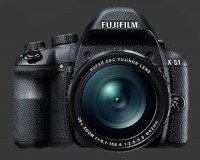


 Large digital camera
Sensor-Size: 9 x 7mm

Actual size when viewed at 100 DPI
| 12 Megapixels Ultra Zoom | ISO 100-3200 |
| 26X Mechanically Linked Ultra-Wide Optical Zoom | Shutter 1/4000-30s |
| Built-in Stabilization | Full manual controls, including Manual Focus |
| 0.47" Built-in EVF 1.4 Megapixels | Custom white-balance with 2 axis fine-tuning |
| Automatic Eye-Start sensor | Spot-Metering |
| 1 Axis Digital Level | Hot-Shoe |
| Weatherproof | Stereo audio input |
| 7 FPS Drive, 8 Images | Lithium-Ion Battery |
| 1920x1080 @ 30 FPS Video Recording | Secure Digital Extended Capacity, Internal Memory |
| 3" LCD 460K Pixels |
Camera Bag


Your camera bag is empty. To add a camera or lens click on the star next to its name.
Your camera bag is empty.
Add cameras or lenses by clicking on the star next to their name.
Updates
2024.04.03

Fujifilm X-T5 Review
Newest Fujifilm flagship boasting a 40 MP APS-C sensor, 5-axis IBIS with 7-stop efficiency, 15 FPS continuous drive, 6.2K Video capture, dual control-dials and dual SDXC UHS-II slots in a sturdy weatherproof and freezeproof body.
2023.11.20

Best Digital Cameras of 2023
Find out which are the Best Digital Cameras of 2023. All the new Mirrorless Digital Cameras from entry-level to high-end professional.
2023.07.10

Fujifilm X-H2 Review
40 Megapixels APS-C Hybrid Mirrorless Digital Camera with 7-stop IBIS. Fastest shutter ever and 8K video capture. Large builtin EVF with 0.8X magnification and 5.8 MP, plus an Eye-Start Sensor. Packed with features and large number of controls in a weatherproof and freezeproof body.
2023.05.07

Sony FE 20-70mm F/4G Review
Review of the unique Sony FE 20-70mm F/4G lens. The optical zoom of this lens spans ultra-wide-angle and medium focal-length coverage, making it one of the most versatile Full-Frame lenses on the market.
2023.01.15

Huion Inspiroy Dial 2 Review
Review of the Huion Inspiroy Dial 2 tablet, a medium sized drawing surface with dual dials and customizable buttons. Connects via USB-C or Bluetooth 5.0 with Windows, Linux and Android support.
2022.12.08

How to Pack for a Photo Trip
Find out how to pack for a travel photography trip, carry your gear safely while meeting airline regulations.
2022.11.13

Best Digital Cameras of 2022
The best digital cameras of 2022. A short list of the most outstanding models in their respective categories. Choose one for yourself or as a gift.
2022.09.21

Pentax DA* 60-250mm F/4 SDM Review
Review of the Pentax DA* 60-250mm F/4 SDM, the constant-aperture telephoto zoom with the highest zoom-ratio on the market.
2022.09.20

Pentax DA* 50-135mm F/2.8 SDM Review
Review of the Pentax DA* 50-135mm F/2.8 SDM, the lightest professional telephoto zoom native to the K-mount.
2022.09.10

Pentax DA* 11-18mm F/2.8 DC AW Review
Review of the Pentax DA* 11-18mm F/2.8 DC AW, the widest professional ultra-wide zoom native to the K-mount.
2021.11.24

50 Gifts Under $50 For Photographers in 2021
50 Gifts photographers will love. All for under $50 USD. 2021 Edition.
2021.11.17

Best Digital Cameras for 2021
Neocamera shows which are the very best Digital Cameras for 2021 in every category: Mirrorless, DSLR, Premium Compact, Ultra-Zoom and Rugged.
2024.04.03
2023.11.20
2023.07.10
2023.05.07
2023.01.15
2022.12.08
2022.11.13
2022.09.21
2022.09.20
2022.09.10
2021.11.24
2021.11.17