Camera Basics
 Camera Choosing
 Camera Models
 Camera Buying
 DSLR Buying

Fujifilm Finepix HS30 EXR Review
 16 Megapixels
 Ultra-Zoom: At least 10X optical zoom.
 Electronic View Finder
 Stabilization: Compensates for tiny involuntary movements of the camera.
 Level: Measures camera tilt and helps to keep the horizon level.
 Continuous Drive
 Full 1080p HD Video: 1920 x 1080 resolution or more but less than 4K.
 Manual Controls: Both fully-manual (M) and semi-automatic modes (T and V).
 Custom White-Balance: Specifies exactly what should be white to the camera.
 Action Photography: Shutter speeds of 1/1500 or more.
 Night Photography: Reaches shutter-speeds longer than 4 seconds.
 Hotshoe: Allows external flash units to be attached.
 Spot Metering
 Accepts Secure Digital Extended Capacity (SDXC), SDHC and SD memory.
 Neocamera detailed review
 Discontinued: No longer produced by the manufacturer. May still be in stock or found used.
 1 - Capability2 - Usability3 - Performance
Fujifilm Finepix HS30 EXR Performance - How well does it take pictures?
The Fuji Finepix HS30 EXR produces reasonable quality images with average noise and noticeable smearing of details at its full 16 megapixels resolution. In the 8 MP EXR modes, Low-Noise Priority and Dynamic-Range Priority, images look dramatically better. While 8 megapixels is not headline grabbing, it is more than the vast majority of people need. High-quality prints up to 9"x12" are easily possible with that resolution. Electronic use such as online sharing, web-galleries, HDTV and digital projectors all require much less. Unfortunately, this performance prevents it from catching up Fuji's own S100FS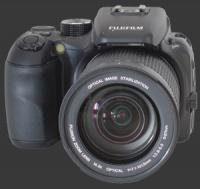
Fujifilm Finepix S100FS and even X-S1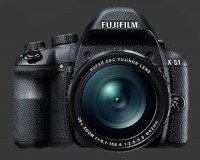
Fujifilm X-S1.
The HS30 EXR has three noise-reduction setting which compromise between noise and details. In all cases, print quality does not change much as noise and details get smeared away. ISO 100 and 200 are acceptable with a little noise and noticeable softness. ISO 400 is only slightly noisier but considering the resolution there is not much to worry about. ISO 800 clearly affects print sizes yet still looks great at 9"x12". Even ISO 1600 works for a medium sized prints despite looking much nosier and softer at 100%. We cannot say the same for ISO 3200 which only remains acceptable for small prints and limited web use.
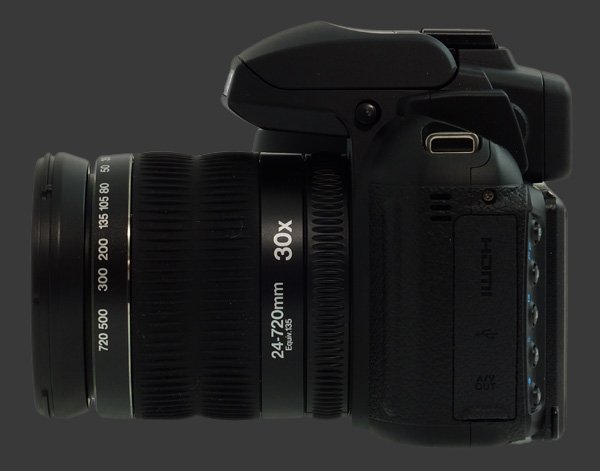
The ultra-wide 30X optical zoom lens is the biggest achievement of the HS30 EXR. It performs incredibly well for such a range. Except for a softening towards the edges of the frame near the ultra-wide end, around 24-27mm, sharpness is quite good. There is some noticeable barrel distortion near the ultra-wide end too. Zooming-in slowly replaces barrel distortion with some measurable but rarely visible pincushion distortion. There is no sign of vignetting throughout the zoom range. The HS30 EXR seems unaffected by chromatic aberrations.
The lens starts at a bright F/2.8 maximum aperture and it closes down slowly while zooming in, only reaching the smallest maximum of F/5.6 passed 320mm. There is a 58mm thread for using optical filters.
Fuji's exposure system is better than average and is tuned to produce a medium-bright image. This means it clips highlights slightly more often than its predecessors while producing more directly printable results. The unfortunate issue is that the LCD and EVF are not Exposure-Priority, so results are often be surprising. When it misses though, it is rarely by more than 2/3 EVs.
Colors are generally good but over-saturated by default, even using Provia Film-Simulation. Setting the Color parameter to Low corrects the problem and produces more natural-looking colors. Automatic White-balance also performs well, better than the majority of ultra-zooms. For difficult lighting, there is a Custom White-Balance option which is close to perfect.
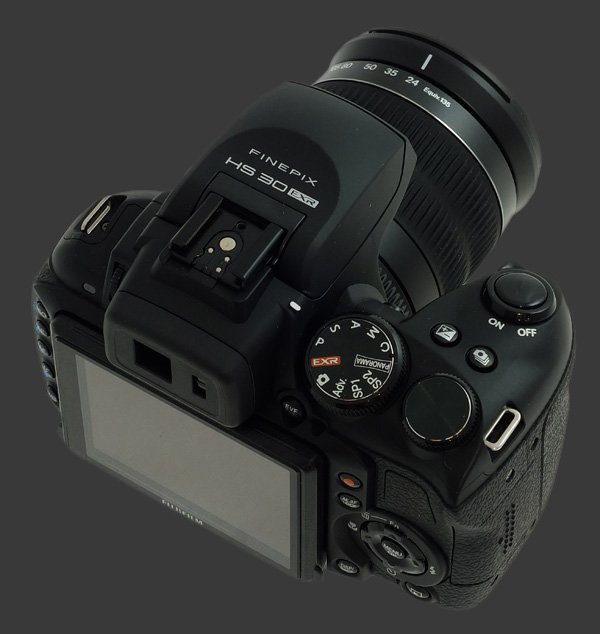
The speed of the Fuji Finepix HS30 EXR is really improved compared to its predecessor. The following measurements characterize its performance:
- Power-On: 1½s. Very good. The mechanical lens does not need to extend on startup.
- Autofocus: ¼ to ½s in moderately light. Down to 1s in very low light. Better than average.
- Shutter-Lag: Virtually none. Great.
- Shot-to-Shot: 1¼, better than most.
- Playback: ½s to enter or exit.
- Power-Off: 1s. Very good, for the same reason as power on.
Since this is a shooting-priority camera, it instantly goes back into shooting mode when pressing the shutter halfway. Scrolling and zooming through images is fast. Panning speed is very good at high magnification but gets slower as magnification decreases.
Unlike the HS20 EXR and its near-twin the NH25 EXR, this digital camera uses a proprietary Lithium-Ion battery. This is now the standard battery type for the vast majority of recent cameras. The Fuji Finepix HS30 EXR is quite efficient with its power usage and manages 600 shots per charge, according to the CIPA standard. As usual, your mileage will vary with use of the rear LCD and power-hungry features like Flash and Video. Going through a day of shooting should be no problem for most users.
Fujifilm Finepix HS30 EXR Conclusion
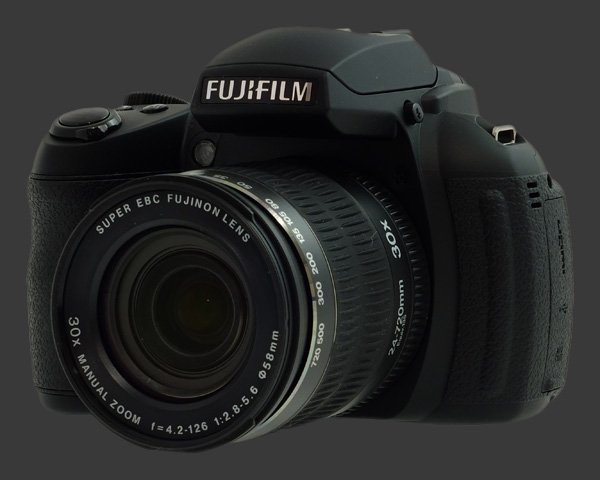
This ultra-zoom provides an excellent feature set in an ergonomic design which emphasizes efficiency and quick access to photographic controls. Its unique mechanical 30X ultra-wide angle optical zoom lens, shared with its predecessor, is a pleasure to use. This lens combined with a EXR CMOS sensor capable of capturing 1600% dynamic-range images makes it the most versatile fixed-lens digital camera to date. Adding the 8 FPS continuous drive at 16 megapixels and full 1080p HD video with stereo sound, the Fuji Finepix HS30 EXR marks itself as truly exceptional.
Optically, results are impressive with good sharpness away from the ultra-wide end of the zoom, low distortion, no vignetting and extremely good control over chromatic aberrations. The high resolution EXR CMOS sensor of the HS30 EXR improves over the first generation and provices more usable results by one stop compared to the HS20 EXR. Noise levels are average for a modern ultra-zoom with, unfortunately, more smearing of details than usual. Still, the full 16 megapixels resolution is more than needed and images scale down well, producing nice mid-size pritns up to ISO 1600. That being said, Low-Noise Priority mode delivers much cleaner results at 8 MP. Dynamic-Range Priority mode is another winner that captures scenes of very wide dynamic-range.
Overall, the Fuji Finepix HS30 EXR is very versatile and most suitable for travel and product photography. This is a rich and complex camera which can deliver good performance using its special 8 MP EXR modes depending on the lighting situation. Image quality is not class-leading but certainly sufficient for most common print sizes even at relatively high sensitivities. The HS30 EXR is surprisingly speedy and keeps up extremely well under most non-action situations.
 |



 
|

 1 - Capability2 - Usability3 - Performance
Please Support Neocamera
All information on Neocamera is provided free of charge yet running this website is a huge endeavor. Purchases made via affiliate links found throughout the site help keep it running and up-to-date. There is no additional cost to you, so please consider buying via these links to our affilates:





If you found any information on this site valuable and did not purchase via our affiliate links, please considering donating via PayPal:
Any amount will be greatly appreaciated. Thank you for your support!


Fujifilm HS30 EXR Highlights


 Large digital camera
Sensor-Size: 6 x 5mm

Actual size when viewed at 100 DPI
| 16 Megapixels Ultra Zoom | ISO 100-3200 |
| 30X Mechanically Linked Ultra-Wide Optical Zoom | Shutter 1/4000-30s |
| Built-in Stabilization | Full manual controls, including Manual Focus |
| 0.26" Built-in EVF 920K Pixels | Custom white-balance |
| Automatic Eye-Start sensor | Spot-Metering |
| 1 Axis Digital Level | Hot-Shoe |
| 8 FPS Drive, 8 Images | Lithium-Ion Battery |
| 1920x1080 @ 30 FPS Video Recording | Secure Digital Extended Capacity, Internal Memory |
| 3" LCD 460K Pixels |
Camera Bag


Your camera bag is empty. To add a camera or lens click on the star next to its name.
Your camera bag is empty.
Add cameras or lenses by clicking on the star next to their name.
Updates
2024.04.03

Fujifilm X-T5 Review
Newest Fujifilm flagship boasting a 40 MP APS-C sensor, 5-axis IBIS with 7-stop efficiency, 15 FPS continuous drive, 6.2K Video capture, dual control-dials and dual SDXC UHS-II slots in a sturdy weatherproof and freezeproof body.
2023.11.20

Best Digital Cameras of 2023
Find out which are the Best Digital Cameras of 2023. All the new Mirrorless Digital Cameras from entry-level to high-end professional.
2023.07.10

Fujifilm X-H2 Review
40 Megapixels APS-C Hybrid Mirrorless Digital Camera with 7-stop IBIS. Fastest shutter ever and 8K video capture. Large builtin EVF with 0.8X magnification and 5.8 MP, plus an Eye-Start Sensor. Packed with features and large number of controls in a weatherproof and freezeproof body.
2023.05.07

Sony FE 20-70mm F/4G Review
Review of the unique Sony FE 20-70mm F/4G lens. The optical zoom of this lens spans ultra-wide-angle and medium focal-length coverage, making it one of the most versatile Full-Frame lenses on the market.
2023.01.15

Huion Inspiroy Dial 2 Review
Review of the Huion Inspiroy Dial 2 tablet, a medium sized drawing surface with dual dials and customizable buttons. Connects via USB-C or Bluetooth 5.0 with Windows, Linux and Android support.
2022.12.08

How to Pack for a Photo Trip
Find out how to pack for a travel photography trip, carry your gear safely while meeting airline regulations.
2022.11.13

Best Digital Cameras of 2022
The best digital cameras of 2022. A short list of the most outstanding models in their respective categories. Choose one for yourself or as a gift.
2022.09.21

Pentax DA* 60-250mm F/4 SDM Review
Review of the Pentax DA* 60-250mm F/4 SDM, the constant-aperture telephoto zoom with the highest zoom-ratio on the market.
2022.09.20

Pentax DA* 50-135mm F/2.8 SDM Review
Review of the Pentax DA* 50-135mm F/2.8 SDM, the lightest professional telephoto zoom native to the K-mount.
2022.09.10

Pentax DA* 11-18mm F/2.8 DC AW Review
Review of the Pentax DA* 11-18mm F/2.8 DC AW, the widest professional ultra-wide zoom native to the K-mount.
2021.11.24

50 Gifts Under $50 For Photographers in 2021
50 Gifts photographers will love. All for under $50 USD. 2021 Edition.
2021.11.17

Best Digital Cameras for 2021
Neocamera shows which are the very best Digital Cameras for 2021 in every category: Mirrorless, DSLR, Premium Compact, Ultra-Zoom and Rugged.
2024.04.03
2023.11.20
2023.07.10
2023.05.07
2023.01.15
2022.12.08
2022.11.13
2022.09.21
2022.09.20
2022.09.10
2021.11.24
2021.11.17